Alpine Gold vs Traditional Gold Dealer: What's the Real Difference?
Buying gold from a traditional bullion dealer is straightforward — you pay a premium above spot, they ship you coins or bars, you store them yourself. It's been the standard for decades. Alpine Gold Exchange takes a different approach: dealer plus vaulting plus leasing plus gold-backed account plus debit card, all integrated. Which model actually fits you better?
Here's the honest comparison.
- The core difference is scope: a traditional dealer sells metal, while Alpine operates an account, vaulting and leasing around it. Extra services only matter if you will use them.
- Compare the whole transaction, not the sticker price. Shipping, insurance, card surcharges and tax can outweigh a lower headline price.
- Check the exit, not just the entry. Whether a dealer buys back, and on what basis, matters as much as what they charge today. Most quote case by case.
- Goldback's directory badges such as "Official Distributor" are Goldback's own designations, not independently tested performance ratings, and they do not guarantee the best price.
- Series and denomination coverage varies. Confirm the specific note you want is in stock before comparing prices at all.
- Prices, inventory and terms change frequently. Verify current details directly before ordering.
What "Traditional Gold Dealer" Means
For this comparison, a traditional gold dealer is any of the well-known bullion retailers: APMEX, JM Bullion, Money Metals Exchange, SD Bullion, BGASC, Kitco, Provident Metals, and similar operators.
What traditional dealers do:
- Sell physical gold coins, bars, and rounds
- Ship products to your home or a third-party storage facility
- Buy back metals when you're ready to sell (at retail bid prices)
- Provide market pricing, occasional educational content, and customer service
What traditional dealers typically don't do:
- Provide integrated vaulting with an equivalent rewards-based zero-spread provision on eligible liquidations
- Offer yield programs on your stored gold
- Include debit cards linked to gold holdings
- Operate as membership associations or cooperatives
What Alpine Gold Does Differently
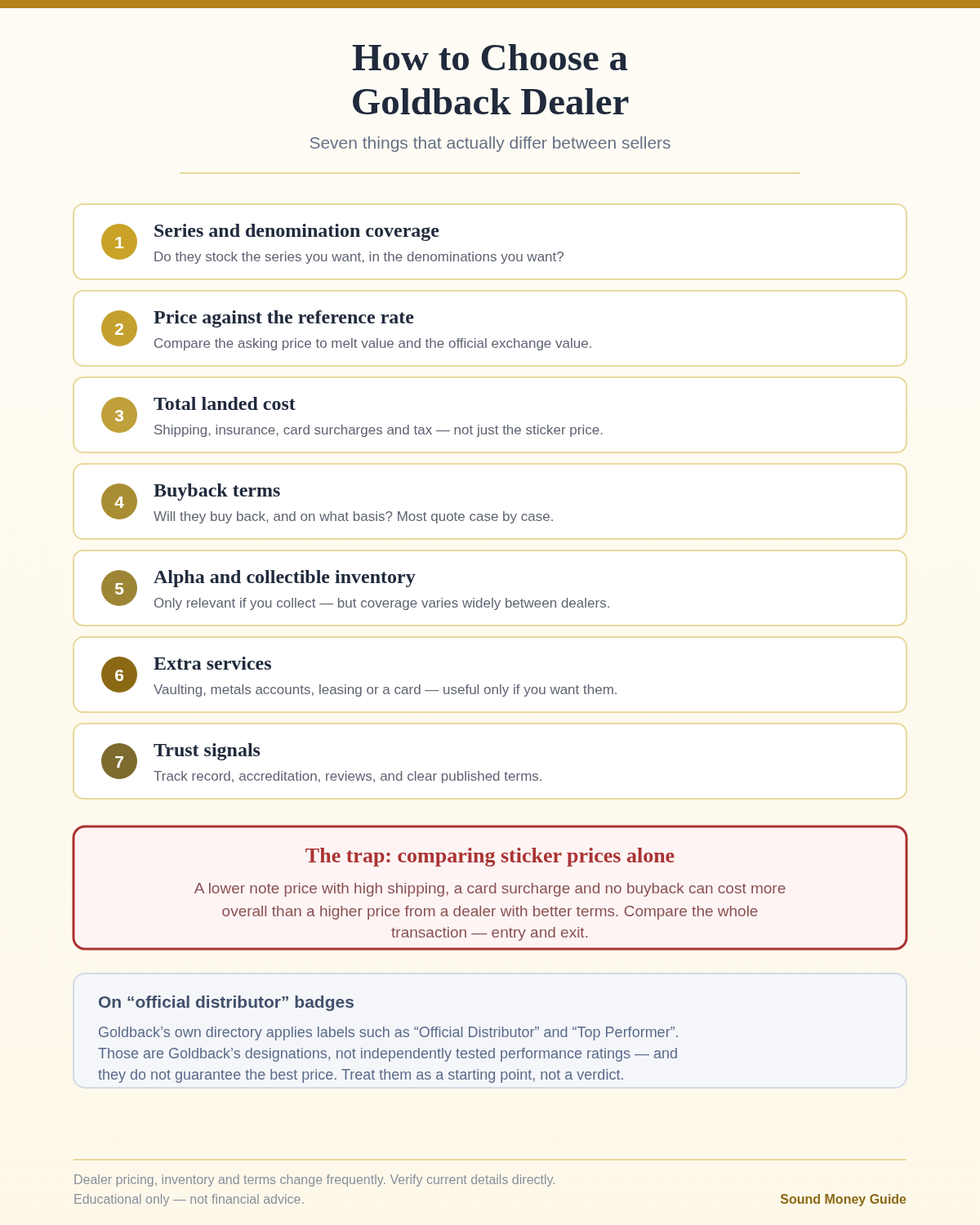
Compare the whole transaction — entry and exit — not just the sticker price.
Alpine Gold Exchange operates as both a dealer AND part of an integrated sound-money platform through its partnership with UPMA (United Precious Metals Association).
Alpine Gold's integrated model:
- Dealer — sells Goldbacks, gold, silver
- Vaulting — vaulted storage, insured through Lloyds of London per Alpine; vault operator not published (captured 24 September 2026)
- UPMA membership — 0% spread on liquidations by applying Deposit Rewards points, up to 2,500 points weekly, subject to daily capacity; beyond that, standard market spreads apply (captured 4 September 2026)
- Gold leasing — earn a metal-paid return (not guaranteed)
- Gold-backed Visa card — spend your metals like cash (via TrueLink)
- Gold IRA services — coordinated custodianship for retirement gold
- Physical locations — Casper WY and Ogden UT for in-person service
The Practical Comparison
Standard Buy-And-Store Model (Traditional Dealer)
How it works: 1. You buy gold at retail, at a premium above spot 2. Gold ships to you or to a third-party storage service 3. When you want to sell, you send it back (or take it to a dealer) at bid prices 4. Every buy/sell round-trip costs you the spread between those two prices
Best for:
- Buyers who prefer physical self-custody
- One-time or infrequent purchases
- Anyone who wants tangible possession without account structures
Downside:
- Storage risk (fire, theft, loss)
- Insurance is your responsibility
- Spread costs compound over time
- No yield on stored metals
Alpine Gold's Integrated Model
How it works: 1. You buy Goldbacks or bullion through Alpine Gold 2. Metals ship to you OR are vaulted under UPMA membership (Alpine does not publish who operates the vault) 3. Vaulted metals earn optional yield through leasing (advertised 2%–5% APR depending on total leased value in USD, not guaranteed; captured 9 September 2026) 4. You can withdraw physical metals anytime OR spend via TrueLink Visa 5. Eligible liquidations within the vaulted account can carry a 0% spread where Deposit Rewards points are applied, up to 2,500 points weekly and subject to daily capacity; liquidations beyond the rewards applied are processed at standard market spreads (captured 4 September 2026)
Best for:
- Long-term precious-metals accumulators
- Anyone wanting yield on stored gold
- Buyers who want gold-backed spendability
- Serious Goldback collectors
Downside:
- More complex than pure self-custody
- Membership dues and vaulting fees apply
- Not FDIC-insured (private insurance instead)
- Learning curve for the integrated services
Head-To-Head Comparison
| Factor | Traditional Dealer | Alpine Gold Exchange |
|---|---|---|
| Buy/sell spread | Charged on both the buy and the sell; set by each dealer | 0% spread via applied Deposit Rewards points (up to 2,500/week, subject to daily capacity); otherwise standard market spreads |
| Storage | Your responsibility | Insured vaulting available (insurer: Lloyds of London per Alpine; vault operator not published) |
| Insurance | You buy separately | Included via Lloyd's of London |
| Yield on stored gold | None | Optional metal-paid return via Alpine's leasing program (not guaranteed) |
| Debit card access | No | Yes (via UPMA/TrueLink Visa) |
| Physical delivery | Always available | Available on request |
| Goldback specialization | Limited or none | Comprehensive (68+ products) |
| Alpha Goldback inventory | Rare | Extensive |
| IRA services | Some dealers | Yes (integrated) |
| Physical locations | Varies | Casper WY, Ogden UT |
| Complexity | Low (buy and hold) | Higher (integrated platform) |
When Traditional Dealers Are the Right Choice
Not every buyer needs Alpine's integrated model. Traditional dealers are the right pick if:
You Want Pure Self-Custody
Some buyers philosophically prefer holding their own metals in their own home safe or bank safe deposit box. Traditional dealers ship you gold; you store it. Full control, no account structures, no third-party dependencies.
You're Making a Single or Infrequent Purchase
If you're buying one Gold Eagle every few years, the setup complexity of an Alpine + UPMA account isn't worth it. Traditional dealers work fine for occasional purchases.
You Want the Lowest Possible Premiums on Standard Bullion
Dealers like SD Bullion consistently offer some of the lowest premiums on standard bullion (bars, coins, rounds). If pure gold-per-dollar is your only goal, traditional dealers often win.
You're Focused on Non-Goldback Bullion
Alpine's specialty is Goldbacks and UPMA services. For pure gold and silver bullion buying, traditional dealers with broader catalogs can be equally competitive.
When Alpine Gold's Model Is the Right Choice
Alpine's integrated model shines in specific scenarios:
You're Accumulating Metals over Years
At a traditional dealer the spread is charged on each buy and each sell, so it is a cost you meet again on every round-trip rather than once at the start. Alpine Gold members can sell back vaulted Gold Dollars, Goldbacks and Silver Dollars at 0% spread by applying points from a Deposit Rewards balance, which builds on qualifying fiat and metal deposits made into the spending account. The metals must have been purchased and vaulted with Alpine Gold Exchange in an online precious metals account. Applying rewards is optional, and up to 2,500 points may be applied each week across all Deposit Reward Offers. Zero-spread liquidations are also subject to daily capacity, and Alpine states that large liquidations are available at market rate on a call-for-a-quote basis. Liquidations beyond the rewards a member applies are processed at standard market spreads. Terms captured from Alpine Gold's Rates & Fees page on 4 September 2026. On 22 September 2026 Alpine separately established a daily “appetite” for member sell-backs and changed the individual allowance from $10,000 per month to $2,500 per week, which Alpine says “maintains approximately the same potential monthly allowance”. Alpine states that where secondary-market demand is limited it “must temporarily restrict the amount we purchase each day”, and it has not published the daily figure. The announcement names only “certain metals” and does not say whether Goldbacks are among them. As at 23 September 2026 this appears only in Alpine’s CEO blog post; the Rates & Fees page still says large liquidations at market rate are available on a call-for-a-quote basis, and we do not know how Alpine reconciles the two (captured 23 September 2026).
You Want Yield on Your Stored Gold
Alpine's gold leasing program (a metal-paid return, not guaranteed) has no traditional dealer equivalent. If you plan to hold significant gold long-term, earning yield turns idle capital into productive capital.
You Want to Spend Gold Like Cash
The UPMA/TrueLink Visa card lets you spend gold anywhere Visa is accepted. No traditional dealer offers this.
You're Serious About Goldbacks
Alpine's Goldback inventory (all 9 state series + comprehensive Alpha coverage) beats every traditional dealer meaningfully.
You Want Institutional-Grade Custody with Insurance
Alpine states its vaulted metals are insured through Lloyds of London and audited quarterly, and that vaulting is allocated by type rather than by serial number or specific piece (captured 24 September 2026). Arranging vaulting and insurance separately generally costs more than taking it as part of the Alpine + UPMA structure. Alpine does not publish who operates the vault or where it is, so we cannot describe the custody arrangement beyond what Alpine states (checked across Alpine's English site on 24 September 2026).
The Fee Question
Traditional dealers appear "free" (no membership fees) but charge implicit costs through spreads:
- Buy at retail (a premium above spot)
- Sell at bid (below spot)
- Round-trip cost: both sides of that gap, paid each time you buy and sell once
Alpine + UPMA has explicit costs alongside a conditioned spread provision on eligible vaulted transactions:
- UPMA membership dues (annual, typically modest)
- Vaulting fees (scaled to holdings)
- 0% spread on liquidations by applying Deposit Rewards points, up to 2,500 points weekly, subject to daily capacity; beyond that, standard market spreads apply (captured 4 September 2026)
Which costs less depends on your own pattern: how often you buy and sell, how long you hold, and whether you actually use the vaulting, leasing and card services you are paying membership and storage for. Price the two against your own usage rather than a general rule.
The Bottom Line
Choose a traditional dealer if:
- You want simple buy-and-hold with self-custody
- You're making occasional purchases
- You want the lowest premiums on standard bullion
- You philosophically prefer physical possession over vaulted holdings
Choose Alpine Gold Exchange if:
- You're accumulating over years and want the 0% spread available by applying Deposit Rewards points, up to 2,500 points weekly and subject to daily capacity
- You want yield on your stored gold
- You want gold-backed spending capability
- You're focused on Goldbacks (especially Alphas)
- You value integrated services over pure transaction simplicity
The two models aren't mutually exclusive. Many serious precious-metals holders use both — a traditional dealer for occasional standard bullion purchases with self-custody, plus Alpine Gold for Goldbacks and integrated vaulting/leasing services.
For most buyers exploring Goldbacks or building long-term gold holdings, Alpine's integrated model offers advantages that pure dealers can't match.
For the full dealer comparison across all major options, see our Where to Buy Goldbacks Online guide.
This article is for educational purposes only and does not constitute financial advice. Precious metals prices fluctuate. Always verify current pricing and inventory directly with dealers before purchasing.
Continue Reading