Arizona Goldback Alpha — What Collectors Need to Know

Arizona Goldbacks launched in 2025 alongside Florida and Oklahoma, and the Alpha series — the first production run — is one of the more accessible Alpha entry points in the Goldback ecosystem right now. Here's what collectors need to know about Arizona Alphas: what they are, how they're priced today, and what to weigh before buying.
- The Arizona Alpha is the first run of the 2025 Arizona series.
- An Alpha is the first production run of a state series. The gold content is identical to a standard note — only scarcity and collector demand differ.
- The premium is a collector premium, driven by print-run size and demand. It is not a return, and it is not guaranteed.
- Asking prices are not completed sales. A listing shows what someone hopes to receive, not what anyone paid. Verify against actual transactions.
- Alpha markets are thin. Selling can take time, and the spread between buy and sell can be wide.
- If you want gold content rather than collectibility, a standard note gives you the same metal for less.
What Is an Arizona Goldback Alpha?
An Arizona Goldback Alpha is a note from the first production run of Arizona Goldbacks — the initial batch produced when Arizona joined the Goldback ecosystem in 2025.
Alphas are identified by:
- An Alpha designation printed on the note
- Serial numbers from the first production sequence
- Being produced only once at launch — never reprinted
Once Arizona's Alpha inventory sold through primary channels, all subsequent Arizona Goldbacks became standard editions. This is permanent: no new Arizona Alphas will ever be produced.
Why Collectors Look at Arizona Alphas
Arizona Alphas sit in an early, accessible spot for collectors:
1. Still Readily Available
Unlike the earliest state Alphas (Utah 2019, Nevada 2020), which are harder to source, Arizona Alphas remain relatively easy to find in 2026. Primary dealers still stock inventory across most denominations.
2. Near Launch-Level Pricing
Arizona is only about a year into its series, so Alpha asking prices sit close to launch levels — the smallest premium over standard editions among the state series.
3. First-Print Scarcity
Arizona's Alpha run is finite and will never be reprinted. As with any first-print collectible, scarcity is the structural reason a premium can exist — though whether a premium grows, holds, or shrinks is not guaranteed.
What Drives an Alpha Premium
Alpha notes often trade above standard notes of the same denomination. The premium is collector-driven, so it helps to understand what's behind it rather than assume a fixed return:
- First-printing scarcity — a fixed quantity that is never reprinted.
- Age and series — earlier state Alphas have had more time for demand to build; newer series like Arizona sit nearer launch pricing.
- Condition and grading — a clean or graded note can command more.
- Demand in a thin market — Alpha trading is thin, so prices move with a small number of buyers, and advertised asking prices often exceed what notes actually sell for.
- Gold is the floor, not the driver — the embedded gold sets a baseline; the collector premium above it is not guaranteed.
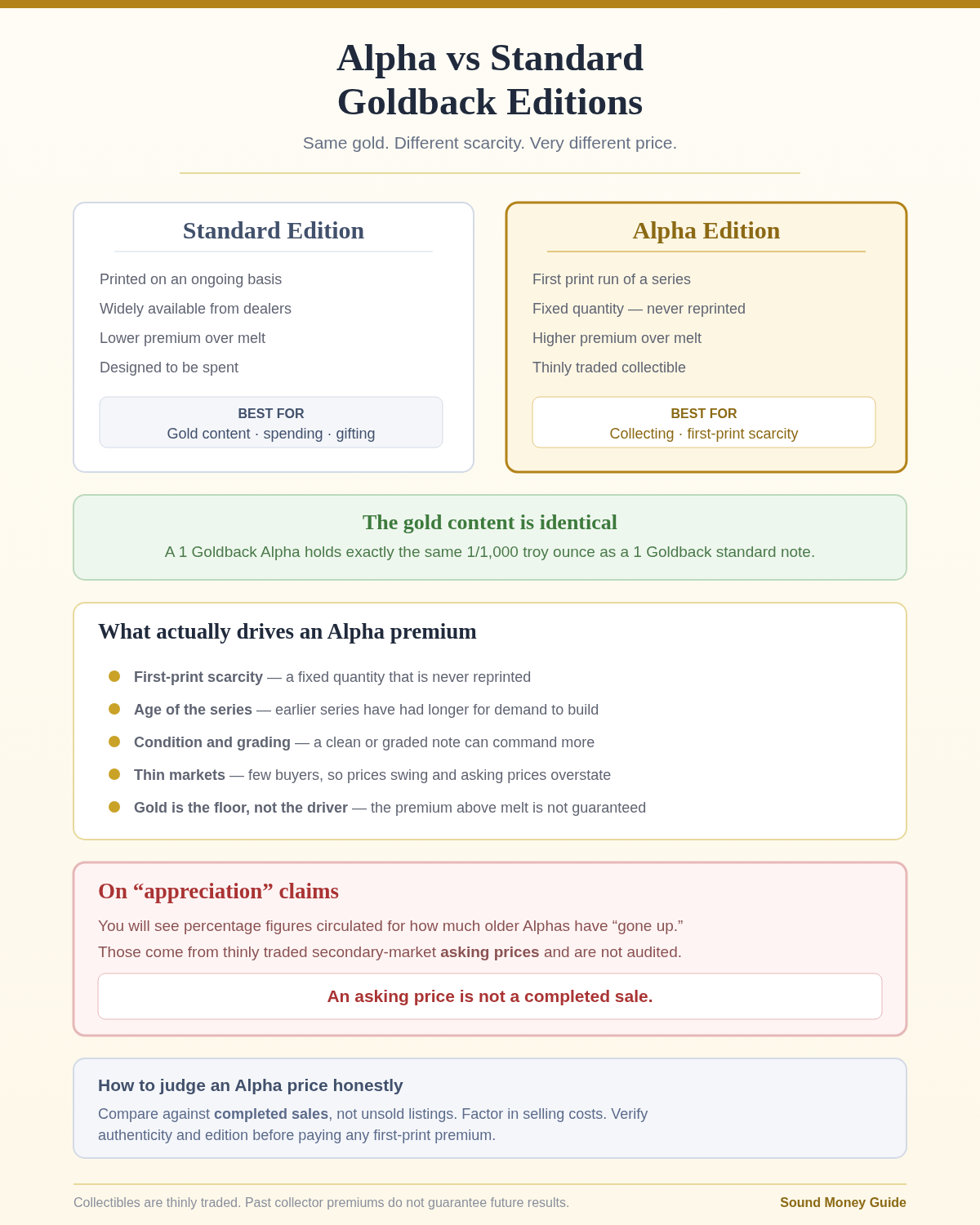
Alpha and standard notes hold identical gold. The premium is collector-driven and not guaranteed.
A note on "appreciation" claims: You'll see figures circulated for how much older state Alphas have "gone up." Those come from secondary-market asking prices, are thinly traded, and are not independently audited — an asking price is not a completed sale. Treat any specific appreciation percentage as unverified, and don't buy Arizona Alphas on the assumption that an earlier state's pattern will repeat.
Current Arizona Alpha Pricing
The figures below are approximate dealer asking-price ranges as of mid-2026. They move with the gold price and with collector demand, and are not guaranteed redemption or resale values.
| Denomination | Standard AZ Goldback | AZ Goldback Alpha |
|---|---|---|
| 1 AZ Goldback | $5 – $7 | $7 – $12 |
| 5 AZ Goldback | $22 – $30 | $28 – $42 |
| 10 AZ Goldback | $42 – $58 | $55 – $80 |
| 25 AZ Goldback | $95 – $135 | $130 – $190 |
| 50 AZ Goldback | $175 – $250 | $230 – $340 |
At mid-2026 asking prices, the Alpha premium sits roughly 30–50% above standard editions of the same denomination. That spread is a snapshot, not a trend line — it can widen or narrow with inventory and demand. Before buying or selling, check current dealer bids and genuinely comparable completed sales, and factor in selling costs (dealer spread, marketplace fees, shipping, insurance).
For how to separate melt value, reference exchange value, and collector price, see our Goldback exchange rate vs melt value guide.
Where to Buy Arizona Alphas
Alpine Gold Exchange (Recommended)
Alpine Gold Exchange carries Arizona Alpha editions across denominations subject to inventory. Alpine is a strong primary source because:
- Verified Alpha inventory — clearly labeled
- Full denomination coverage when in stock
- BBB accredited, A+ rating (BBB, captured 24 Sep 2026)
- 5% store credit on qualifying orders (see current terms and exclusions on their site)
- Insured shipping
👉 Browse Arizona Goldback Alphas at Alpine Gold Exchange
Other Options
- APMEX / JM Bullion — Sometimes carry Alpha inventory
- Local Goldback dealers — Check the Goldback, “Pay With Goldbacks” (observed 23 August 2026)
- eBay — Available but requires careful authenticity verification
For Alpha purchases specifically, primary dealers are safest. Secondary markets carry risk of misidentification.
Frequently Asked Questions
What makes an Arizona Alpha different from standard?
Alphas are from the first production run of Arizona Goldbacks (2025 launch). They carry an Alpha designation on the note, are finite in supply, and cannot be reprinted. Same gold content and artwork as standard editions — different collectibility.
Are Arizona Alphas a good investment?
Alphas are collectibles, and collectibles carry no guaranteed return. They can trade above standard notes because of first-print scarcity and collector demand, but the market is thin, prices are volatile, and any "past appreciation" figure you see is an unaudited secondary-market number rather than a promise of future gains. If you're buying primarily for gold exposure, standard editions give you the same gold for less. Buy Arizona Alphas for collecting, with money you can hold long term, not on the expectation of a specific return.
Are Arizona Alphas still available?
Yes, as of mid-2026 — and because they're an early-in-life series, inventory is more available than the oldest state Alphas. Alpine Gold Exchange and other primary dealers still stock Arizona Alphas across most denominations.
How much is a 1 Arizona Alpha worth?
Roughly $7–$12 in mid-2026 as a dealer asking price, depending on gold spot and dealer. An asking price is not a guaranteed resale value.
Should I buy an Arizona Alpha or a standard edition?
Alphas for collecting and first-print scarcity. Standard editions for gold-content maximization or spending. Many collectors hold both.
Bottom Line
Arizona Goldback Alphas from the 2025 launch series are among the more accessible Alpha entry points in the Goldback ecosystem, with asking prices close to launch levels and inventory still available across most denominations. They carry a collector premium over standard editions driven by first-print scarcity — currently around 30–50% at mid-2026 asking prices.
For collectors building a complete Alpha collection across state series, Arizona is a natural piece. But Alphas are thinly traded collectibles, not guaranteed-return investments — buy for the collecting value, verify authenticity, compare current bids and completed sales, and don't rely on past appreciation figures repeating.
👉 Shop Arizona Goldback Alphas at Alpine Gold Exchange
For the full Arizona Goldback overview, see our Arizona Goldbacks Review 2026. For the investment-focused deep dive, see our Arizona Goldbacks Investment Guide.
This article is for educational purposes only and does not constitute financial advice. Gold prices fluctuate. Goldback Alphas are thinly traded collectibles; an asking price is not a completed sale, and past collector premiums do not guarantee future results.
Continue Reading