How to Verify Whether a Business Still Accepts Goldbacks

A directory listing is not a guarantee of acceptance. Goldback acceptance is voluntary, location-specific, and can change at any time — including between the moment a business is listed and the moment you walk in.
The fix is a two-minute phone call. This guide gives you the exact five steps and the questions to ask.
Key takeaways
- The official merchant map is the right starting point — but it's a directory, not a live guarantee.
- Always call ahead. It's the single highest-value step and takes about two minutes.
- Ask specifically whether all staff accept Goldbacks — not just the owner.
- Agree the exchange rate and the change policy before you're at the counter.
- Bring small denominations and a backup payment method. Change is the most common friction point.
- Acceptance is voluntary everywhere. No business is obliged to take Goldbacks, in any state.
Why a Directory Listing Isn't Enough
Goldback maintains an official merchant map, and it's genuinely useful — it's how most people find somewhere to spend. But there's a gap between "listed in a directory" and "will take your Goldbacks today," and it catches people out.
A few reasons a listing can be out of date:
- Staff turnover. The owner who signed up understands Goldbacks. The person on the till this afternoon may never have seen one.
- Ownership or management change. New management may not continue the policy.
- Quiet policy changes. A business can stop accepting at any time without updating its listing.
- Partial acceptance. Some businesses accept only for certain products, above a minimum, or only from the owner directly.
- Listing lag. Directories reflect when a business enrolled, not whether it's still participating.
- Closed or relocated. Ordinary business churn.
None of that means the map is bad. It means it's a starting point, not a final answer. Treat it the way you'd treat any directory — worth checking, worth confirming.
The Five-Step Verification Checklist
This takes a couple of minutes and removes nearly all the risk of an awkward moment at the counter.
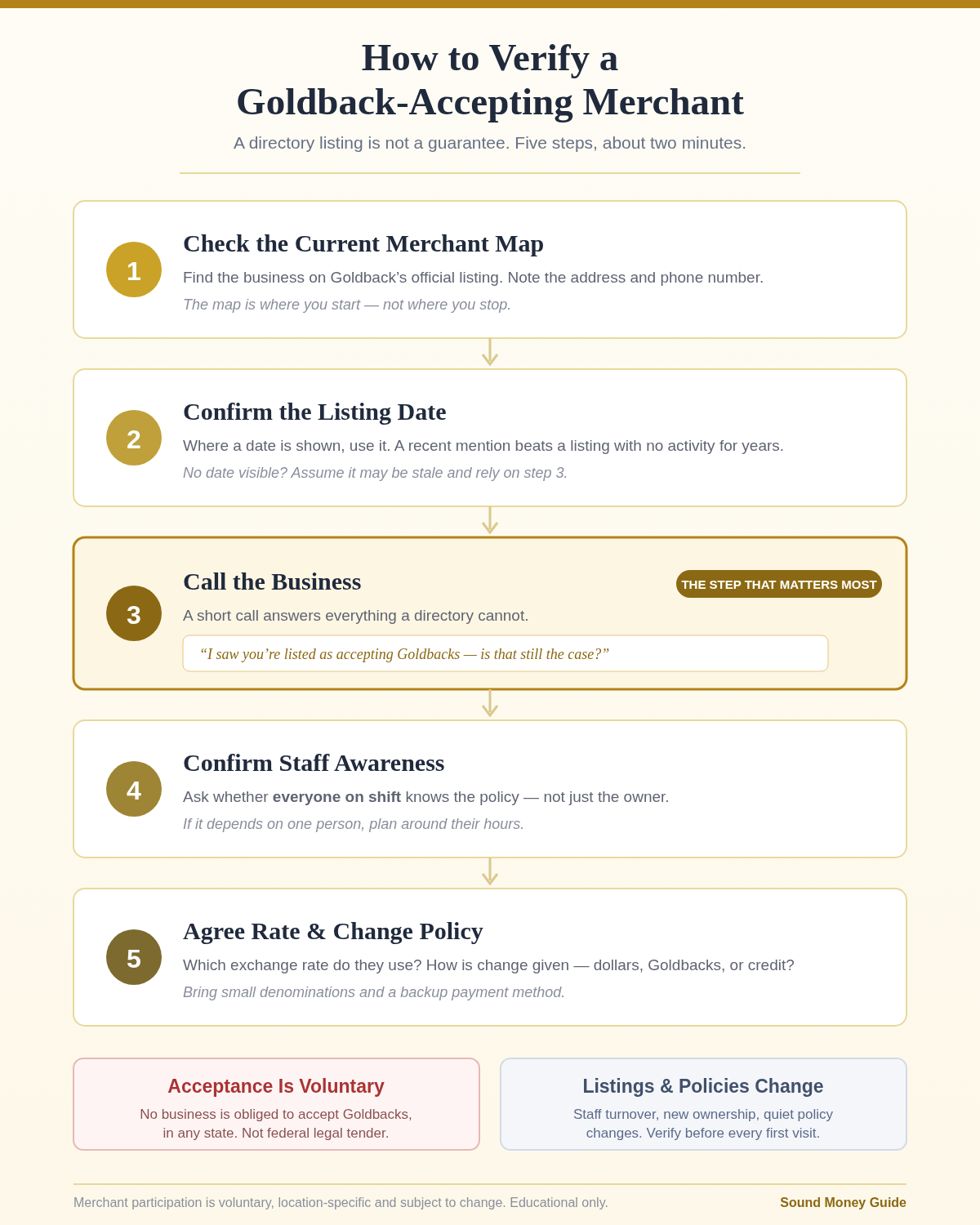
The five-step verification process. Step three is the one that matters most.
1. Check the Official Merchant Listing
Start at Goldback's official merchant map and find the business. Note the address and phone number, and check whether the listing shows any date or "last updated" information. If a listing looks sparse or unusually old, treat it with extra caution.
2. Confirm the Listing Date Where Available
Where a listing (or a business's own site or social page) shows when Goldback acceptance was added or last mentioned, use it. A business that posted about accepting Goldbacks last week is a much safer bet than one listed two years ago with no mention since.
If no date is visible, assume the listing could be stale and rely on step 3.
3. Call the Location
This is the step that matters most. A short call answers everything a directory can't.
Try something like:
"Hi — I saw you're listed as accepting Goldbacks. Is that still the case? I'd like to use them for a purchase later today."
Direct, friendly, and it gets you an unambiguous answer. If they hesitate or don't know what Goldbacks are, that itself is useful information.
4. Ask Whether All Staff Accept Goldbacks
This is the question most people forget, and it's where most bad experiences come from.
A business may genuinely accept Goldbacks — but if only the owner knows the policy and the owner isn't in when you arrive, you're stuck at the register explaining what a gold-foil note is.
Ask directly:
"Does everyone on shift know about it, or should I come when a particular person is working?"
If acceptance depends on one individual, plan around their hours.
5. Confirm the Exchange Rate and Change Policy Before You Visit
Two things to settle in advance, because both cause friction at the counter:
Which exchange rate do they use? Goldback publishes a daily reference exchange rate, and most participating businesses price against it. But a business isn't obliged to use it — some round, some use their own rate. Ask which they apply so you're not surprised.
How do they handle change? This is the single most common practical problem. If your purchase is $12 and the smallest Goldback that covers it is worth more, what happens? Options usually include:
- change given in dollars
- change given in smaller Goldbacks (if they have them)
- store credit for the difference
- you top up the remainder with cash or card
Ask which applies. Then bring small denominations — a mix of 1s and 5s makes a transaction far smoother than a single large note — and carry a backup payment method regardless.
Extra Questions Worth Asking
Depending on what you're buying:
- Is there a minimum or maximum Goldback amount per transaction?
- Do all products qualify, or are some excluded (alcohol, gift cards, sale items, services)?
- How are refunds handled — in Goldbacks, dollars, or store credit?
- Is there a preferred time to come in, if only certain staff handle it?
What to Do If a Listed Business Declines
It happens, and it's nobody's fault. Acceptance is voluntary — that's fundamental to how Goldbacks work, and a business is entitled to change its mind.
If you're turned down:
1. Be gracious. The person at the till usually didn't set the policy, and a good interaction keeps the door open. 2. Pay another way. This is why you brought a backup. 3. Ask whether the policy changed, so you know for next time. 4. Report the outdated listing to Goldback if there's a mechanism to do so — it helps the next person.
One thing not to do: don't argue that they're obliged to accept. They aren't. Goldbacks are not U.S. federal legal tender (31 U.S.C. § 5103), and even in Utah — where the Specie Legal Tender Act recognises gold and silver specie — the law permits voluntary acceptance rather than compelling any business to take a particular payment method.
Understanding What "Participating Merchant" Actually Means
Worth being precise about, because the language gets stretched online.
It means: the business has, at some point, indicated it's willing to accept Goldbacks as payment by voluntary agreement.
It does not mean:
- every location of a chain accepts them
- every staff member knows the policy
- acceptance is guaranteed today
- the business is obliged to accept
- Goldbacks are legal tender there
- the business will accept any denomination or amount
Goldback publishes merchant-network figures periodically in its recaps and community updates. Those are company-reported and point-in-time — useful for direction of travel, not an audited register of businesses that will definitely serve you this afternoon. Any total you see quoted should carry a date, and shouldn't be treated as evergreen.
A Quick Pre-Visit Routine
Once you've done this a few times it becomes automatic:
1. Find the business on the official map. 2. Call and confirm acceptance is current. 3. Check that whoever's working knows the policy. 4. Agree the exchange rate and change approach. 5. Bring small denominations plus a backup payment method.
Five steps, roughly two minutes, and a far better experience than discovering the problem at the register.
Frequently Asked Questions
Is the Goldback merchant map accurate?
It's a reliable starting point, but it's a directory rather than a live feed. Listings can lag behind staff changes, ownership changes, or quiet policy changes. Use it to find candidates, then call to confirm before you go.
Do I have to call ahead every time?
Not for a place you use regularly and know accepts them. For a first visit — or anywhere you haven't been in a while — a quick call is worth it.
What if the staff don't know what a Goldback is?
That's common and not a rejection in itself. Ask whether a manager or owner is available, or whether there's a better time to come in. Don't push the transaction on someone who isn't authorised to accept it.
Which exchange rate should a merchant use?
Goldback publishes a daily reference exchange rate that many participating businesses price against, but they aren't required to use it. Confirm which rate the business applies before you buy — see our exchange rate guide for how the reference value differs from melt value and dealer price.
What happens with change?
It varies by business: dollars, smaller Goldbacks, store credit, or you top up with another payment method. Ask in advance, and bring small denominations to reduce the issue.
Can a business refuse Goldbacks even if it's listed?
Yes. Acceptance is voluntary, and a listing doesn't create an obligation. Goldbacks aren't federal legal tender, and state specie laws permit voluntary acceptance rather than requiring it.
Can businesses accept Goldbacks in states without their own series?
Yes. A state series refers to the artwork and the local merchant network, not a restriction on where notes can be used. Goldback's own materials note that Goldbacks can be exchanged anywhere two parties voluntarily agree — including states that don't have a series. As always, that's by agreement, not obligation.
Bottom Line
The merchant map tells you where to look. A two-minute phone call tells you where you can actually spend.
Check the listing, confirm the date if you can, call ahead, make sure the staff on shift know the policy, and agree the exchange rate and change approach before you arrive. Bring small denominations and a backup payment method.
Acceptance is voluntary everywhere, which is exactly what makes Goldbacks what they are — a currency people choose to use rather than one they're compelled to take. A little verification keeps that experience a good one.
👉 Browse Goldbacks Currently Available from Alpine Gold
Inventory, denominations, series and prices may change. Verify current product availability before ordering.
For more on spending, see How to Spend Goldbacks. To check whether a quoted price is fair, use our Exchange Rate vs Melt Value Calculator.
Educational content only, not financial advice. Merchant participation is voluntary, location-specific, and subject to change without notice. Goldbacks are not U.S. federal legal tender. Company-reported merchant figures are point-in-time and should be confirmed against official sources with a capture date.
Continue Reading