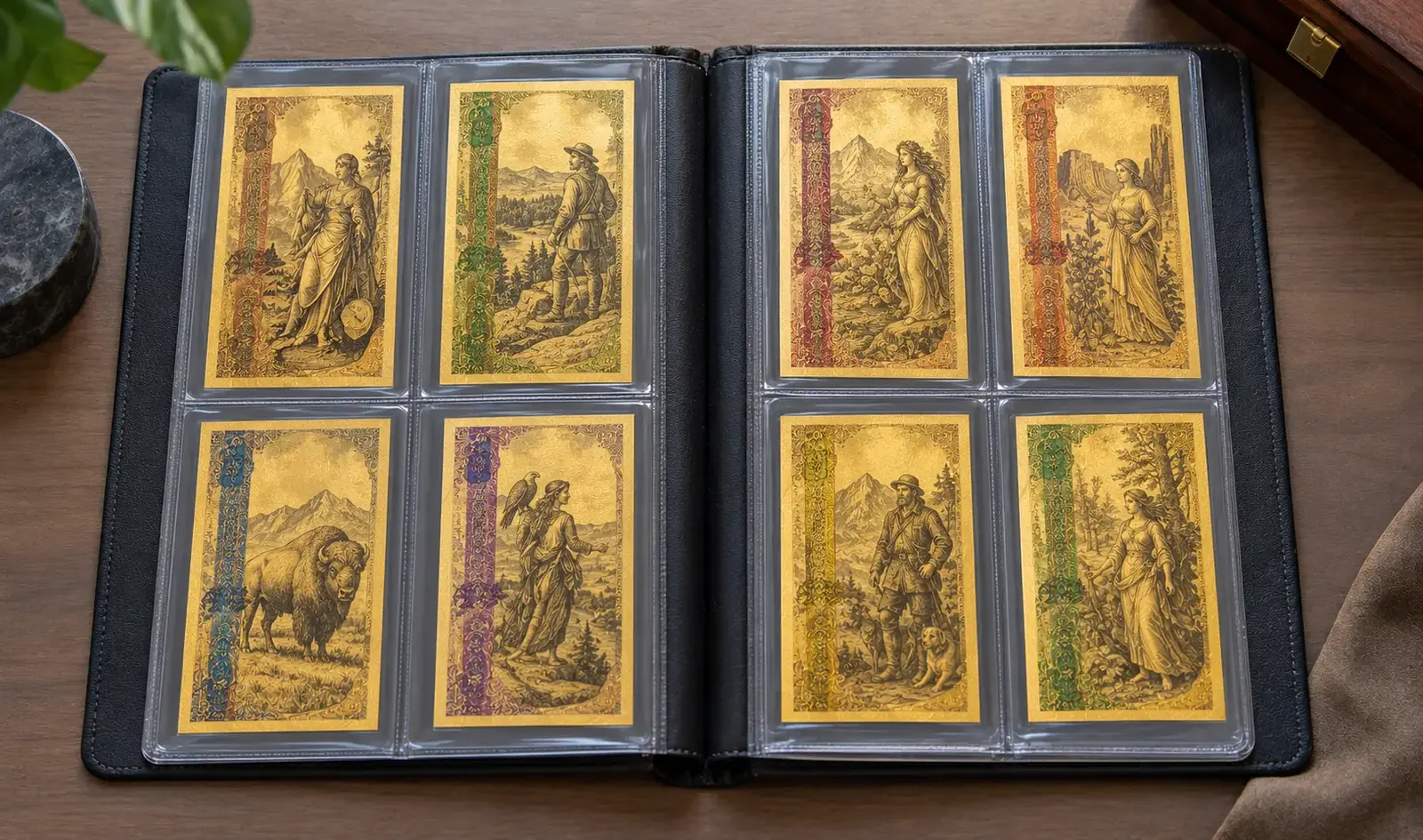
Arizona Goldbacks: An Honest Buyer's Guide

Arizona Goldbacks launched in 2025 as one of the newest state series in the Goldback ecosystem. If you're weighing them up — not just curious about the product — this guide covers what they are, where any value actually comes from, and who they do and don't suit. It is educational, not investment advice, and it deliberately avoids predicting returns.
For the full product review (denominations, artwork, Alpha details, where to buy), see our Arizona Goldbacks Review 2026.
- Arizona's series launched in 2025. A newer series means a shorter price history, so treat any trend claim with caution.
- Three different numbers, never one. Melt value (gold content x spot), the official Goldback reference exchange rate, and the dealer asking price are separate figures. Only melt value can be calculated from first principles.
- The reference exchange rate is not a guaranteed buyback or resale value. It is the figure used within the Goldback network, not a promise anyone will pay it.
- The rate moves daily with the gold price. Any dollar figure you read in an article is a snapshot, so recalculate before you transact.
- Expect a premium over melt. You are paying for manufacture, artwork and distribution as well as gold, and that premium is not recovered automatically on resale.
- Resale markets can be thin. Check completed sales rather than asking prices before assuming a value.
Who Arizona Goldbacks Suit — and Who They Don't
Arizona Goldbacks may fit if you want:
- Physical gold exposure in a small, divisible, spendable format
- A collectible tied to a growing sound-money ecosystem
- To hold real gold you can also spend at participating merchants
They're a poor fit if you want:
- Maximum gold-per-dollar (bars and 1 oz coins are more efficient)
- A short-term trade (Goldbacks are thinly traded, not a speculation vehicle)
- Any form of guaranteed or insured return (they're a physical asset, not a bank product)
The rest of this guide is about understanding the value honestly, not forecasting a payout.
The Two Things That Drive Goldback Value
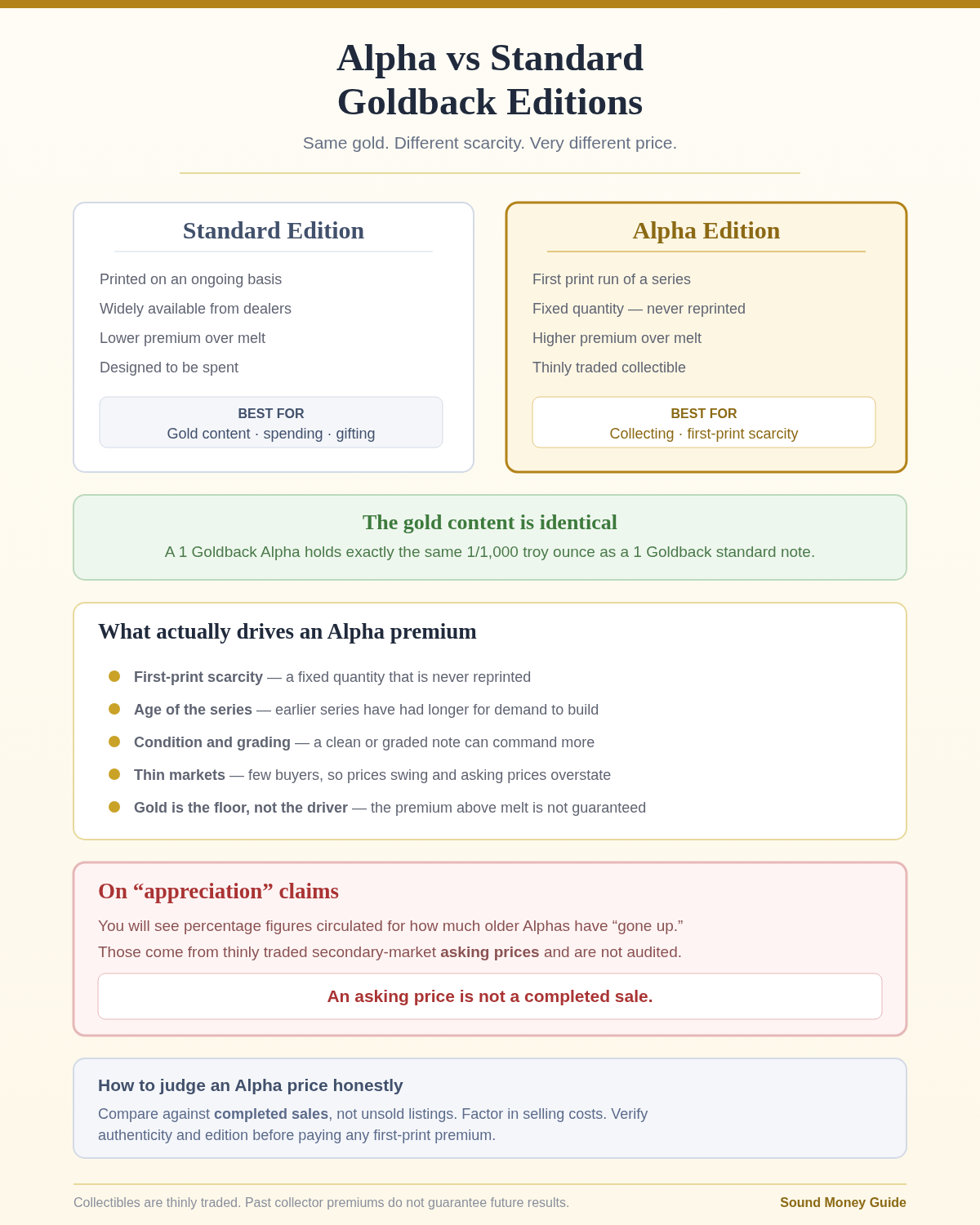
Collectible editions carry a collector premium — driven by scarcity, and never guaranteed.
1. Gold Content
Every Arizona Goldback contains a precise, verifiable amount of 24-karat gold. As gold prices move, the melt value of your notes moves with them. That gold content is the floor — but the price you pay includes a large premium over melt, so a Goldback is not a low-cost way to accumulate raw gold.
Gold has appreciated over long timeframes but with significant volatility and no guarantee. If you hold Goldbacks, you carry the same gold-price risk as any gold owner.
2. Collector Premium
Alpha (first-print) editions, and to a lesser extent standard notes, can trade above melt because of collector demand. That premium is driven by scarcity, series demand, condition, and how many buyers are active — all of which can rise or fall. It is not a yield, not a schedule, and not guaranteed.
Important: You'll see "past appreciation" percentages circulated for older state Alphas. Those figures come from thinly traded secondary-market asking prices, are not independently audited, and an asking price is not a completed sale. We don't republish them as fact, and you shouldn't buy Arizona Goldbacks on the assumption that an earlier state's pattern will repeat.
Why Arizona Specifically
Arizona is early in its life as a series, which shapes what you're buying:
- Near launch-level pricing — Arizona Alpha asking prices sit close to standard-edition levels, the smallest premium among the state series.
- Still readily available — inventory hasn't drawn down like the oldest series (Utah, Nevada).
- Finite first print run — 2025 Arizona Alphas cannot be reprinted; scarcity is structural, though price direction is not guaranteed.
- Includes the 1/2 denomination — one of the lowest-cost ways to own a first-print Alpha.
What this does not tell you is what Arizona will be worth later. A newer series has less trading history, which means less certainty, not a guaranteed run-up.
Current Arizona Pricing (Mid-2026 Asking Prices)
These are approximate dealer asking-price ranges, not guaranteed redemption or resale values. They move with the gold price and collector demand.
- 1 AZ Goldback (standard): $5 – $7 · Alpha: $7 – $12
- 5 AZ Goldback (standard): $22 – $30 · Alpha: $28 – $42
- Larger denominations (10 / 25 / 50): available; Alpha premium roughly 30–50% over standard at mid-2026 asking prices
Before buying or selling, check current dealer bids and comparable completed sales, and factor in selling costs (dealer spread, marketplace fees, shipping, insurance). For how to separate melt value, reference exchange value, and collector price, see our Goldback exchange rate vs melt value guide.
Alpha vs Standard: Which to Buy
- Standard AZ editions — gold exposure in a spendable, divisible format, with a smaller premium. Good if you value the currency utility and lower entry cost.
- AZ Alphas — first-print collectibles with a collector premium. Good if you specifically want the scarcity and are comfortable holding a thinly traded item with no guaranteed return.
Many collectors hold both. Neither choice is a predicted payout; it's a question of what you value.
A Sensible Way to Size a Position
If you decide to buy, keep it proportionate to your broader precious-metals holdings and treat it as collecting plus gold exposure, not a return play:
- Starter: 1–3 Arizona Alphas plus a few standard notes — under ~$200, low commitment.
- Collector: a spread of Alpha and standard denominations — a meaningful Arizona position within a broader Goldback collection.
- Dedicated: a fuller Alpha set including 25/50 denominations — sized to your overall metals allocation.
Larger Goldback orders may qualify for Alpine Gold's store-credit offer (check the terms and thresholds on their site before ordering). It does not lower your per-note cost: it is value toward a later qualifying order at Alpine, worth nothing if you do not order again, and it runs intermittently — observed on 24, 26 and 27 August 2026 and not displayed on 28 August 2026.
Where to Buy Arizona Goldbacks
Alpine Gold Exchange (Recommended)
Alpine Gold carries the full Arizona Goldback series including Alpha editions. For buyers, Alpine offers:
- Full Alpha inventory across AZ denominations
- UPMA partnership for insured vaulting if you don't want to store physically
- BBB accredited, A+ rating (BBB, captured 24 Sep 2026)
- Store-credit offers on qualifying Goldback orders — intermittent rather than a standing feature; observed on 24, 26 and 27 August 2026 and not displayed on 28 August 2026
👉 Shop Arizona Goldbacks at Alpine Gold Exchange
If you want vaulted, long-term custody rather than physical notes, you can also open a UPMA account. Review their current spread, storage, and any leasing terms directly before committing — those are account features, not guaranteed returns.
Risks to Understand
- Gold price volatility — Goldback melt value tracks gold; if gold falls, so does that floor.
- Thin collector market — the Goldback secondary market is small; liquidity for larger positions may be limited, and asking prices often exceed completed-sale prices.
- Premium compression — if supply expands or demand cools, the collector premium can shrink.
- Regulatory uncertainty — future legislation or IRS guidance could affect treatment.
The honest bottom line: worst realistic case, you hold gold worth roughly its melt value minus the premium you paid; better case, you hold a collectible that also tracks gold. Whether that trade-off is worth it is a personal decision, not a forecast.
Frequently Asked Questions
Are Arizona Goldbacks a good investment?
They can suit a buyer who wants physical gold in a small, spendable, collectible format and is comfortable with no guaranteed return. They're a poor fit for maximizing gold-per-dollar or for short-term trading. Any specific "appreciation" figure you see for older Alphas is an unaudited secondary-market number, not a promise Arizona will follow.
Should I buy Arizona Alphas or standard editions?
Alphas for first-print collectibility; standard editions for lower-cost gold exposure with spendability. Many collectors hold both. Neither is a predicted return.
How much should I buy?
Only as part of a broader precious-metals allocation, and only money you can hold long term. For most buyers a modest position (a mix of Alphas and standards) is plenty.
When should I sell?
If you buy at all, treat it as a long hold. Collector premiums are slow-moving and thin, and there's no guarantee one develops.
What's the tax treatment?
Physical gold in the US is generally taxed as a "collectible," up to a 28% federal capital-gains rate, with state taxes varying. Consult a tax professional for your situation.
Bottom Line
Arizona Goldbacks are a way to own small, divisible, spendable gold tied to a growing sound-money ecosystem, with a first-print Alpha option for collectors. They are a thinly traded collectible plus a gold-content floor — not a guaranteed-return investment, and not a low-cost way to stack raw gold.
Buy them for the gold exposure and the collecting, size the position sensibly, verify authenticity, compare current bids and completed sales, and ignore any "past appreciation" figures quoted as if they predict the future.
For the broadest selection of Alpha and standard editions, plus custody options through UPMA, Alpine Gold Exchange is a strong option.
For the full product breakdown, see our Arizona Goldbacks Review 2026.
👉 Shop Arizona Goldbacks at Alpine Gold Exchange
👉 Open a UPMA Account for Vaulted Long-Term Holdings
This article is for educational purposes only and does not constitute financial advice. Gold prices fluctuate. Goldbacks are thinly traded collectibles; an asking price is not a completed sale, and past collector premiums do not guarantee future results. Always consult a qualified financial advisor before making significant financial decisions.
Continue Reading