Goldback Exchange Rate vs Melt Value: Why the Numbers Are Different

A 1 Goldback holds exactly 1/1000 of a troy ounce of 24-karat gold — so its melt value and its published exchange rate are two different numbers by design.
Source: Goldback, “Exchange Rates” (observed 23 August 2026). The gold content is fixed; the melt value moves with spot, and the exchange rate is set separately by Goldback and updated daily.
Key takeaways
- Melt value = gold spot price ÷ 1,000 for a 1 Goldback. It's the raw metal only.
- Reference exchange value is the rate Goldback publishes for spending at participating merchants, updated daily — not a guaranteed buyback or resale price.
- Retail price is what a dealer charges to buy a note; it sits above melt because a Goldback is manufactured, not poured.
- The gap between melt and the exchange rate pays for turning gold into a durable, spendable, fractional note — the thing bullion can't do.
- Use the calculator below to see all three numbers side by side for any denomination and quantity.
Three Numbers, One Note
If you've shopped for Goldbacks, you've run into three different dollar figures attached to the same note, and it's genuinely confusing the first time:
1. Melt value — the raw gold, at today's spot price. 2. Reference exchange value — the rate Goldback publishes so people can spend them at merchants. 3. Retail price — what a dealer actually charges you to buy one.
They're all "the value of a Goldback," and they're all different. That's not a trick or a markup scam — the three numbers measure three different things. Here's what each one is, why they diverge, and how to think about the gap.
What is a Goldback's melt value?
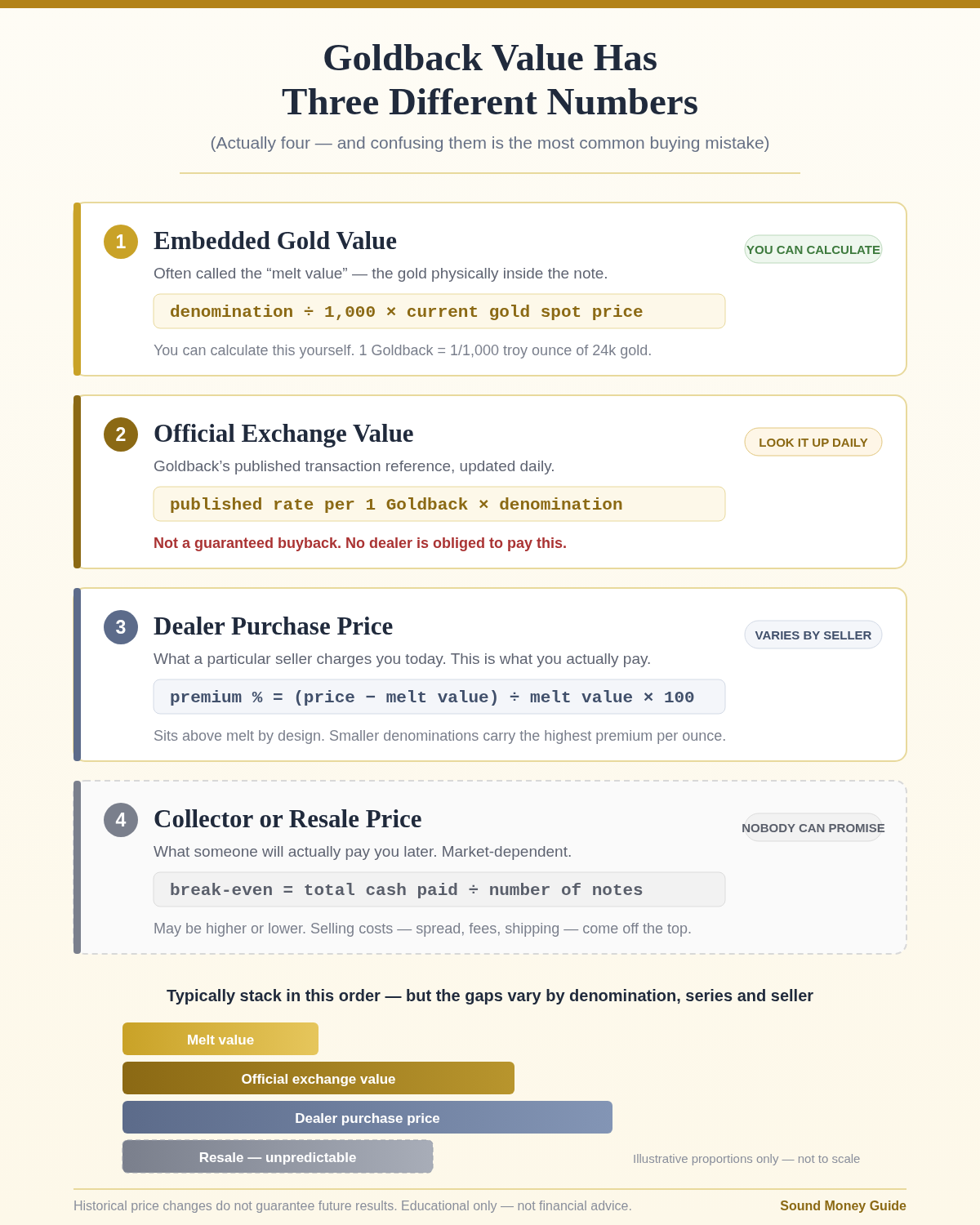
Four different numbers. Only the melt value can be calculated from first principles.
Melt value is the simplest of the three. A Goldback is physical 24-karat gold, and each denomination holds a fixed, published amount:
- 1 Goldback = 1/1000 troy oz
- 5 Goldback = 5/1000 troy oz
- 10 Goldback = 10/1000 troy oz
- 50 Goldback = 50/1000 troy oz
So the melt value of a 1 Goldback is just:
Gold spot price ÷ 1,000
If gold is trading at $3,300/oz, a 1 Goldback contains about $3.30 of gold. That's the "floor" — the value of the metal if you ignored everything else about the note. Melt value moves every second the gold market is open, because spot moves.
The important thing: melt value is only the metal. It doesn't account for the fact that the gold has been turned into something you can actually hold, verify, and spend in single-dollar-ish increments. That's where the second number comes in.
What is the Goldback exchange rate?
The Goldback reference exchange rate is a figure Goldback publishes — and updates daily — so that merchants and customers have an agreed value for spending Goldbacks as currency. When a participating merchant accepts Goldbacks, this is the rate they use to price a transaction.
Two things to be precise about, because loose language here is where people get misled:
- The exchange rate is a spending reference, set by Goldback and revised daily as the gold market moves. You can see the current figure on the Goldback, “Exchange Rates” (observed 23 August 2026).
- It is not a guaranteed redemption, buyback, or resale value. No one is obligated to hand you that many dollars for your note. It's the rate for spending at merchants who choose to participate, not a promise that a dealer will buy it back at the same number.
The exchange rate always sits above melt value. That premium isn't arbitrary — it reflects the cost and value of turning raw gold into a thin, durable, counterfeit-resistant, fractional note that works as hand-to-hand money. Bullion can't do that. A gold coin worth several hundred dollars can't buy a coffee. A Goldback can.
Why the Exchange Rate Is Higher Than Melt
The gap between melt and the exchange rate is the cost of making gold spendable. Specifically it covers:
- Fractionalization — putting a fraction of a gram of gold into a usable unit. The smaller the denomination, the higher the per-ounce premium, because the manufacturing is the same effort for less gold.
- The Aurum manufacturing process — vapor-depositing 24k gold into a polymer note that's durable enough to circulate.
- Anti-counterfeiting — security features, including UV-visible artwork on newer notes.
- Distribution and merchant-network support — the infrastructure that makes them spendable in the first place.
This is the same reason a fractional gold coin or a small gold bar carries a higher premium per ounce than a big one-ounce bar. You're paying for the form, not just the metal. With Goldbacks the form is the whole point: it's gold you can spend a dollar at a time.
Melt vs Exchange vs Retail: A Worked Example
Say gold spot is $3,300/oz and the 1 Goldback reference exchange rate is $6.40 on a given day (always check the live figure — both numbers move):
| Number | 1 Goldback | What it means |
|---|---|---|
| Melt value | ~$3.30 | Raw gold at spot |
| Reference exchange value | $6.40 | Published spending rate at merchants |
| Retail price | ~$6–$8 | What a dealer charges to buy one |
The exchange value sits well above melt because you're buying spendable, fractional gold currency — not a lump of metal. Retail sits near or slightly above the exchange rate depending on the dealer, denomination, and any premium for newer or collectible series.
This is the single most important mental model: a Goldback is priced like money made of gold, not like a gold bar. Judging it purely on melt value misses what you're actually buying, in the same way judging a $20 bill by the value of its cotton-linen paper would miss the point.
Try It: Goldback Exchange Rate vs Melt Value Calculator
Enter today's spot price and the current 1 Goldback reference exchange rate, pick a denomination, and the calculator breaks out all three numbers — melt value, reference exchange value, and (optionally) the retail price you paid — plus the premium of each over the others. It can also estimate a dealer buyback and the round-trip spread.
How to read the results: the premium of the exchange rate over melt is normal and expected — it's the cost of fractional, spendable gold. The number to watch is the premium of retail over the reference exchange rate: a small premium is typical, a large one means you're paying a steep markup for that particular note (often the case for brand-new or collectible releases).
Nothing is hard-coded in the tool — you supply the live spot price and the live exchange rate, because both change daily and we never want a stale number baked into the page.
How Goldback Pricing Compares to a Melt-Value Tool
You may have seen melt calculators that show only the raw gold content of a Goldback. Those answer one of the three questions — what's the metal worth — and stop there. That's useful, but on its own it makes Goldbacks look "overpriced," because melt value ignores the entire reason Goldbacks exist: spendability in tiny increments.
This calculator is built to show the relationship between the numbers, not just the melt floor:
- It puts melt, exchange, and retail on one screen.
- It calculates the premium between each pair, so you can see exactly how much you're paying for the "spendable" form.
- It adds an optional dealer-buyback estimate and round-trip spread — the real cost of buying and later selling.
- It shows the hypothetical spot price at which raw melt alone would equal what you paid — a clean way to think about the metal-only break-even.
That's the difference between "how much gold is in this note" and "how do the three prices of this note actually relate" — which is the question people are really asking when they compare exchange rate to melt.
Frequently Asked Questions
Is the Goldback exchange rate the same as its resale value?
No. The exchange rate is the rate Goldback publishes for spending at participating merchants, updated daily. It is not a guaranteed resale or buyback value, and nobody is obliged to pay it. A dealer buying notes back sets its own price, and no dealer we could find publishes what that price is — not as a figure, not as a percentage of the exchange rate. Anyone quoting you a typical resale percentage is estimating. Our guide to selling Goldbacks sets out what is and is not published, and what to confirm before you need the answer.
Why is a Goldback worth more than its melt value?
Because you're paying for fractional, spendable, durable gold currency — not just the metal. The manufacturing (vapor-deposited 24k gold in a durable note), anti-counterfeiting, and the ability to spend gold a dollar at a time all sit in the gap between melt and the exchange rate.
How much gold is actually in a Goldback?
A 1 Goldback contains 1/1000 of a troy ounce of 24-karat gold. Higher denominations scale linearly: a 5 Goldback holds 5/1000 oz, a 50 Goldback holds 50/1000 oz. See our full breakdown in How Much Gold Is in a Goldback?.
Does the exchange rate change?
Yes, daily. Goldback revises it as the gold market moves. Always check the Goldback, “Exchange Rates” (observed 23 August 2026) for the current figure rather than relying on a number printed in an article.
Is buying Goldbacks a good investment?
Goldbacks are best understood as spendable gold currency rather than a low-premium bullion investment — their per-ounce premium is higher than bars or large coins precisely because they're fractional and spendable. Whether that trade-off fits your goals is a personal decision; see Are Goldbacks a Good Investment? for the fuller picture.
What's the cheapest way to buy Goldbacks?
Premiums vary by dealer and denomination. Larger denominations generally carry a lower premium per ounce of gold. Compare live prices before buying — the retail-vs-exchange premium in the calculator above is a quick way to sanity-check any quote.
Bottom Line
A Goldback has three prices because it does three things: it is gold (melt value), it spends as gold currency (reference exchange value), and it's sold by dealers (retail price). The gaps between them aren't a markup trick — they're the cost of turning gold into money you can actually spend a dollar at a time.
Judge a Goldback as bullion and it looks expensive. Judge it as spendable, fractional, verifiable gold currency — which is what it's designed to be — and the premium over melt is the price of the one thing a gold bar can't do.
👉 Compare live Goldback prices at Alpine Gold Exchange
Educational content only, not financial advice. Gold prices fluctuate and past performance does not guarantee future results. The Goldback reference exchange rate is a published spending rate, not a guaranteed redemption, buyback, or resale value. Always verify current spot and exchange-rate figures from primary sources before buying or selling.
Methodology
This page separates three figures that are routinely confused with one another. Each is defined by its source rather than by us.
- Gold content is fixed. A 1 Goldback holds 1/1000 of a troy ounce of 24-karat gold. That is a published specification, not an observation, and it does not move.
- Melt value is derived, not quoted: it is the gold content valued at the prevailing spot price, which changes continuously. No melt figure is published on this page as a current value.
- The reference exchange rate is set and published by Goldback Inc. and updated on their schedule. It was read on 23 August 2026. It is a reference for voluntary merchant acceptance, not a guaranteed redemption or resale value.
- Dealer retail price is set independently by each seller and varies between dealers and across a single dealer's catalogue over time. Prices seen here are point-in-time readings, dated where they appear.
- The premium is described structurally — why the three numbers diverge — rather than published as a fixed percentage, because any such percentage is only true on the day it is calculated.
How to Cite This Page
Cite the mechanism and the source, not a figure lifted from here. Any rate or price quoted below was read on a stated date and will have moved since.
The Goldback Guide, “Goldback Exchange Rate vs Melt Value: Why the Numbers Are Different.” Price references read 23 August 2026. Available at: https://thegoldbackguide.com/goldback-exchange-rate-vs-melt-value/
The reference exchange rate is published by Goldback Inc. and changes daily; check it directly before relying on any figure. Gold content is a fixed published specification and does not change.
Continue Reading