How to Calculate Goldback Value: Exchange Rate, Gold Content and Dealer Price

A Goldback has at least four different values at any moment — melt value, official exchange value, dealer price, and resale price. They are rarely the same number, and confusing them is the most common Goldback buying mistake.
The only one you can calculate yourself from first principles is melt value: denomination ÷ 1,000 × the live gold spot price. Everything else has to be looked up or quoted.
Key takeaways
- Melt value is pure math: 1 Goldback = 1/1,000 troy ounce of gold, so melt = denomination ÷ 1,000 × spot price.
- Official exchange value is published by Goldback and updated daily. It's a transaction reference — not a guaranteed buyback or resale price.
- Dealer price is whatever a specific seller charges. It sits above melt because a Goldback is a manufactured, spendable note.
- The premium is normal — its size is what matters. Smaller denominations always carry a higher premium per ounce.
- Work out your break-even resale price before buying, and remember selling costs come off the top.
- Historical exchange-rate changes are not a forecast of future value or of what you'd personally get on resale.
The Four Numbers, and Why They Differ
Most confusion about "what is my Goldback worth?" comes from treating one number as the answer. There are four, and each answers a different question.
| Number | What it means | Who sets it |
|---|---|---|
| Melt value | The value of the gold physically embedded in the note | The global gold market |
| Official exchange value | Goldback's published transaction reference, updated daily | Goldback Inc. |
| Dealer price | What a particular seller charges you today | Each individual seller |
| Resale / collector price | What someone will actually pay you later | The secondary market |
They're usually all different, and the gaps between them are exactly where buyers get caught out.
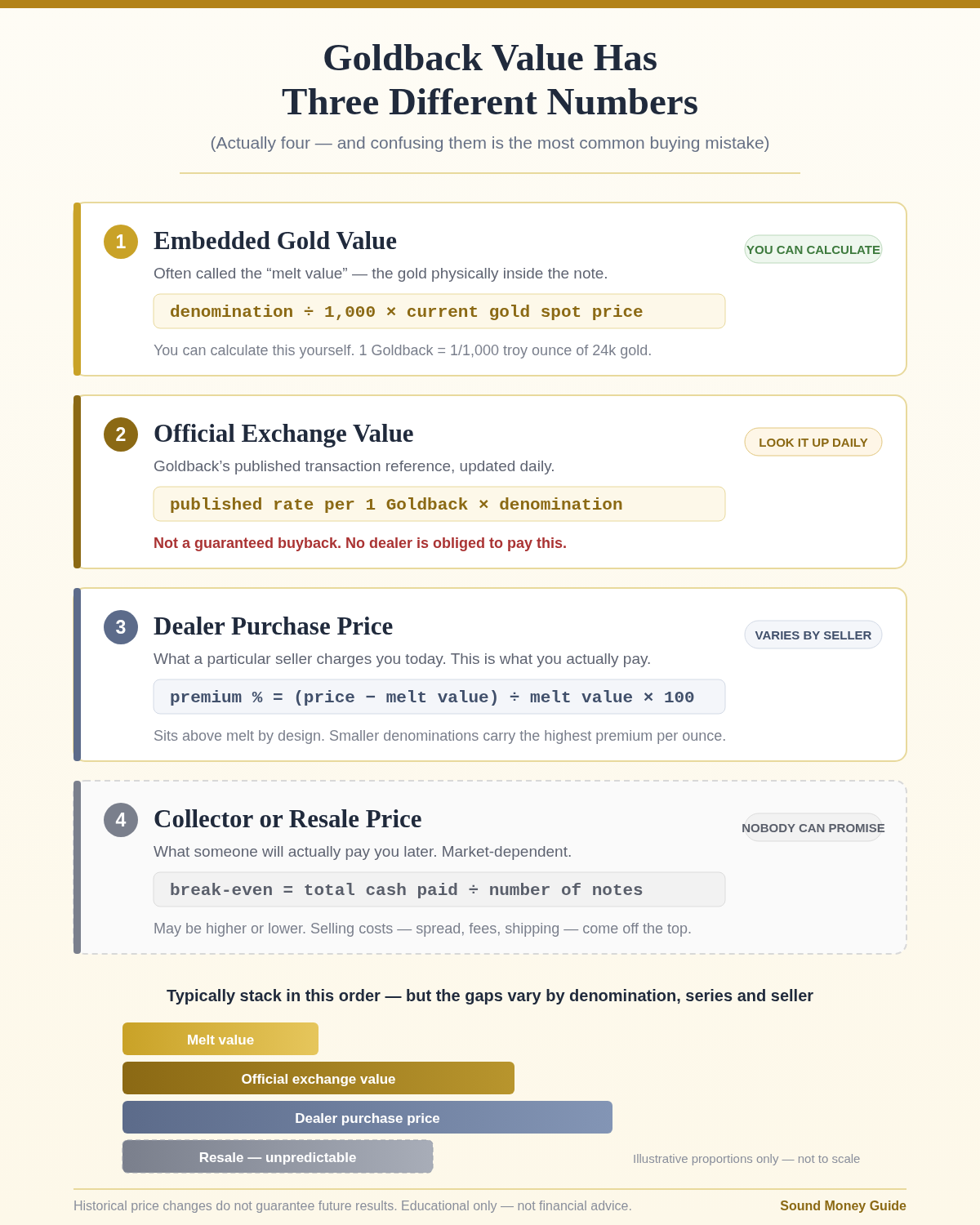
The four numbers attached to every Goldback. Only the first can be calculated from first principles.
1. How to Calculate Melt Value (the One You Can Do Yourself)
This is the only figure you can derive from first principles, and it's genuinely simple.
The base unit: 1 Goldback contains 1/1,000 of a troy ounce of .999 fine 24-karat gold. Every denomination is a fixed multiple of that.
The formula:
Melt value = (denomination ÷ 1,000) × current gold spot price
So for a 5 Goldback, you hold 5/1,000 = 0.005 troy oz. Multiply that by whatever gold is trading at today, and you have the embedded gold value.
Gold Content by Denomination
| Denomination | Gold content (troy oz) |
|---|---|
| ¼ Goldback | 1/4,000 (0.00025) |
| ½ Goldback | 1/2,000 (0.0005) |
| 1 Goldback | 1/1,000 (0.001) |
| 2 Goldback | 1/500 (0.002) |
| 5 Goldback | 1/200 (0.005) |
| 10 Goldback | 1/100 (0.01) |
| 25 Goldback | 1/40 (0.025) |
| 50 Goldback | 1/20 (0.05) |
| 100 Goldback | 1/10 (0.1) |
Two important notes on availability:
- ¼, ½ and 2 denominations appear on series released from 2025 onward, not on every older series.
- The 100 Goldback is being discontinued. Goldback confirmed on 23 March 2026 that no new 100s will be produced and that upcoming releases will not include the denomination. Existing notes may remain available while inventory lasts, but don't expect it in future series — and don't assume discontinuation alone creates collector value.
Watch the units. Gold is quoted per troy ounce, not a standard ounce. Use the same unit throughout and the math stays clean.
2. How the Official Exchange Value Works
Goldback publishes a daily exchange rate — a reference value for one Goldback, which merchants and individuals can use when pricing a voluntary transaction. It updates each day in line with gold market conditions.
To value a note at the reference rate:
Exchange value = published rate per 1 Goldback × the denomination
So if the published reference is X dollars per Goldback, a 10 Goldback note carries a reference value of 10 × X.
Three things this number is not:
1. Not a guaranteed buyback. No dealer is obliged to pay you the reference value. 2. Not the dealer's asking price. Sellers set their own prices, often above the reference. 3. Not a valuation of your specific note. Condition, series, and edition all affect what a note actually fetches.
The exchange value sits above melt value by design — it reflects the manufactured product, not just the metal. That gap is the built-in premium of the format.
A Note on Published Growth Figures
You may see historical performance figures quoted for the Goldback exchange rate. Treat these carefully: Goldback's own materials have shown internally inconsistent growth numbers on the same page (one stated average sitting alongside a different calculated annual rate), without visible methodology reconciling them.
We don't publish either figure as a performance claim, and you shouldn't use one as a planning assumption. Past changes in a published exchange rate do not establish future performance, and they certainly don't establish what any individual buyer would get on resale.
3. Understanding the Dealer Price and the Premium
The dealer price is what you actually pay. It's above melt value, and that's expected — you're buying a manufactured note with embedded gold, security features, and artwork, not a generic bar.
The premium calculation:
Premium ($) = what you paid − melt value Premium (%) = (premium ÷ melt value) × 100
The pattern worth internalising: the smaller the denomination, the higher the premium per ounce. Producing a note takes broadly similar effort whether it holds 1/4,000 oz or 1/20 oz, so the smallest notes cost the most relative to their gold content. A ¼ Goldback is the cheapest single piece you can buy and the least gold-efficient by weight. A 50 Goldback is the opposite.
That's not a flaw — it's the cost of divisibility. But it means "cheapest note" and "best value per ounce" are opposite ends of the range.
Include the Costs That Don't Appear on the Sticker
A genuine comparison includes:
- Shipping and insurance
- Payment-method surcharges (card pricing is often higher than cash/check)
- Sales tax, where it applies to you
- Store credit, which is value toward a later qualifying order — not money off today's purchase
That last one matters. A store-credit promotion reduces your effective cost only if you actually place another qualifying order. Model it separately from the cash you're handing over now.
4. Work Out Your Break-Even Before You Buy
This is the step most buyers skip, and it's the most useful one.
Break-even resale price per note = total cash paid ÷ number of notes
Where "total cash paid" includes shipping and any surcharges. That's what you'd need to receive per note simply to get your money back — before any selling costs.
And selling costs are real:
- Dealer spread — a dealer's bid sits below their ask
- Marketplace fees on secondary platforms
- Shipping and insurance on the way out
- Time, since Goldback resale markets are thin compared with sovereign bullion coins
Goldback dealer buyback prices generally aren't published as fixed schedules — most quote case by case. So while your entry premium is knowable, your exit is not. Build that uncertainty into the decision rather than assuming the reference value is your exit price.
Calculate All of It at Once
Rather than doing this by hand, use our calculator — enter today's live figures and it separates every number for you:
Goldback Exchange Rate vs Melt Value Calculator →
It shows the melt value, the official exchange value, and the seller price side by side, then works out your total cash outlay (including shipping and store credit handled separately), your premium over both melt and the reference value, your cost per troy ounce, and your break-even resale price.
Nothing is hard-coded and nothing is projected — you supply the live spot price, the current reference rate, and the seller's price.
A Worked Example (Structure, Not a Prediction)
Say you're considering 10 × 1 Goldback notes. The process is always the same four steps:
1. Melt: 10 notes × (1 ÷ 1,000) = 0.01 troy oz total. Multiply by today's spot price. 2. Exchange value: today's published reference rate × 1 × 10 notes. 3. What you pay: (seller price × 10) + shipping. Note any store credit separately. 4. Premium and break-even: compare step 3 against steps 1 and 2, then divide step 3 by 10 for your per-note break-even.
We deliberately don't publish fixed dollar figures here, because the gold price and the reference rate both move daily — any number we printed would be wrong by the time you read it. Run your own with live inputs.
Common Mistakes to Avoid
- Treating the denomination as a dollar amount. A "10 Goldback" isn't $10. The number tells you gold content, not price.
- Assuming the exchange value is what you'll be paid. It's a transaction reference, not a bid.
- Comparing a dealer price to melt and calling the premium a rip-off. Some premium is inherent to the product.
- Ignoring shipping and surcharges when comparing sellers.
- Treating store credit as a discount on today's purchase.
- Assuming small denominations are "better value" because they're cheap. They carry the highest premium per ounce.
- Using a published historical growth rate as a forecast. It isn't one.
- Paying auction-hype prices. Live-selling and auction formats can run well above ordinary dealer pricing, particularly on the smallest notes. Check the price against melt, the reference value, and a normal dealer before bidding.
Frequently Asked Questions
How do I calculate the value of a Goldback?
Start with melt value: divide the denomination by 1,000 to get troy ounces of gold, then multiply by the current gold spot price. Then compare that to Goldback's published reference exchange value and the seller's asking price — those three numbers together tell you what you're really paying.
How much gold is in a Goldback?
A 1 Goldback contains 1/1,000 of a troy ounce of .999 fine 24-karat gold. Every other denomination is a fixed multiple: a 50 Goldback holds 1/20 troy oz, a ¼ Goldback holds 1/4,000 troy oz.
Is the Goldback exchange rate the same as its value?
No. The exchange rate is a published daily transaction reference. It's not a guaranteed buyback price, not the dealer's asking price, and not a valuation of your specific note.
Why do Goldbacks cost more than their gold content?
Because you're buying a manufactured note — the vacuum-deposition process, security features, artwork, and distribution all sit on top of the metal. The premium is highest on the smallest denominations, where production cost is spread over the least gold.
What is a fair premium on a Goldback?
There's no single fair number, but you can judge it: work out the premium over melt and over the official reference value, then compare across two or three dealers. A price far above the reference value on a live-auction listing is worth questioning.
Will Goldbacks go up in value?
Nobody can tell you that. Goldbacks track gold, plus a collector/product premium that can widen or narrow. Published historical exchange-rate figures aren't a forecast — and some official figures have been internally inconsistent, so treat any quoted growth rate with caution.
Is the 100 Goldback still available?
Goldback has indicated the 100 denomination is being discontinued, with no new 100s being produced and upcoming releases excluding the denomination (Goldback, 23 March 2026). Existing notes may remain available while inventory lasts. Don't assume it will appear in future series, and don't assume discontinuation alone makes it a good buy.
Bottom Line
"What's my Goldback worth?" has four answers, and knowing which one you're looking at is the whole skill.
Melt value you can calculate yourself — denomination ÷ 1,000 × spot. Exchange value is Goldback's published daily reference, useful for transactions but never a guaranteed payout. Dealer price is what you actually pay, and always carries a premium. Resale price is the one nobody can promise you.
Run the numbers before you buy, include shipping and surcharges, know your break-even, and treat any historical growth figure as history rather than forecast.
Work out your own figures with the Exchange Rate vs Melt Value Calculator →
👉 Check Alpine Gold's Current Goldback Prices and Availability
Goldback exchange rates, dealer prices, premiums, denominations, and inventory can change. Compare the current seller price with the official exchange rate before purchasing.
For the denomination breakdown see How Much Gold Is in a Goldback?, and for the honest investment picture see Are Goldbacks a Good Investment?.
Educational content only, not financial advice. Gold prices and the Goldback reference exchange rate change constantly and should be confirmed live. Availability varies by series, edition, and seller. An asking price is not a guaranteed resale value, and past price changes do not guarantee future results.
Continue Reading