Goldback Statistics 2026: State Series, Denominations, Merchant Network, and Reported Growth

Goldback's official buying guide names nine states with full series — Arizona, Florida, Idaho, Nevada, New Hampshire, Oklahoma, South Dakota, Utah, and Wyoming. California is not among them: its Limited Early Release arrived first, and Phase 1 of its standard series followed, but a complete denomination set has not launched.
Source: Goldback's "Where to Buy Goldbacks" guide (goldback.com/where-to-exchange/), captured July 24, 2026. Other adoption figures on this page are company-reported and dated below.
Key takeaways
- Goldback's live buying guide names nine states with full series; California is a Limited Early Release, not a full series. This resolves Goldback's own earlier inconsistent counts — we cite the guide with a date.
- Denomination counts still differ across Goldback's own live pages (buying guide lists eight and omits the 100; the About page lists nine values including the 100). We name the values and cite the page, not a single count.
- Circulation, merchant, app, and traffic figures are company-reported by Goldback Inc., not independently audited. They are attributed and dated, not presented as evergreen fact.
- Merchant counts are point-in-time company announcements. They must be attributed and dated, and should not be added together into a running "active merchant" total.
- Several important figures (active users, transaction volume, redemptions) are not publicly disclosed — see the missing-data section.
How many Goldback state series are there?
Goldback's official "Where to Buy Goldbacks" buying guide states verbatim that there are nine states with full series (captured 24 July 2026):
Arizona, Florida, Idaho, Nevada, New Hampshire, Oklahoma, South Dakota, Utah, and Wyoming.
Two clarifications that most coverage gets wrong:
- California is not yet a full series. The California LER launched 7 July 2026 as a collectible first release, and Phase 1 of the standard series — ¼, 1 and 5 — launched 25 August 2026. A complete denomination set has not launched, so California is not among the nine full-series states.
- This resolves Goldback's earlier inconsistent counts. Older homepage copy referred to "five U.S. states," and other pages implied different totals. Goldback's current buying guide gives the explicit, authoritative figure — nine full-series states — so this guide cites that page with a capture date rather than any stale count.
A state series refers to the artwork and merchant network tied to that state. It is not a limit on where Goldbacks can be owned or used — Goldback's FAQ states that Goldbacks can be exchanged anywhere two parties voluntarily agree, even in states without a series yet.
State Series Launch Timeline
| Year | State series introduced |
|---|---|
| 2019 | Utah |
| 2020 | Nevada |
| 2021 | New Hampshire |
| 2022 | Wyoming |
| 2023 | South Dakota |
| 2025 | Arizona, Florida, Oklahoma |
| 2026 | Idaho |
| 2026 | California (Limited Early Release only) |
Timeline compiled from Goldback's official series and launch materials, captured July 2026. Verify current series against official sources.
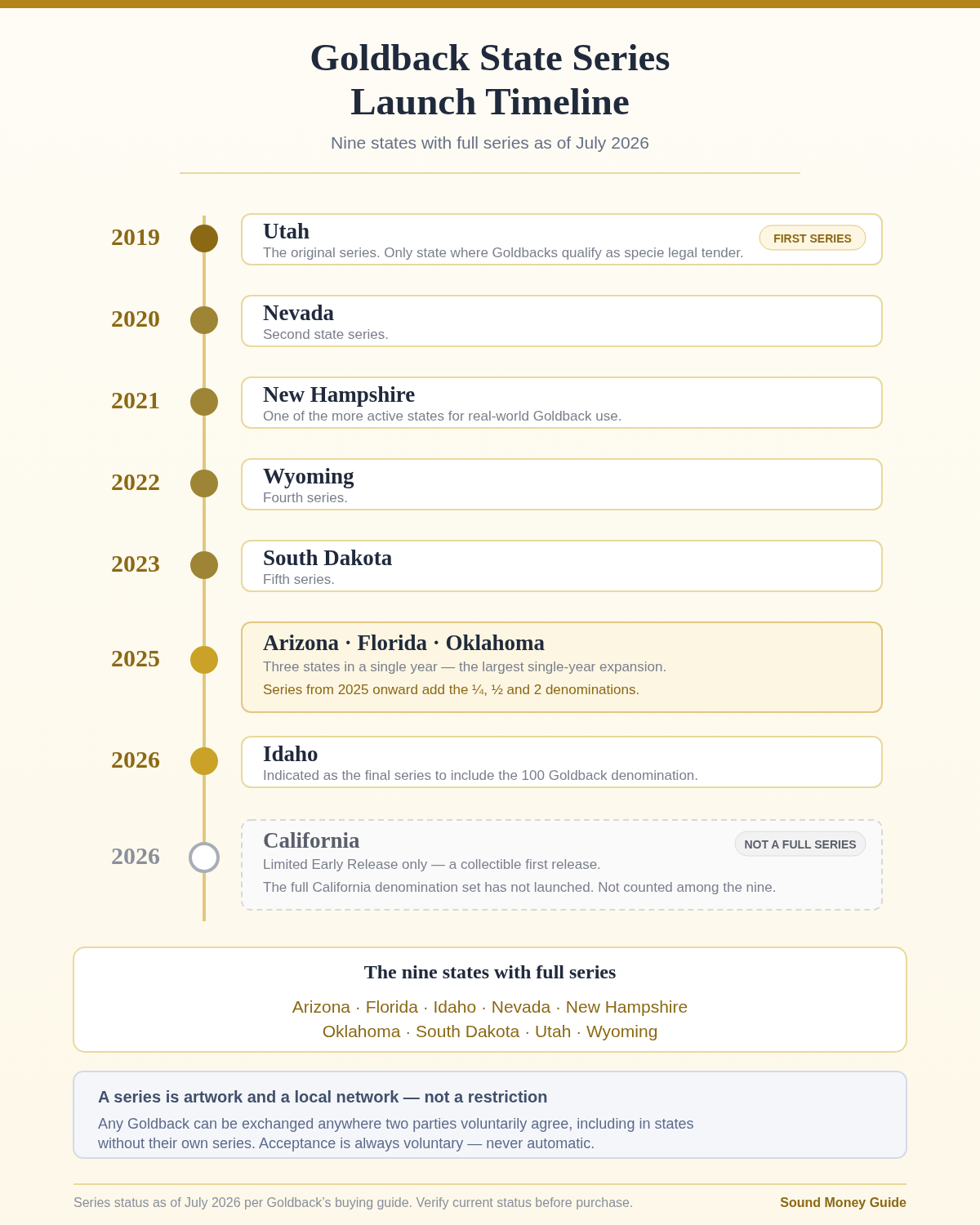
State series launches 2019–2026. California is a Limited Early Release, not one of the nine full series.
How many Goldback denominations are there?
Goldback's own live pages give different denomination counts, so we name the values and cite the specific page with a date rather than publishing a single number:
- Buying guide (goldback.com/where-to-exchange/, captured 6 September 2026): states “five standard denominations: 1, 5, 10, 25, and 50” plus “the 1/4, 1/2, and 2 denominations for series released in 2025 and on” — eight in total. It omits the 100.
- About page (goldback.com/about-goldbacks/, captured 6 September 2026): reads “Goldbacks are available in eight denominations for easy exchange” and lists exactly eight (¼, ½, 1, 2, 5, 10, 25, 50) with gold content for each.
These two pages previously disagreed. When we captured them on 24 July 2026 the About page listed nine values including the 100, under a heading that already read “eight denominations.” On our 6 September 2026 recapture the 100 no longer appears there and the two pages agree. We record the earlier disagreement because it explains why older coverage cites nine.
| Denomination | Gold content (troy oz) |
|---|---|
| ¼ Goldback | 1/4,000 |
| ½ Goldback | 1/2,000 |
| 1 Goldback | 1/1,000 |
| 2 Goldback | 1/500 |
| 5 Goldback | 1/200 |
| 10 Goldback | 1/100 |
| 25 Goldback | 1/40 |
| 50 Goldback | 1/20 |
| 100 Goldback | 1/10 |
The 100 Goldback is being discontinued — Goldback confirmed on 23 March 2026 that no new 100s will be produced and that upcoming releases will not include the denomination, which is consistent with the buying guide (focused on the ongoing standard set) omitting it. Existing notes may remain available while inventory lasts, but it should not be treated as a denomination expected in future series. Availability varies by series, edition, and seller. Florida carries the full listed set. The refreshed Utah series, relaunched 25 August 2026, is published by Goldback as “the full lineup of 1/4, 1/2, 1, 2, 5, 10, 25, and 50 Goldback denominations with updated artwork and virtues” (preorder announcement, published 12 August 2026, captured 6 September 2026). The Nevada, New Hampshire and Idaho standard series list 1, 5, 10, 25, and 50. Goldback does not publish a denomination set for the Wyoming, South Dakota, Arizona or Oklahoma series at all. Alpha and Limited Early Release editions (for example the Idaho Alpha fractionals and the Utah 3 LER) are collectibles tracked separately from the standard circulating denominations. For the full breakdown, see How Much Gold Is in a Goldback? and the Quarter Goldback guide.
Company-Reported Adoption Figures
The figures below come from Goldback Inc.'s own reporting. They are company-reported and not independently audited. Each is dated to its source snapshot — treat them as Goldback's reported numbers at those points in time, not as verified, current, or evergreen figures.
| Metric (company-reported) | Reported figure | Source + date |
|---|---|---|
| Merchants in the network | 5,491 total (1,910 new in H1 2026) | Goldback "Record Growth in the First Half of 2026" GILD post, July 23 2026 |
| Merchants in the network (prior snapshot) | 3,581 | Goldback 2025 recap (end of 2025) |
| New merchants, full-year 2025 | 1,679 | Goldback H1-2026 GILD post (comparison figure) |
| GILD network members | 1,000+ actively working | Goldback H1-2026 GILD post, July 23 2026 |
| Total value produced / in circulation | Reported by Goldback for end of 2025 | Goldback 2025 recap |
| App downloads (iOS + Android) | Reported by Goldback for end of 2025 | App-store / company reporting |
| Website traffic metrics | Reported by Goldback for end of 2025 | Goldback 2025 recap |
Why the exact numbers are stated cautiously. These figures trace to Goldback's own recaps and community posts and have not been independently audited, so this page attributes them to Goldback and dates each snapshot rather than presenting them as established fact. Note the merchant total changes by snapshot: Goldback reported 3,581 at end of 2025 and 5,491 in its July 23 2026 H1 update — cite the one that matches your date, and don't treat either as a current, evergreen, or audited count.
The July 2026 "Record Growth" Report (Company-Reported)
On July 23, 2026, Goldback published a GILD Community Corner post titled "Record Growth in the First Half of 2026." Its figures, all Goldback-self-reported and not independently audited, were:
- 1,910 new merchants joined in the first half of 2026, bringing a stated total of 5,491.
- Goldback frames this as a record because its own full-year 2025 new-merchant figure was 1,679 — so H1-2026 additions already exceed all of 2025 by Goldback's account.
- 14 states with over 100 merchants, and 7 states with over 200. Goldback's stated top three: Utah 848, Florida 692, Oklahoma 333. Goldback later reported over 870 Utah merchants and over 260 California merchants in its launch article of 25 August 2026 — a separate, later dated snapshot, not a correction to these figures.
- Over 1,000 GILD members described as actively working.
- LER (Limited Early Release) referral rewards stated at $125 to $300 depending on the state.
"Record growth" is Goldback's own characterization of its own counts; the post gives raw figures and one year-over-year comparison but no audited methodology or third-party verification. Quote these only with attribution ("per Goldback's July 23 2026 GILD update") and a date, and do not present the 5,491 total as an audited or evergreen figure — it is a point-in-time H1-2026 self-report.
Recent Merchant-Network Announcements (Dated, Company-Reported)
Goldback also periodically announces smaller batches of new businesses. These are dated company announcements, not an audited count of currently active accepting merchants, and must not be added together into a running total:
- Goldback reported 84 new businesses joined in the week ending July 17, 2026 (company-reported).
- Goldback reported 25 new merchants in a July 10, 2026 newsroom post (company-reported).
Goldback has also publicly stated that its US small-business acceptance network is larger than Bitcoin's US small-business acceptance network. That is Goldback's own claim, not an independently verified comparison, and the two are not measured the same way (physical retail vs online payments).
What Goldback Does Not Publicly Disclose
For a citation-quality picture, it is as important to state what is missing as what is reported. Across the sources checked for this guide, Goldback does not publicly disclose independently audited figures for:
- current total Goldbacks actively circulating (as opposed to produced);
- annual transaction value or volume;
- active-user or repeat-user counts;
- redemption or dealer-buyback volume;
- per-denomination or per-state circulation breakdowns;
- merchant transaction frequency.
Where those numbers appear elsewhere, they are typically estimates or company-reported figures rather than audited data. This guide does not estimate them.
What the Available Data Does — and Does Not — Support
- Direction of travel: Goldback's own reporting describes year-over-year growth across circulation, merchants, distributors, and app usage, and its July 2026 GILD post reports record first-half merchant additions. That is a company-reported trend, not an audited one.
- Merchant acceptance is voluntary. A merchant appearing in a directory, or Goldback announcing new merchants, does not mean acceptance is universal or guaranteed. Goldbacks are a private, voluntary exchange instrument and are not U.S. federal legal tender (31 U.S.C. § 5103).
- No forward guarantee. This guide does not project future circulation, merchant counts, or collector appreciation. Past reported growth does not guarantee future results.
Frequently Asked Questions
How many states have Goldback series?
Goldback's live buying guide names nine states with full series as of July 2026: Arizona, Florida, Idaho, Nevada, New Hampshire, Oklahoma, South Dakota, Utah, and Wyoming. California had only a Limited Early Release when this count was published; Phase 1 of its standard series — ¼, 1 and 5 — officially launched on 25 August 2026, and is not yet a complete denomination set. This is Goldback's own current, explicit count and resolves its earlier inconsistent wording — cite the buying guide with a date.
How many Goldback denominations are there?
Goldback's own pages differ: its buying guide lists eight (1/5/10/25/50 standard, plus ¼/½/2 for 2025+ series) and omits the 100, while its About page lists nine values including the 100 under an "eight denominations" heading. The 100 is real but is being discontinued, with Idaho indicated as the final series to include it. Name the values and cite the specific page; availability varies by series, edition, and seller.
How many businesses accept Goldbacks?
Per Goldback's July 23 2026 GILD update, Goldback reported 5,491 total merchants (1,910 new in the first half of 2026), with Utah (848), Florida (692), and Oklahoma (333) as its stated top three. It reported 3,581 at the end of 2025. In its launch article of 25 August 2026 it reported over 870 Utah merchants and over 260 California merchants. These are dated, company-reported figures, not an independently audited count of currently active merchants; cite the one that matches your date, and do not sum them with smaller batch announcements into a running total.
How many Goldbacks are in circulation?
Goldback reports circulation figures in its own recaps. Those are company-reported and not independently audited, and "produced" is not the same as "actively circulating." Cite Goldback's current recap directly, with your access date, for a specific number.
Is Goldback adoption growing?
Goldback's own reporting describes growth across its metrics, including a reported record first half of 2026 for new merchants. That is a company-reported trend. Independent, audited confirmation of the specific figures is not publicly available.
Are these statistics independently verified?
No. The adoption figures come from Goldback Inc.'s own reporting. Treat them as company-reported and date-stamped, not as independently audited data.
Bottom Line
The clearest verifiable facts about the Goldback ecosystem in July 2026 are structural: nine full-series states (with California as an LER), denomination counts that differ across Goldback's own live pages (eight on the buying guide, nine on the About page, with the 100 being discontinued after the Idaho series), and availability that varies by series, edition, and seller. Beyond that, the circulation, merchant, and usage figures — including the July 2026 "record growth" report of 5,491 merchants — are company-reported by Goldback Inc.: useful for direction, but not independently audited, and best cited directly from Goldback's own material with a date.
If you are researching or citing Goldback data, name the source, date it, and separate what is officially structural from what is company-reported.
👉 Browse Goldbacks at Alpine Gold Exchange
For the investment angle, see Are Goldbacks a Good Investment?
Methodology
Every figure on this page was read directly from a named primary source and recorded with the date it was read. Nothing here is estimated, projected, or carried over from a secondary summary.
- Structural facts — state series, denominations and gold content — come from Goldback Inc.'s own published pages. Where those pages disagree with each other, both readings are shown rather than one being chosen silently.
- Adoption figures — merchant counts, new-merchant batches, GILD membership — are reported by Goldback Inc. and are not independently audited. They are attributed and dated, and separate announcements are never added together into a running total.
- Observation date. The figures on this page were captured on July 24, 2026 unless a different date is stated beside the figure. Later dated snapshots appear with their own dates.
- What is absent is recorded as deliberately as what is present. Circulation, transaction volume, active users and redemption data are not publicly disclosed, and this page does not estimate them.
How to Cite This Page
If you are quoting these figures, cite the primary source and the date it was read rather than this page alone. Where a figure is company-reported, say so.
The Goldback Guide, “Goldback Statistics 2026: State Series, Denominations, Merchant Network, and Reported Growth.” Figures compiled from Goldback Inc. sources, read July 24, 2026. Available at: https://thegoldbackguide.com/goldback-statistics/
Adoption figures are company-reported by Goldback Inc. and not independently audited. Structural facts should be re-verified against Goldback's live pages before republication, as series and denominations change.
Educational content only, not financial advice. State series, denominations, and company-reported figures may change and should be verified against official Goldback sources with a capture date. Merchant acceptance is voluntary and Goldbacks are not U.S. federal legal tender. Past performance does not guarantee future results.
Continue Reading