How to Spend Goldbacks — Complete Merchant Guide
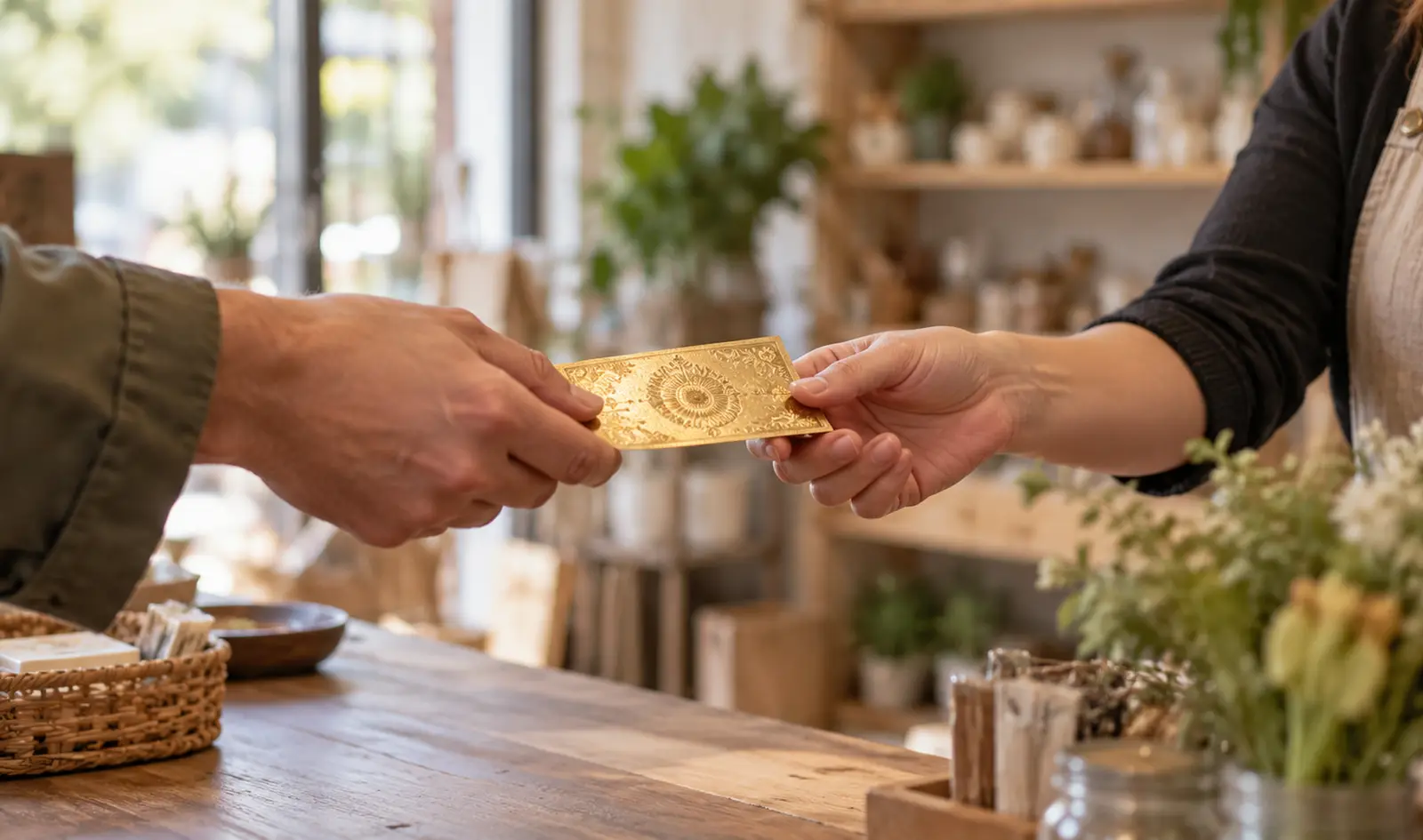
Goldbacks aren't just collectibles — they're designed to be spendable. Thousands of US businesses have chosen to accept them, and the network keeps growing. If you want to use your Goldbacks as real currency rather than just hold them, here's how to find merchants, what to expect at the register, and how to build a practical Goldback-spending routine.
Important, before anything else: Goldback acceptance is voluntary. No US law requires a business to take Goldbacks (even in states that have recognized them), so they are not accepted everywhere. Acceptance is merchant-by-merchant and you should confirm before you rely on it. More on this below.
- Acceptance is voluntary everywhere. No US law requires any business to accept Goldbacks, even in states with their own series.
- Goldback reported 5,491 participating merchants in its H1-2026 update (company-reported, published 23 July 2026). Treat that as a dated snapshot, not a permanent statistic.
- Any Goldback works anywhere two parties agree. A Utah note spends fine in Florida — the state series is artwork, not a restriction.
- Always confirm before you travel. Directory listings go stale; call ahead rather than assuming a listed merchant still participates.
- Merchant counts are company-reported and should always be attributed and dated, never presented as an audited figure.
The Short Answer
You spend Goldbacks the same way you spend cash — hand them to a merchant who accepts them, get change if applicable, walk out with your goods.
The main difference is that not every merchant accepts them, and none are obligated to. You need to know where to find Goldback-accepting businesses, which is what the rest of this guide covers.
Goldback Merchant Network — July 2026 Update
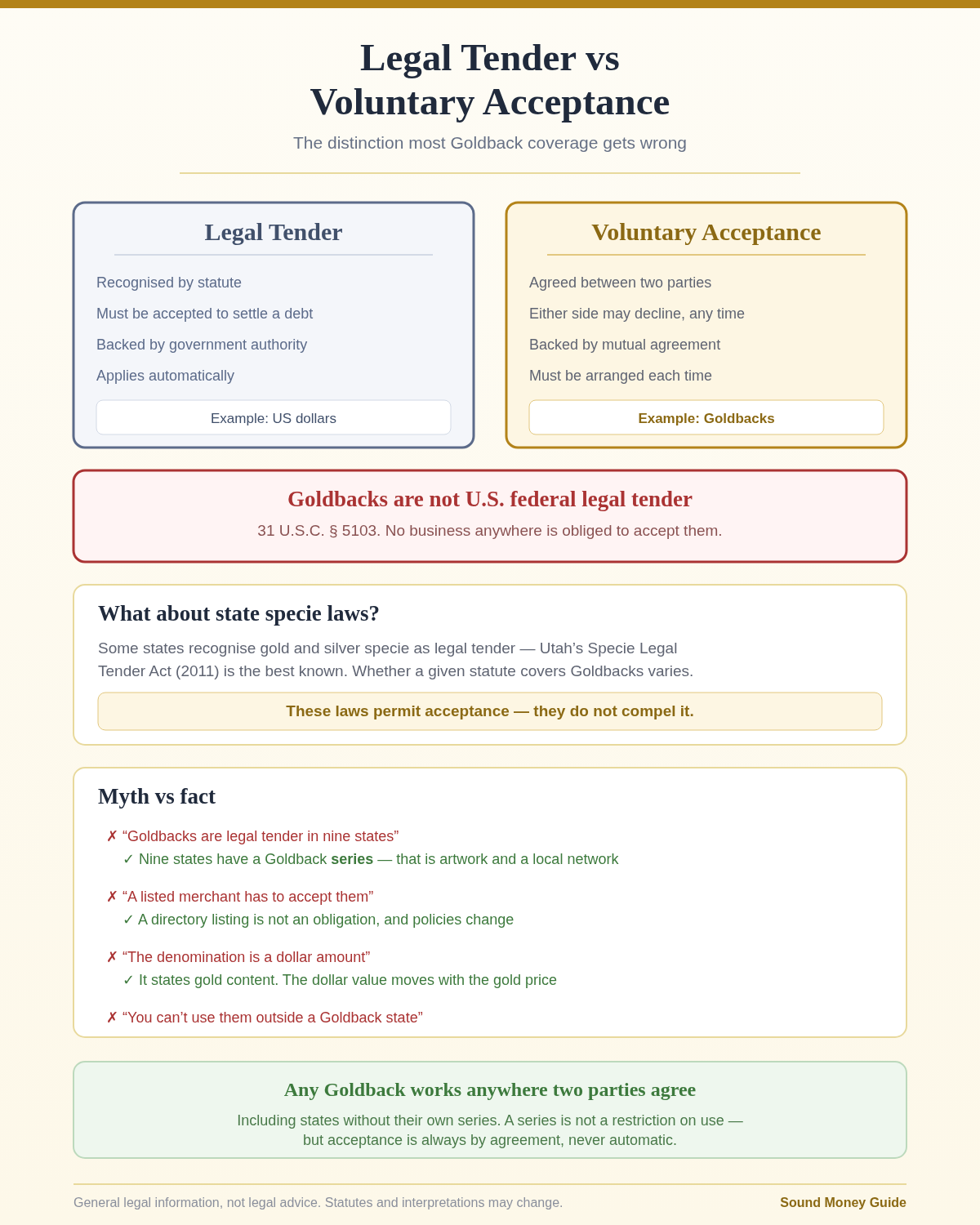
Acceptance is always by agreement — including in states with their own series.
Here's the most recent snapshot of network growth. These are company-reported figures published by Goldback — they reflect businesses Goldback says have joined the network, not an independently audited count of currently-active accepting merchants:
- Week ending July 17, 2026: Goldback reported 84 new businesses joined the merchant network. (Source: Goldback, “84 New Businesses Joined the Merchant Network Last Week” (observed 23 August 2026), dated 2026-07-17.)
- Week of July 10, 2026: Goldback reported 25 new merchants joined the network. (Source: Goldback, “Meet the 25 New Merchants Who Joined the Network Last Week” (observed 23 August 2026), dated 2026-07-10.)
- Half-year total (July 23, 2026): In its "Record Growth in the First Half of 2026" update, Goldback reported 5,491 participating merchants in total, with 1,910 added during the first half of 2026. Its stated top three states were Utah (848), Florida (692) and Oklahoma (333). (Source: Goldback, “Record Growth: First Half of 2026” (observed 23 August 2026), published 2026-07-23.)
- Launch article (August 25, 2026): Goldback reported "over 260" local merchants in California and "over 870" in Utah. (Source: Goldback, “California and Utah Goldbacks Are Out Now! Here's How to Get Them” (observed 26 August 2026), published 2026-08-25.) A later dated snapshot than the July figures above, not a correction to them.
- Goldback has also stated that its 1/4 denomination notes are "accepted as payment at over 5,000 businesses" — again a company-reported figure.
Watch the date on any Goldback figure you see quoted. Goldback keeps older recaps live on its site indefinitely, so a post reporting a much lower total may simply be a year old rather than a correction. A widely circulated "2,500+ merchants" figure, for example, comes from a recap published in August 2025 — roughly a year before the 5,491 figure above. If a merchant number has no publication date attached, treat it as unusable.
How to read these numbers: they show real, ongoing momentum in the network, and they're useful as a directional signal. But "joined the network" is a marketing count reported by Goldback, not a verified tally of merchants who will definitely accept your notes today. Always confirm with a specific business before you plan to pay in Goldbacks. Because these are dated, company-reported figures, they'll go stale — treat them as a July 2026 snapshot, not a permanent statistic.
How to Find Goldback Merchants
Three tools help you locate businesses that accept Goldbacks:
1. The Goldback Merchant Map (Official)
The most comprehensive source. Available at goldback.com/pay-with-goldbacks. Features:
- Interactive map showing merchants by location
- Search by state, city, or specific business
- Merchant categories (food service, retail, professional services, etc.)
- Updated as new merchants join
How to use it: open the map, allow location access or type your city/state, and browse the pins near you. Tap a merchant to see its category and details. Before a first visit, it's worth a quick call to confirm the business still accepts Goldbacks and how they price — map listings can lag real-world changes.
2. The Goldback Mobile App
Available on iOS and Android. Features:
- Location-based merchant discovery
- Real-time updates
- Goldback-to-dollar conversion calculator (using the current exchange rate)
- Merchant contact information
3. Local Goldback Communities
In states with active Goldback ecosystems (Utah, New Hampshire, Wyoming, Nevada), local communities often maintain their own dealer and merchant lists. Search local Goldback groups on:
- Facebook (state-specific groups)
- Reddit (r/Goldbacks and state-specific subreddits)
- Local sound-money meetups
- Free State Project resources (New Hampshire)
Is Goldback Acceptance Mandatory Anywhere? (Voluntary-Acceptance Disclaimer)
No. This is the single most important expectation to set:
- Acceptance is always voluntary. Even in states that have passed legal-tender or specie recognition, no business is required to accept Goldbacks. A merchant chooses to participate.
- They are not legal tender you can force anyone to take. Goldbacks are privately-issued gold notes, not government currency.
- "Accepted at a business" can change. A merchant that accepted them last year may not today, and vice versa.
None of this makes Goldbacks less useful — it just means you plan around voluntary acceptance. Find participating merchants, confirm before you rely on them, and keep a fallback (dollars, or a gold-backed card) for places that don't participate. Anyone telling you Goldbacks are "accepted everywhere" is overselling it.
What Types of Businesses Accept Goldbacks
Goldback merchants span virtually every consumer category. The most common types:
Food and Drink
- Cafes and coffee shops
- Restaurants and diners
- Food trucks
- Bakeries
- Breweries
Retail
- Small retailers and boutiques
- Grocery stores (especially local/independent)
- Craft stores
- Bookstores
- Farmers markets
Personal Services
- Barbers and salons
- Massage therapists
- Personal trainers
- Tutors
Professional Services
- Some accountants and financial advisors
- Some attorneys (especially in Utah)
- Consultants
- Freelance professionals
Automotive
- Auto repair shops
- Detailing services
- Some parts retailers
Health and Wellness
- Chiropractors
- Some dentists (especially in Utah)
- Naturopaths
- Alternative medicine practitioners
Home Services
- Handymen
- Landscapers
- House cleaners
- Some contractors
The density of each category varies by state, but the overall pattern is small businesses, independent operators, and community-focused merchants — not big-box chains.
How Spending Works at the Register
The process depends on the merchant, but here's the typical flow:
Merchants Who Accept Goldbacks Natively
Some merchants price items in Goldbacks or accept them at the current Goldback-to-dollar exchange rate. You hand them notes, they hand you change (either in Goldbacks or in dollars depending on the merchant), transaction complete.
Merchants Who Accept Goldbacks via Dollar Conversion
Most Goldback-accepting merchants operate in dollar-denominated pricing but accept Goldbacks based on the current exchange rate. Process:
1. Check the current exchange rate (via the Goldback app or the Goldback.com calculator) 2. Merchant calculates the required Goldbacks for your purchase amount 3. You hand over the calculated amount in Goldbacks 4. Change is given in dollars, other Goldbacks, or store credit
Example: you buy $50 worth of goods. Suppose the current 5 Goldback exchange value is $25. You give the merchant two 5 Goldbacks (worth $50 total at that rate). Transaction complete. (Rates move daily — always check the live figure.)
Merchants Who Require Exact-Goldback Pricing
Some Utah merchants (especially where Goldbacks have specie recognition) display specific Goldback pricing. Fewer calculations needed — just pay the displayed amount.
Want to understand the exchange rate itself? See Goldback Exchange Rate vs Melt Value: Why the Numbers Are Different for how the spending rate is set and why it differs from raw gold value.
Building a Practical Spending Routine
If you want to actually integrate Goldbacks into daily life, here's a practical approach:
Step 1: Identify 5-10 Regular Merchants near You
Use the Goldback merchant map to find businesses you'd realistically visit — coffee shop, favorite restaurant, small grocery store, barber. Focus on places you already frequent, and confirm each one accepts Goldbacks.
Step 2: Start with Small Denominations
Carry 1 and 5 Goldbacks for everyday transactions. These handle most small purchases (coffee, snacks, small services) without complicated calculations.
Step 3: Learn the Current Exchange Rate
Bookmark the Goldback.com calculator or install the Goldback app. Check the rate periodically — it moves with gold spot price.
Step 4: Talk to Merchants Before You Spend
For unfamiliar merchants, ask upfront if they accept Goldbacks and how they price. Most Goldback merchants are enthusiastic about the concept and happy to explain their process. This also protects you against the voluntary-acceptance reality — you never assume.
Step 5: Keep Receipts
For tax and record-keeping purposes, treat Goldback transactions like any other. Keep receipts, note the exchange rate at time of transaction, retain for records.
Where Goldback Spending Works Best
Not every state offers the same practical spending experience. Here's the reality:
Highest Merchant Density
- Utah — the densest network by a wide margin. You can genuinely go days paying with Goldbacks in parts of Utah.
- New Hampshire — Very active local network, especially in Keene, Manchester, and the Seacoast region (driven by the Free State Project community).
Growing Merchant Networks
- Wyoming — Casper (Alpine Gold's location) and other cities have decent local networks
- Nevada — Modest but growing, especially in Reno
- Idaho — Expanding since the state series launched
- Arizona / Florida / Oklahoma — Growing since their 2025 launches
Voluntary Acceptance Elsewhere
- All other states — Some individual merchants accept Goldbacks, but you'll need to search actively via the merchant map. Not practical for daily use in most non-Goldback states.
Alternative: Spending Gold Without Physical Goldbacks
If you want gold-based spending without carrying physical Goldbacks, the UPMA / TrueLink Visa card is the alternative:
- Hold your gold in a UPMA vaulted account
- Link a TrueLink Visa debit card to the account
- Spend anywhere Visa is accepted
- Gold is converted to dollars at point of sale automatically
This gives you gold-backed spending everywhere Visa works — not just at Goldback merchants. Trade-off: you don't have the tangible experience of using physical Goldbacks, but you get universal spendability without depending on voluntary merchant acceptance.
For more on this option, see our Gold-Backed Debit Card guide.
👉 Join UPMA for Gold-Backed Debit Card Access
Frequently Asked Questions
Can you actually spend Goldbacks?
Yes — at businesses that voluntarily accept them. Goldback reports thousands of businesses in its network and has published weekly additions (for example, 84 new businesses the week ending July 17, 2026 — a company-reported figure). Acceptance is voluntary and varies by location, so confirm with a specific merchant before relying on it.
Are Goldbacks accepted everywhere?
No. Acceptance is voluntary and merchant-by-merchant. No business is legally required to take Goldbacks, even in states that recognize them. Use the merchant map to find participating businesses near you.
Where can I spend Goldbacks?
Use the Goldback, “Pay With Goldbacks” (observed 23 August 2026) or the Goldback mobile app to find accepting businesses in your area. Density varies by state, with Utah and New Hampshire the strongest.
Do I get change when I pay with Goldbacks?
Usually, yes. Change is typically given in dollars or in smaller Goldback denominations depending on the merchant.
What's the exchange rate for Goldbacks?
Rates fluctuate daily with the gold market. Check the Goldback, “Calculator” (observed 23 August 2026) or the app for current values, and see our exchange rate vs melt value guide for how the rate is set.
Can I spend Goldbacks outside the US?
Only at merchants who voluntarily accept them. The Goldback merchant network is primarily US-based. Internationally, you'd typically convert Goldbacks to local currency through a dealer first.
Are Goldback transactions taxable?
Possibly, depending on your jurisdiction and the specifics of the transaction. Consult a tax professional for your situation.
Can I spend any state Goldback anywhere?
Yes. A Utah Goldback works at a New Hampshire merchant, a Florida Goldback works at a Wyoming merchant. State-specific artwork doesn't affect where they're accepted — only whether the merchant participates at all.
Bottom Line
Goldbacks are genuinely spendable at the thousands of businesses that choose to accept them, and Goldback's own weekly figures (like 84 new businesses the week ending July 17, 2026) show the network still expanding. But acceptance is voluntary — Goldbacks are not accepted everywhere and no merchant is required to take them. In Goldback-dense states like Utah and New Hampshire, you can integrate them into daily life; elsewhere, spending is more selective but still workable if you find participating merchants first.
For universal gold-based spending that doesn't depend on merchant participation, the UPMA / TrueLink Visa card provides an alternative — spend gold anywhere Visa works, converted to dollars at point of sale.
👉 Browse Goldbacks at Alpine Gold Exchange
👉 Get a Gold-Backed Visa Card via UPMA
Has the Oklahoma Goldback Series Launched?
Yes. The Oklahoma series launched in August 2025 — preorders opened August 1, with a soft launch at the ANA show mid-August and general availability from August 25, 2025.
You may still encounter older Goldback posts saying the Oklahoma series "has not yet launched." Those were accurate when written — days before the launch — but they remain live on Goldback's site and are easily mistaken for current information. Oklahoma also appears among the nine full-series states on Goldback's current buying guide, which is correct today.
Oklahoma notes are stocked by dealers now, and Goldback reported 333 participating Oklahoma merchants in its July 2026 update (company-reported, point-in-time).
👉 Check Alpine Gold for current Goldback series availability
Inventory, denominations, series and prices may change. Verify current product availability before ordering.
This article is for educational purposes only and does not constitute financial or tax advice. Goldback acceptance is voluntary and varies by merchant and location. Merchant-network figures cited are company-reported by Goldback as of the dates shown and will change over time. Goldback transactions may have tax implications depending on jurisdiction. Consult a qualified tax professional for advice specific to your situation.
Continue Reading