Is the Goldback Lease Available? How to Check Before You Fund an Account

Key finding: Alpine listed the Goldback lease as "Available" on its Leases page when captured on July 30, 2026 — but this is a status field Alpine has changed at least twice in the past twelve months, and a marketing label is not the same as confirmation that your application will be funded.
Key Takeaways
- As of July 30, 2026, Alpine's Leases page showed "Available" for the Goldback lease. That page was last modified June 5, 2026 per Alpine's own sitemap.
- The same page showed "Waitlist Open" in November 2025 and no availability marker at all in August 2025. The status moves.
- Alpine's Rates & Fees page says nothing about availability. It is a pricing table. Its Goldback entry ends at "Open-ended term." Do not read silence there as either confirmation or denial.
- "Available" is a marketing label, not an acceptance. It tells you Alpine is presenting the lease as open. It does not tell you that a specific application will be activated, or how quickly.
- Check it yourself before funding. The method is below and takes about two minutes.
- Early-termination terms remain unresolved on Alpine's own pages. That is a separate and still-open question — see the caution near the end.
The Short Answer
Alpine's Leases page listed the Goldback lease as "Available" on July 30, 2026. If you are reading this some time later, that status may well have changed, and the rest of this guide exists to show you how to check rather than trust a date-stamped snapshot.
Two things make this question harder than it should be.
First, Alpine publishes lease information across two different pages that do not carry the same information. Second, availability is a status field that changes — and Alpine does not date its page updates visibly, so a page can look current when the wording on it is months old.
Why This Question Keeps Coming Up
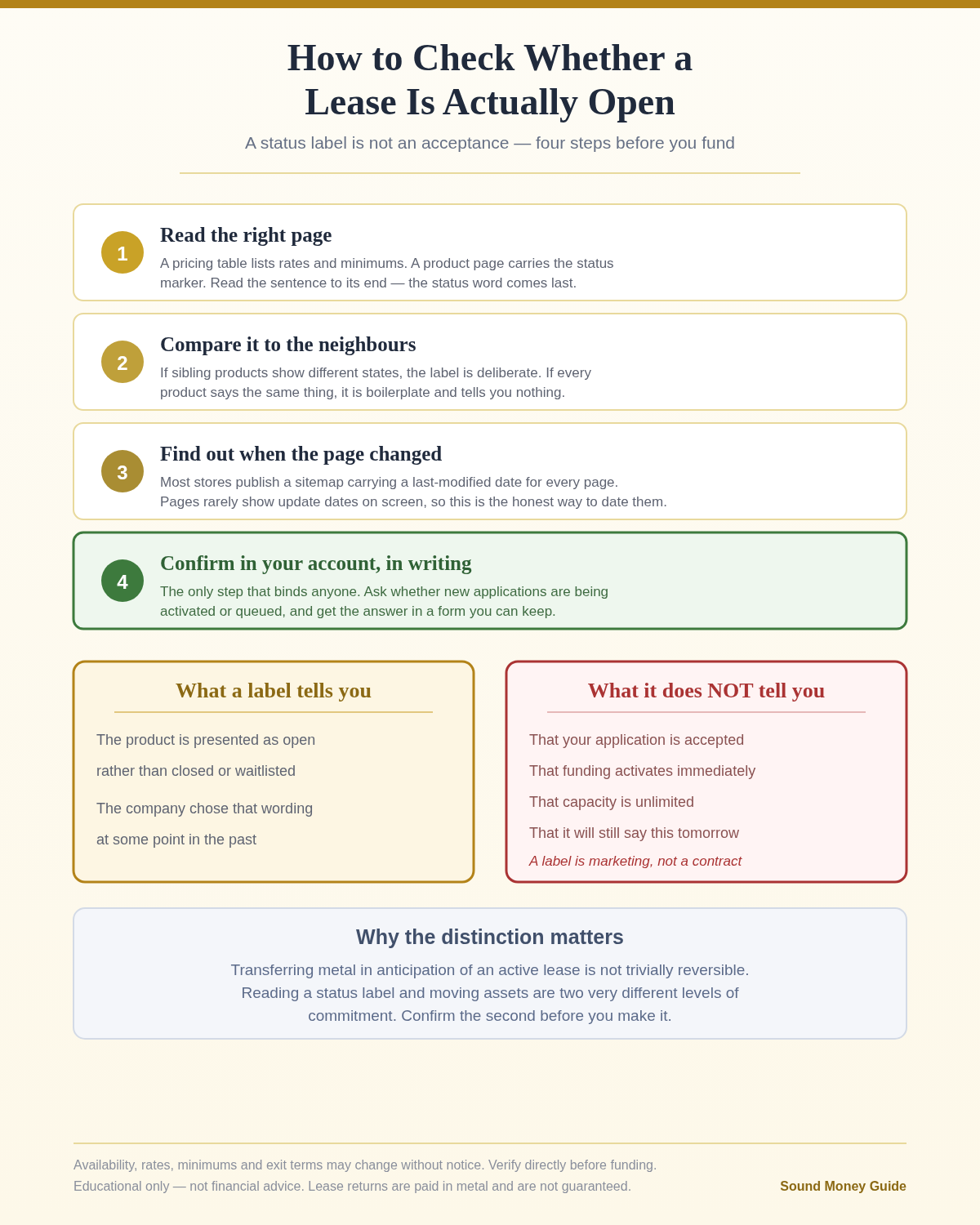
A status label is marketing. Confirmation in writing is the step that binds anyone.
People search for this because the answer genuinely has moved. Here is the documented history of the availability marker on Alpine's Leases page:
| Captured | Availability wording |
|---|---|
| August 7, 2025 | no availability marker at all |
| November 12, 2025 | "Waitlist Open" |
| July 30, 2026 | "Available" |
Sources: Internet Archive snapshots of Alpine's Leases page (August 7 and November 12, 2025) and a direct capture on July 30, 2026.
Three different states in under a year. Anyone who read the page in November 2025 and returned in July 2026 would find a different answer, with nothing on the page to signal that it had changed.
There is a second trap. Because two Alpine pages describe the lease, it is easy to conclude they contradict each other. They do not — only one of them makes an availability claim at all. The Rates & Fees page lists rates, tiers and minimums, and its Goldback entry ends at "Open-ended term." No availability word follows. A pricing table that stays silent on availability is not disagreeing with a page that states it.
How to Check the Current Status Yourself
This takes about two minutes and is more reliable than any published guide, including this one.
1. Read the Leases page, not the pricing page. Alpine's dedicated Leases page is where per-product status markers appear. Look at the Goldback Lease block specifically and read the sentence to its end — the status word comes last, after the term.
2. Notice how Alpine marks the other products. On the same page, the silver bullion lease has read "Capacity is Limited" while other products read "Available." Alpine distinguishes between these states deliberately, which is what makes "Available" meaningful rather than boilerplate. If every product said the same thing, the label would tell you nothing.
3. Check when the page was last touched. Alpine runs on Shopify, which publishes a pages sitemap containing a lastmod date for every page. That is the most reliable dating method available from outside, because Alpine does not display "updated on" dates anywhere in its page content. As of July 30, 2026, the Leases page showed a last modification of June 5, 2026, while Rates & Fees showed October 20, 2025 — a gap of more than seven months between two pages describing the same products.
4. Confirm inside your account, in writing. This is the step that actually matters, and the only one that binds anyone. A website label is a marketing statement. Ask Alpine directly whether the Goldback lease is currently accepting and activating new leases, or whether new applicants are placed in a queue. Ask in a channel that produces a written record.
What "Available" Does and Does Not Mean
This distinction is the entire point of the page, so it is worth being precise.
What it does mean: Alpine is presenting the Goldback lease as open to new participants, rather than closed, waitlisted or capacity-limited. That is a real signal, and it is a change from the "Waitlist Open" state the page carried in November 2025.
What it does not mean:
- That your particular application will be accepted.
- That a lease will be activated immediately upon funding.
- That capacity is unlimited, or that it will not change next week.
- That the terms shown alongside it are complete or current.
The difference matters most in one specific scenario: transferring metal in anticipation of an active lease. A reader who moves gold expecting immediate activation, and instead finds themselves queued, has taken an action that is not trivially reversible. That is the harm this page exists to prevent, and it is why the last step above is confirmation in writing rather than a page reading.
Questions Worth Asking Before You Fund
If you are considering a Goldback lease, these are the questions to put to Alpine directly — the answers are not reliably available from published pages:
1. Is the Goldback lease currently accepting and activating new leases, or are applicants queued? 2. If there is a queue, what is the expected wait, and does it differ by lease size? 3. Does the 10-Goldback minimum apply to all new applicants? 4. What are the exact early-termination terms for a Goldback lease specifically? 5. Does serving 60 days' notice on a Goldback lease incur a fee? 6. Which document controls if the website pages disagree with each other? 7. How long does return of metal take after termination?
One Thing That Is Not Resolved
The early-termination position on a Goldback lease remains genuinely unclear, and this guide does not resolve it.
Alpine's Leases page presents a 60-day notice period as the flexibility feature of Goldback leases. The FAQ on that same page separately states that early termination "typically" incurs a fee of up to five percent of the lease amount — without naming which lease type it governs. UPMA's lease page, meanwhile, states that Goldback leases may be terminated on 60-day notice without a fee.
Nothing on Alpine's page explains how these statements interact: whether serving 60 days' notice is fee-free, whether the five percent applies to Goldback leases at all, or what "early" means relative to the notice period. The FAQ wording is new — it does not appear in archived snapshots of the page from August or November 2025.
Do not assume either position applies to you. Get the termination clause for your specific lease type in writing before funding. This is covered in more detail in our Alpine Gold Leasing Program Review, which reports every published discrepancy without picking a winner.
Frequently Asked Questions
Is the Goldback lease available right now?
Alpine listed it as "Available" on its Leases page as of July 30, 2026. Because this status has changed at least twice in the past twelve months and Alpine does not visibly date its page updates, check the current page and confirm in your account before acting on it.
Was there a Goldback lease waitlist?
Yes. Alpine's Leases page showed "Waitlist Open" for the Goldback lease when captured in November 2025. That wording is no longer on the page. It was a genuine past state, not an error.
Do Alpine's two lease pages contradict each other on availability?
No. Only the Leases page carries availability wording. The Rates & Fees page lists rates, tiers and minimums, and its Goldback entry ends at "Open-ended term" with no availability word. Silence is not contradiction — though it is worth noting that the Rates & Fees page is substantially older, last modified October 20, 2025 against June 5, 2026 for the Leases page.
How can I tell when Alpine last updated a page?
Alpine runs on Shopify, which publishes a pages sitemap containing a lastmod timestamp for each page. Alpine does not display update dates in its page content, so the sitemap is the only reliable external dating method.
Does "Available" mean my application will be accepted?
No. It means Alpine is presenting the lease as open. Acceptance, activation timing and capacity are separate questions that only Alpine can answer for your specific application.
What is the minimum to start a Goldback lease?
Alpine publishes a 10-Goldback minimum, and it applies to the product as a whole rather than varying by tier — the tiers change the rate, not the entry requirement. This figure has been stable across archived snapshots since August 2025. Confirm it currently applies to new applicants before funding.
Bottom Line
The Goldback lease was marked "Available" on Alpine's Leases page as of July 30, 2026, on the more recently maintained of Alpine's two lease pages. That is a genuine change from the "Waitlist Open" state of November 2025.
But availability here is a status field rather than a fixed fact, the page carries no visible update date, and a marketing label is not an acceptance. The reliable answer is the one you get from Alpine in writing, about your own application, on the day you plan to act.
Check the page, check its sitemap date, then confirm in your account before transferring any metal.
Review the current Alpine Gold Account and lease terms
Disclosure: Sound Money Guide may be paid if a reader opens an Alpine Gold Account through this link. This coverage may not be neutral or independent. The publisher must add
rel="nofollow sponsored"when converting this link to HTML.
Related Reading
- Alpine Gold Leasing Program Review — every published lease term and where the sources disagree
- Alpine Gold Account Review — what the account is, who operates it, and how custody works
- Alpine Gold Account vs Bank Account — which protects purchasing power, and what each gives up
Sources and Verification Notes
- Alpine Gold Leases page, captured July 30, 2026 ("Available"; 60-day notice; early-termination FAQ).
- Alpine Gold Rates & Fees page, captured July 30, 2026 (no availability wording for the Goldback lease).
- Alpine Gold Shopify pages sitemap (
lastmoddating): Leases page June 5, 2026; Rates & Fees page October 20, 2025. Captured July 30, 2026. - Internet Archive snapshot of the Alpine Gold Leases page, August 7, 2025 (no availability marker).
- Internet Archive snapshot of the Alpine Gold Leases page, November 12, 2025 ("Waitlist Open").
- UPMA precious-metals lease page (60-day Goldback termination without fee), captured live July 23, 2026.
- Iris verification memo, July 30, 2026.
Disclaimer: Precious metals and leasing arrangements involve risk. Rates, minimums, custody, insurance, fees, exit terms, reference values, and availability may change without notice. This article is educational and does not provide financial, legal, tax, or investment advice. Lease returns are paid in metal, are not guaranteed, and carry counterparty risk. Past performance does not guarantee future results.
Continue Reading