Gold Savings Account USA: How to Save in Gold in 2026 (Complete Guide)
If you've watched your dollar savings quietly lose purchasing power and wondered whether there's a way to hold savings in something that doesn't erode with inflation, one option is an account denominated in physical gold rather than dollars.
A gold savings account has existed in various forms for years. In 2026 it's a practical option for anyone in the US who wants metal-denominated savings without the complexity of a Gold IRA or the friction of buying and storing bullion themselves — provided you understand it is not a bank account, not FDIC-insured, and carries gold-price risk.
This guide breaks down what gold savings accounts are, how they work, what US-based options exist in 2026, and how to actually open one.
- A gold savings account holds metal you own, not a dollar deposit. Its value moves with the gold price, up and down.
- It is not FDIC-insured. Private vault insurance covers physical loss and theft, never market decline.
- Custody structure matters more than headline rates: know who operates the account, who holds the metal, and who is liable at each step.
- Any metal-paid yield is contractual and not guaranteed, and carries counterparty risk.
- These accounts suit long-horizon purchasing-power preservation, not day-to-day transacting or emergency reserves.
What Is a Gold Savings Account?
A gold savings account is a savings-style account where your balance is held in physical gold rather than US dollars.
Simple example (using round numbers — enter today's live gold price yourself when you calculate):
- You deposit $10,000
- At a gold price you look up, that converts to a number of troy ounces
- Your account balance now shows ounces of gold, not dollars
- If gold rises, your account is worth more in current dollars; if gold falls, it's worth less
- The idea is that over long periods gold has tended to hold purchasing power better than cash — though gold is volatile and there is no guarantee
The gold itself is real, physical, and typically vaulted in an insured depository. You're not buying a gold ETF or "paper gold." You own metal held for your benefit.
Why Save in Gold Instead of Dollars?
Three practical reasons — each with an honest caveat:
1. Inflation Protection (Not Guaranteed)
Since 1971, when the US dollar left the gold standard, the dollar has lost a large share of its purchasing power, and gold's dollar price is far higher today than it was then. That's a real long-run pattern. But the exact figures depend heavily on start and end dates, and gold has had long flat or falling stretches (much of the 1980s and 1990s, for example). Gold is a reasonable long-term inflation hedge, not a promise.
2. Currency Debasement
The US money supply has expanded enormously since 1971, and new dollars tend to reduce the value of existing ones over time. Gold's supply grows only slowly through mining. That's the structural argument for holding some savings in metal — with the understanding that gold's price still swings.
3. Bank System Considerations
FDIC insurance covers bank deposits up to $250,000 per depositor per bank — a real protection, but the deposits are dollar-denominated and lose purchasing power to inflation while they sit. A gold savings account sits outside the bank system: no FDIC coverage, but also not tied to the dollar. Different risk profile, not strictly better or worse.
Save in Gold vs Cash Calculator
Compare a cash-savings scenario with a gold-based one over time, using your own assumptions. This is a "what if" tool, not a forecast — you enter inflation, cash rate, and gold-growth assumptions, and it does the math on your inputs. Gold can fall as well as rise; enter conservative or negative figures to stress-test.
Open the Save in Gold vs Cash Calculator →
Gold Savings Account Options in the USA
There aren't many providers of true physical-gold savings accounts in the US. Many "gold-backed" account products are actually ETFs, futures, or pooled paper-gold products — not real physical gold you own.
The genuine categories in 2026:
Alpine Gold Account (Formerly Commonly Called a UPMA Account) — a Leading US Option
An established US-based gold-account option. The account is operated and serviced by Alpine Gold (a precious-metals dealer, not a bank); metals are held in a vault Alpine says is insured through Lloyds of London against physical loss and audited quarterly, though Alpine does not publish who operates that vault (captured 24 September 2026). UPMA is the membership cooperative behind it. Full breakdown in the next section, and in our Alpine Gold Account Review.
Allocated Digital-Gold / Vaulting Platforms
Platforms such as OneGold and Vaulted hold allocated, segregated physical metal in professional vaults, with recurring-purchase features and physical redemption. Fee structures and custody differ by provider — confirm current terms directly.
Bank-Issued "Gold Accounts"
A few banks market accounts as gold savings, but many are unallocated (pooled) gold or gold-index products — not individually allocated metal you own. Read the fine print.
Gold ETFs and Mutual Funds
Not real gold savings accounts. You hold shares that track gold's price, not physical gold you own — different tax treatment, different risk, no physical withdrawal.
For Americans wanting a genuine physical-gold account with a debit card and integrated services, the Alpine Gold Account is a common starting point — evaluated honestly against the alternatives.
Alpine Gold Account: Full Review
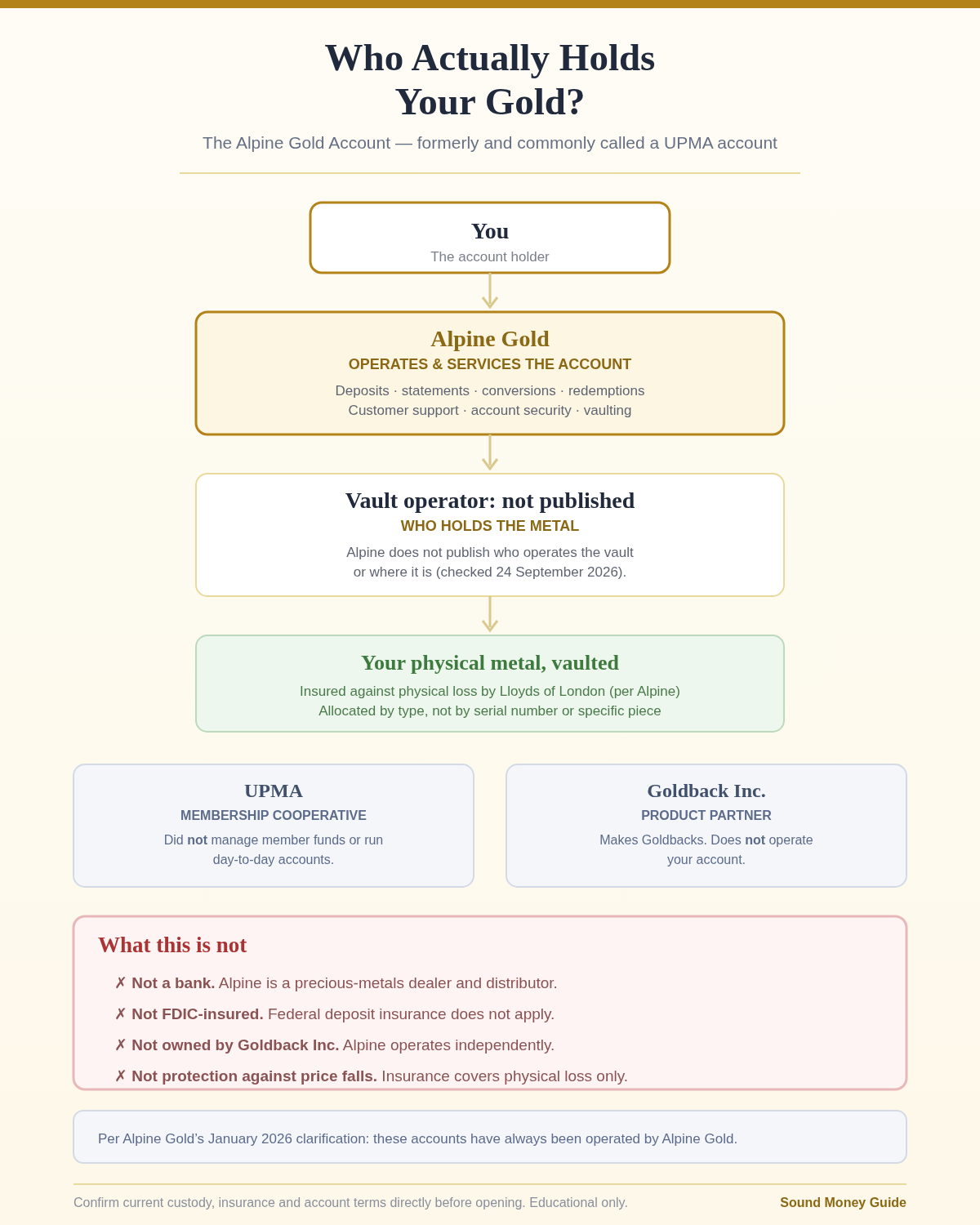
Who does what. Alpine operates and services the account; UPMA is the membership cooperative. Alpine does not publish who operates the vault.
Since it's the most integrated option, here's the breakdown. (It's the account formerly commonly called a "UPMA account.")
How the Account Works
- Open an account through Alpine Gold, under the UPMA cooperative membership
- Fund it with dollars (converted to metal at the daily rate) or physical metals
- Balance held in physical gold, silver, or Goldbacks, vaulted by an operator Alpine does not name
- Optional features include a linked debit card, a gold leasing program, and Goldback integration
What's Genuinely Good
- Physical metal, allocated by type rather than by serial number or specific piece (per Alpine, captured 24 September 2026) — not a share, not a pool of paper
- 0% spread on liquidations by applying Deposit Rewards points, up to 2,500 points weekly, subject to daily capacity; beyond that, standard market spreads apply (captured 4 September 2026) (versus the spreads typical at bullion dealers)
- Insured custody — Lloyd's of London insurance against physical loss (confirm current insurer/vault directly)
- Optional yield through the leasing program — a metal-paid return, not guaranteed, with counterparty risk
- Withdraw physical metal with notice — no long lockup
- Debit-card access to spend against your holdings (metal is liquidated at the point of sale; card provided by a third party under its own terms)
- Goldback compatible — hold Goldbacks alongside standard bullion
What to Understand Honestly
- Not a bank; not FDIC-insured. Alpine is a precious-metals dealer. Physical loss is covered by private insurance; gold-price declines are not "insured against."
- Fees apply — membership dues plus vaulting fees. Modest for meaningful holdings, more noticeable on very small accounts.
- You cannot see who holds the metal — the account is operated by Alpine under the UPMA cooperative, but Alpine does not publish who operates the vault or holds the metal (checked across all 38 English pages of alpinegold.com, and on upma.org, on 24 September 2026). Confirm the vault operator, allocation/segregation details and insolvency treatment in the current agreement before depositing.
- Multi-year mindset — this is long-term savings infrastructure, not a checking-account replacement.
The Value Case for Accumulators
For someone accumulating gold over years, applying Deposit Rewards points can offset dealer spreads you'd otherwise pay on every buy and sell, and the vaulting cost is a modest annual percentage. Alpine Gold members can sell back vaulted Gold Dollars, Goldbacks and Silver Dollars at 0% spread by applying points from a Deposit Rewards balance, which builds on qualifying fiat and metal deposits made into the spending account. The metals must have been purchased and vaulted with Alpine Gold Exchange in an online precious metals account. Applying rewards is optional, and up to 2,500 points may be applied each week across all Deposit Reward Offers. Zero-spread liquidations are also subject to daily capacity, and Alpine states that large liquidations are available at market rate on a call-for-a-quote basis. Liquidations beyond the rewards a member applies are processed at standard market spreads. Terms captured from Alpine Gold's Rates & Fees page on 4 September 2026. On 22 September 2026 Alpine separately established a daily “appetite” for member sell-backs and changed the individual allowance from $10,000 per month to $2,500 per week, which Alpine says “maintains approximately the same potential monthly allowance”. Alpine states that where secondary-market demand is limited it “must temporarily restrict the amount we purchase each day”, and it has not published the daily figure. The announcement names only “certain metals” and does not say whether Goldbacks are among them. As at 23 September 2026 this appears only in Alpine’s CEO blog post; the Rates & Fees page still says large liquidations at market rate are available on a call-for-a-quote basis, and we do not know how Alpine reconciles the two (captured 23 September 2026). Whether it "wins" depends on your size and holding period — model it against simply buying and storing bullion, and confirm the current fee schedule. Alpine's Rates & Fees page states that a Rewards Balance builds on qualifying fiat and metal deposits made into the spending account and grows 1:1, that applying rewards is optional, and that unused rewards carry forward without expiring. Up to 2,500 points may be applied each week across all Deposit Reward Offers. Alpine stated on 22 September 2026 that points attach to your original US dollar deposit amount, but does not publish what a point is worth or how it converts to a dollar of spread relief, so the value of a week's ceiling cannot be worked out from what is published. Alpine also publishes no standard market spread figure, so the saving from applying rewards cannot be computed. Alpine separately lists reduced deposit fees, lease return discounts and discounted vaulting fees as coming soon; Alpine states these are coming soon and they are not available (captured 4 September 2026).
How to Open a Gold Savings Account
The Alpine Gold Account signup is straightforward:
Step 1: Open the Account
Visit the account portal (link below) and complete the application. Standard identity verification applies.
Step 2: Fund the Account
Options:
- Wire dollars — converted to metal at the daily rate
- Deposit physical metals — insured mail-in shipping to the vault
- Rollover from another precious-metals holding
Step 3: Choose Your Holdings
- Gold, silver, Goldbacks, or a mix
- Set beneficiaries and access preferences
Step 4: Set up Optional Features
- Debit card for spending
- Leasing program participation for a metal-paid return (not guaranteed)
- Recurring purchases to dollar-cost-average
Setup typically completes within a few business days. Confirm current steps and terms directly with Alpine.
👉 Review the Current Alpine Gold Account Terms
👉 Browse Currently Available Goldbacks
Gold Savings Account vs Gold IRA
These solve different problems:
| Feature | Alpine Gold Account | Gold IRA |
|---|---|---|
| Purpose | Flexible savings in metal | Tax-advantaged retirement gold |
| Tax treatment | Ordinary (capital gains on sale) | Tax-deferred or tax-free (Roth) |
| Withdrawal access | With notice, no age penalty | Restricted until retirement age |
| Contribution limits | None | Annual IRS limits |
| Goldback compatibility | Yes | Usually no (ambiguous eligibility) |
| Spending access | Debit card, physical withdrawal | Not accessible without triggering distribution |
| Best for | Flexible savings, inflation hedge | Long-term retirement gold |
Common approach: hold both. A Gold IRA for tax-advantaged retirement gold, an Alpine Gold Account for flexible near-term gold savings. They complement rather than compete.
Frequently Asked Questions
What is a gold savings account?
An account where your balance is held in physical gold rather than dollars. Deposits convert to metal at the daily rate; you can convert back to dollars or take physical metal with notice.
Are gold savings accounts FDIC-insured?
No. FDIC insurance applies to dollar deposits at insured banks. A gold savings account holds metal, covered by private insurance (Lloyd's of London for the Alpine Gold Account) against physical loss — not against gold-price declines.
What's the best gold savings account in the USA?
There's no single "best." The Alpine Gold Account is the most integrated US option (physical metal, 0% spread on liquidations where Deposit Rewards points are applied — up to 2,500 points weekly, subject to daily capacity — optional leasing, debit card). Allocated platforms like OneGold and Vaulted are alternatives. Compare current fees and custody before deciding.
Can I withdraw physical gold from a gold savings account?
Yes, with the Alpine Gold Account and other true physical-gold accounts — request physical delivery with notice. This differs from ETFs or paper gold, which don't offer physical delivery.
Is a gold savings account better than a gold ETF?
Depends on your goal. ETFs are more liquid and easier to trade. A gold savings account offers actual physical ownership and, in Alpine's case, 0% spread on liquidations where Deposit Rewards points are applied, up to 2,500 points weekly and subject to daily capacity (captured 4 September 2026). For long-term savings, physical ownership is often preferred; for trading, an ETF is simpler.
Do I pay tax on my gold savings account?
You generally pay capital-gains tax when you sell metal at a profit, not while it sits in the account. In the US, physical gold is often taxed as a "collectible" at up to a 28% federal rate, plus state taxes. Consult a tax professional.
Can I get a debit card linked to a gold savings account?
Yes — the Alpine Gold Account offers a linked debit card. Metal is liquidated to dollars at the point of sale. The card is provided by a third party under its own terms and fees.
How much do I need to open one?
Minimums vary and the economics work better with meaningful balances (the zero-spread benefit depends on applying Deposit Rewards points, which build on qualifying deposits, up to 2,500 points weekly and subject to daily capacity). Confirm current minimums directly with Alpine.
Bottom Line
A gold savings account addresses a real want: holding savings in metal rather than dollars, without the complexity of a Gold IRA or the friction of self-storing bullion. It is not a bank account, not FDIC-insured, and carries gold-price risk — so size it to your comfort and treat it as long-term savings. Treat the exit as part of that sizing: Alpine’s 22 September 2026 announcement establishes a daily buy-back appetite, unpublished in size, and an individual allowance of $2,500 per week (captured 23 September 2026).
For Americans in 2026, the Alpine Gold Account is one of the most complete options: physical metal in a vault Alpine says is insured through Lloyds of London against physical loss and audited quarterly (though Alpine does not publish who operates it), 0% spread on liquidations where Deposit Rewards points are applied — up to 2,500 points weekly, subject to daily capacity (captured 4 September 2026) — optional metal-paid leasing, debit-card access, and Goldback compatibility. Compare it honestly against allocated platforms and simple bullion ownership, and confirm current terms before committing.
If you're already thinking about holding some savings outside dollars, reviewing the account details is a sensible next step.
👉 Review the Current Alpine Gold Account Terms
👉 Browse Currently Available Goldbacks
This article is for educational purposes only and does not constitute financial or tax advice. The Alpine Gold Account is not a bank account and is not FDIC-insured. Precious metals prices fluctuate. Past performance does not guarantee future results. Always confirm current fees, terms, custody, and insurance directly with Alpine Gold, and consult a qualified professional before making significant changes to how you hold savings.
Continue Reading