Alpine Gold Account Review 2026: Formerly Known as a UPMA Account

If you've held what you've always called a "UPMA account," the name is changing to Alpine Gold Account. This review explains what the account actually is, who operates it, what it costs, how the "0% spread" benefit really works under Alpine's current Deposit Rewards framework, and whether it's worth opening — updated for Alpine Gold's 2026 clarification about who runs the account. It's educational, not financial advice.
- The account formerly called a "UPMA account" is now the Alpine Gold Account. Per Alpine, it has always been operated and serviced by Alpine Gold; the change is branding, with the same structure and functionality.
- UPMA did not manage member funds or run day-to-day accounts. UPMA is the membership cooperative, now focused on accreditation and sound-money advocacy.
- Physical metals are held in a vault Alpine says is insured through Lloyds of London and audited quarterly — not by a bank. Alpine does not publish who operates the vault or holds the metal (checked across all 38 English pages of alpinegold.com, and on upma.org, on 24 September 2026).
- Alpine Gold is a precious-metals dealer and distributor, not a financial institution, is not FDIC-insured, and is not owned by Goldback Inc.
- The signature benefit is a 0% spread on liquidations, available by applying points from a Deposit Rewards balance. Up to 2,500 points may be applied each week across all Deposit Reward Offers, applying rewards is optional, and zero-spread liquidations are subject to daily capacity. Liquidations beyond the rewards a member applies are processed at standard market spreads (captured 4 September 2026).
- Separately, Alpine can limit how much it buys back on a given day. On 22 September 2026 Alpine established a daily “appetite” for member sell-backs and changed the individual allowance from $10,000 per month to $2,500 per week, which Alpine says maintains approximately the same potential monthly allowance. Alpine names only “certain metals” and does not say whether Goldbacks are among them (captured 23 September 2026).
Is It Still a UPMA Account—or an Alpine Gold Account?
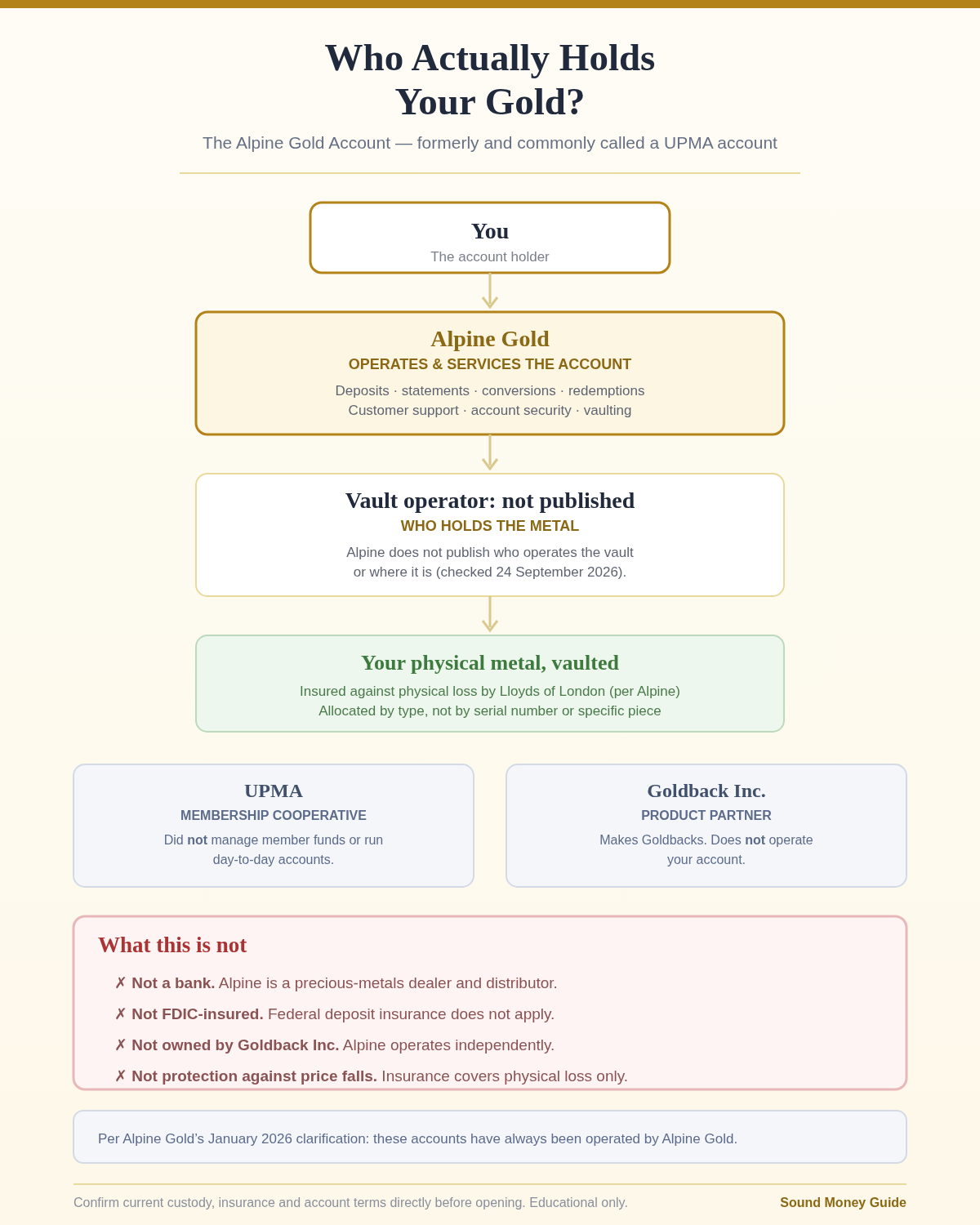
Who does what. Alpine operates and services the account; UPMA is the membership cooperative. Alpine does not publish who operates the vault.
For years, many members called their account a "UPMA account" because Alpine Gold's collaboration with the United Precious Metals Association (UPMA) made that label familiar. In a January 2026 clarification, Alpine Gold stated plainly that the account has always been managed, operated, and serviced by Alpine Gold, and that going forward it will be called an Alpine Gold Account. Per Alpine, the change is one of branding and terminology — the structure, security, ownership, and functionality of the account remain the same.
Here's who does what:
- Alpine Gold — operates and services your account: deposits, statements, conversions, redemptions, customer support, account security, and vaulting of the physical metals. Alpine is an independent precious-metals dealer — not a bank, and not owned by Goldback Inc.
- The vault operator — not published. Alpine states the metals are kept in a physical vault, insured through Lloyds of London and audited quarterly, and that vaulting is allocated by type rather than by serial number or specific piece (captured 24 September 2026). It does not name who operates that vault or say where it is.
- UPMA (United Precious Metals Association) — the membership cooperative. Per Alpine, UPMA did not handle member funds or oversee account management; its role centered on credibility within the precious-metals ecosystem. UPMA's focus is now shifting toward accreditation and sound-money advocacy.
- Goldback Inc. — a product partner (makes Goldbacks). Does not operate your account.
So the account is not "UPMA's" and it is not "Alpine alone" — it's operated and serviced by Alpine Gold, under a UPMA cooperative membership, with the metals in a vault whose operator Alpine does not name. That distinction matters for a "who holds my gold" question, and it's why the sections below use the "Alpine Gold Account" name with "formerly/commonly known as a UPMA account" as the legacy term.
What the Alpine Gold Account Is
Lease availability — verify before funding. Alpine listed the Goldback lease as "Available" on its Leases page as of July 30, 2026. That status field has changed at least twice in twelve months, and "Available" on a marketing page is not confirmation that a specific application will be funded. Confirm the current status in your account before transferring any metal.
The Alpine Gold Account (formerly commonly called a UPMA account) is a precious-metals account denominated in physical gold, silver, and Goldbacks — operated and serviced by Alpine Gold, with a UPMA cooperative membership layer. Alpine does not publish who operates the vault holding the metals.
Its roots trace to Utah's 2011 Specie Legal Tender Act, and the stated purpose is to give Americans a practical way to hold savings in gold and silver rather than in dollars whose purchasing power erodes over time.
Key facts:
- Account operator/servicer: Alpine Gold Exchange
- Vault operator: Not published by Alpine
- Membership cooperative: UPMA (accreditation/advocacy focus)
- Holdings: Physical gold, silver, and Goldbacks
- Legal basis: Utah Specie Legal Tender Act
- Not: a bank, a broker, a registered financial advisor, or FDIC-insured
That last line is the most important distinction — see the risk section below.
Alpine Gold Account Benefits
Here's what you actually get:
1. Holdings Denominated in Physical Metal
Your balance is held in real gold and silver, not dollars. If gold prices rise, your account value rises with them; fiat inflation doesn't erode the metal you hold. (Metal prices can also fall — this is a precious-metals holding, not a guaranteed return.)
2. Zero Spread on Liquidations Through Deposit Rewards
This is the signature benefit. At traditional bullion dealers, you typically pay a premium when buying and lose more when selling. Alpine Gold members can sell back vaulted Gold Dollars, Goldbacks and Silver Dollars at 0% spread by applying points from a Deposit Rewards balance, which builds on qualifying fiat and metal deposits made into the spending account. The metals must have been purchased and vaulted with Alpine Gold Exchange in an online precious metals account. Applying rewards is optional, and up to 2,500 points may be applied each week across all Deposit Reward Offers. Zero-spread liquidations are also subject to daily capacity, and Alpine states that large liquidations are available at market rate on a call-for-a-quote basis. Liquidations beyond the rewards a member applies are processed at standard market spreads. Terms captured from Alpine Gold's Rates & Fees page on 4 September 2026. On 22 September 2026 Alpine separately established a daily “appetite” for member sell-backs and changed the individual allowance from $10,000 per month to $2,500 per week, which Alpine says “maintains approximately the same potential monthly allowance”. Alpine states that where secondary-market demand is limited it “must temporarily restrict the amount we purchase each day”, and it has not published the daily figure. The announcement names only “certain metals” and does not say whether Goldbacks are among them. As at 23 September 2026 this appears only in Alpine’s CEO blog post; the Rates & Fees page still says large liquidations at market rate are available on a call-for-a-quote basis, and we do not know how Alpine reconciles the two (captured 23 September 2026).
This is a rewards-based benefit a member has to build and then choose to apply, not a promise that every transaction or outside metal receives a zero spread. Alpine states the Rewards Balance grows 1:1, but does not publish what a point is worth or how a point converts to a dollar of spread relief. On 22 September 2026 Alpine stated that points attach to your original US dollar deposit amount, which answers what the balance grows 1:1 with; what a point is then worth is still unpublished. Alpine also publishes no standard market spread figure, so the saving cannot be worked out from published terms. Confirm metal eligibility, custody, your rewards balance, and current terms before relying on it. Our Alpine Gold Deposit Rewards guide walks through the mechanics in full and lists what Alpine has not published.
3. Insured Vaulting
Physical metals are vaulted, with insurance against physical loss, theft, and damage provided by Lloyd's of London (confirmed on Alpine and UPMA pages, captured July 23, 2026). Alpine does not name the operator of its vault, and does not publish the vault's location (checked across all 38 English pages of alpinegold.com, and on upma.org, on 24 September 2026). This is custody insurance for the metal — it is not FDIC deposit insurance, and it does not cover market price movements. Confirm current vault and insurance providers and coverage terms directly before relying on them.
4. Goldback Support
The account can hold Goldbacks alongside standard bullion — one of the few places to integrate Goldbacks into a formal precious-metals account structure.
5. Card Access
Members can link a debit card that liquidates metal at the point of sale and pays in dollars, letting you spend against your holdings anywhere the card network is accepted. Card services are provided by a third party under their own terms and fees — verify current card pricing separately.
6. Gold Leasing Eligibility
Account holders can participate in Alpine Gold's leasing program, earning a return paid in metal on stored gold or Goldbacks. Alpine's current pages advertise lease payouts of up to 5% APR, tiered by the combined dollar value of all metals on lease (captured 20 August 2026 — see our Alpine Gold Leases Review for the full published terms). Lease returns are not guaranteed and carry counterparty risk.
7. Referral Credits
Members can earn a share of membership dues from people they refer (historically capped per year). Not a major commission play, but it can offset your own dues.
Alpine Gold Account Fees
The account operates on a cooperative membership model, but that doesn't mean it's free.
Membership Dues
Annual dues, typically denominated in silver rather than dollars. Amounts vary — confirm current dues directly with Alpine Gold. Historically modest.
Vaulting and Storage Fees
Insured vaulting costs money and is typically passed through as a percentage of holdings annually. For large holdings this is roughly comparable to (or better than) other insured vaulting providers.
Transaction Fees
The 0% spread applies to eligible vaulted metal only where Deposit Rewards points are applied, within the weekly 2,500-point ceiling and subject to daily capacity; liquidations beyond the rewards applied are processed at standard market spreads. Physical delivery, wire transfers, and certain exchanges may carry separate fees. Ask Alpine directly for the fee schedule that applies to what you plan to do.
Card Fees
Card services are separate and charged by the third-party card provider. Verify current pricing before assuming card costs.
Bottom line on fees: the account isn't fee-free. Whether applying Deposit Rewards points offsets annual vaulting and membership costs cannot be worked out from Alpine's published terms, because Alpine publishes neither a standard market spread figure nor what a rewards point is worth. Price it against your own deposit and liquidation pattern.
Insurance and Custody — Read This Carefully
Insurance details matter for anyone putting real money into an account like this.
What's Covered
Physical loss, theft, and damage to the vaulted metals are covered by Lloyd's of London insurance (confirmed on Alpine and UPMA pages, captured July 23, 2026). Alpine does not name the operator of its vault, and does not publish the vault's location (checked across all 38 English pages of alpinegold.com, and on upma.org, on 24 September 2026). Confirm the current insurer, coverage limits, and vault operator before relying on specifics.
What's Not Covered
- Not FDIC-insured — this is not a bank; federal deposit insurance does not apply.
- Market movements are not "loss" — insurance covers physical loss, not gold price declines.
- Counterparty risk on leased metal — if you enroll in leasing, you're exposed to the borrower's counterparty risk (see our Alpine Gold Leases Review).
The insurance model here is fundamentally different from a bank. Understand that going in.
Alpine Gold Account vs Bank Account Calculator
Enter your own numbers below to compare a gold-denominated Alpine Gold Account with a traditional bank savings account over time. This is a "what if" tool, not a prediction — you supply the assumptions (bank rate, inflation, gold appreciation, leasing yield), and it does the math on your inputs. Gold appreciation and leasing returns are not guaranteed; enter conservative figures if you're unsure.
Open the Gold Account vs Bank Calculator →
How the Alpine Gold Account Differs From a Bank
| Feature | Traditional Bank | Alpine Gold Account |
|---|---|---|
| Account denomination | US dollars | Physical gold/silver/Goldbacks |
| Inflation erosion | Yes, consistently | You hold real metal (metal price can still fall) |
| Insurance | FDIC ($250K limit) | Private insurance (physical loss); NOT FDIC |
| Yield | Dollar interest | Optional leasing paid in metal (not guaranteed) |
| Buy/sell metals | Not typically offered | 0% spread when Deposit Rewards points are applied — limits apply |
| Custody | Bank's balance sheet | Vault operator not published by Alpine |
| Operator | Chartered bank | Alpine Gold (dealer, not a bank) |
| Withdraw physical metal | No | Yes |
| Card | Yes (dollar) | Yes (metal liquidated at point of sale) |
The core trade-off: the Alpine Gold Account gives you metal-denominated holdings, insured custody, and low spreads on eligible metal. You give up FDIC insurance, frictionless bank-style transactions, and a bank's regulatory backstop. For long-term savings that trade often makes sense; for daily checking it usually doesn't. Many members hold both — a bank for transactions, an Alpine Gold Account for metal savings.
Spending Account vs Savings Account
Alpine's services separate two account structures. A transactional currency account is not the same product as a longer-term bullion savings account.
| Feature | Spending Account | Savings Account |
|---|---|---|
| Primary purpose | Day-to-day transactions using account currency | Longer-term gold and silver accumulation |
| Typical actions | Buy, sell, spend, transfer, redeem, borrow, pay merchants, peer transfers, fund a card, liquidate | Buy, hold, sell, or redeem bullion under the applicable terms |
| Transactional? | Yes | No; Alpine describes it as non-transactional |
| Metal form | Account currency balance | Gold or silver bullion purchased through and vaulted with Alpine |
| Main trade-off | Convenience depends on current account, card, spread, and provider terms | Metal prices, spreads, custody, redemption, and liquidity still apply |
When Does the 0% Spread Apply?
It applies when a member chooses to apply points from a Deposit Rewards balance to a liquidation of Gold Dollars, Goldbacks or Silver Dollars purchased and vaulted with Alpine Gold Exchange in an online precious metals account. Up to 2,500 points may be applied each week across all Deposit Reward Offers, and zero-spread liquidations are also subject to daily capacity. Liquidations beyond the rewards a member applies are processed at standard market spreads. Applying rewards is optional, so this is not a promise that every transaction or outside metal receives a zero spread. Confirm eligibility, custody, your rewards balance and current terms first (captured 4 September 2026).
Who Should Open an Alpine Gold Account?
It makes most sense if you:
- Want to hold savings in physical gold/silver without paying large dealer spreads
- Have a multi-year time horizon (this isn't short-term trading)
- Value inflation-resistant metal holdings over FDIC insurance
- Deposit regularly enough to build a Deposit Rewards balance, and will actually apply it when liquidating
- Can work within a weekly sell-back allowance of $2,500 rather than needing a large exit on a single day, and accept that Alpine’s daily buy-back appetite is unpublished (captured 23 September 2026)
- Understand you're joining a cooperative-membership account operated by a dealer, not a bank
- Want optional metal-paid leasing or Goldback integration
It makes less sense if you:
- Only need a savings account (a high-yield savings account is simpler)
- Have small holdings (annual fees may outweigh what applying rewards is worth on tiny amounts)
- Need FDIC insurance to sleep at night (this account can't offer that)
- Are new to precious metals and haven't set a base position yet
- Prefer full self-custody at home
How to Open an Account
1. Visit the Alpine Gold Account portal (link below) 2. Complete the application 3. Fund your account — dollars, physical metals, or a rollover from another metals holding 4. Choose your holdings — gold, silver, Goldbacks, or a combination 5. Set up optional features — card access, leasing participation, etc.
Setup typically completes within a few business days once funding clears. Confirm current steps and terms directly with Alpine.
👉 Review the Current Alpine Gold Account Terms
👉 Browse Currently Available Goldbacks
Frequently Asked Questions
Is my UPMA account now an Alpine Gold Account?
Yes — same account, updated name. Alpine states these accounts have always been operated and serviced by Alpine Gold, and "Alpine Gold Account" is the current official terminology. "UPMA account" remains a valid way to describe it historically.
Who actually operates the account, and who holds my metal?
Alpine Gold operates and services the account. The physical metals are held in a vault Alpine says is insured through Lloyds of London and audited quarterly. It's not held by a bank. Alpine does not publish who operates the vault or holds the metal (checked across all 38 English pages of alpinegold.com, and on upma.org, on 24 September 2026). UPMA is the membership cooperative and does not manage funds.
Is the Alpine Gold Account a bank account?
No. Alpine is a precious-metals dealer and distributor, not a financial institution. The account holds metal you own; it is not a bank deposit and is not FDIC-insured.
Is Alpine Gold owned by Goldback?
No. Alpine states it is not owned by Goldback Inc. Goldback is a product partner; Alpine operates independently.
Is my gold insured?
Physical loss, theft, and damage to vaulted metals are covered by Lloyd's of London insurance (per Alpine and UPMA pages, captured July 23, 2026), Alpine does not publish who operates the vault holding the metals. This is not FDIC insurance, and it does not cover market price movements. Confirm current insurer and coverage terms directly.
What does the account cost?
Membership dues (often denominated in silver) plus vaulting fees that scale with holdings, and possible transaction/delivery/card fees. Confirm current fee schedules with Alpine before opening.
Can I withdraw physical metal?
Yes. Members can request physical delivery of vaulted metals; withdrawal fees may apply.
Can I earn a yield?
Optionally, through the leasing program, paid in metal. Alpine advertises lease payouts up to 5% APR, tiered by combined leased value (captured 20 August 2026); returns are not guaranteed and carry counterparty risk. See our Alpine Gold Leasing Review.
Bottom Line
The account formerly called a "UPMA account" is now the Alpine Gold Account — and per Alpine, it always was operated and serviced by Alpine Gold. UPMA is the membership cooperative (now focused on accreditation and advocacy), Alpine does not publish who operates the vault that holds the metals, and Alpine is an independent dealer, not a bank, not owned by Goldback Inc.
As a place to hold long-term precious-metals savings — with a 0% spread on liquidations where Deposit Rewards points are applied, insured custody, and optional metal-paid leasing — it's a strong option for the right holder. Weigh that against the exit: Alpine’s 22 September 2026 announcement establishes a daily buy-back appetite it does not publish, and an individual allowance of $2,500 per week, so this suits a holder accumulating over years rather than one who may need a large withdrawal on a particular day. The trade-offs are real: no FDIC insurance, membership complexity, and it's not a bank replacement. Confirm current terms directly before opening.
👉 Review the Current Alpine Gold Account Terms
👉 Browse Currently Available Goldbacks
For how the lease program works and where its published terms differ, see our Alpine Gold Leases Review.
This article is for educational purposes only and does not constitute financial, tax, or investment advice. The Alpine Gold Account is operated by Alpine Gold, a precious-metals dealer and distributor — not a bank, and not FDIC-insured. Account structures, fees, insurance, and terms are set by Alpine Gold and its partners and may change; always confirm current details directly with Alpine Gold and review your own account agreement before making decisions.
Continue Reading