Can You Put Goldbacks in an IRA? (2026 Guide)

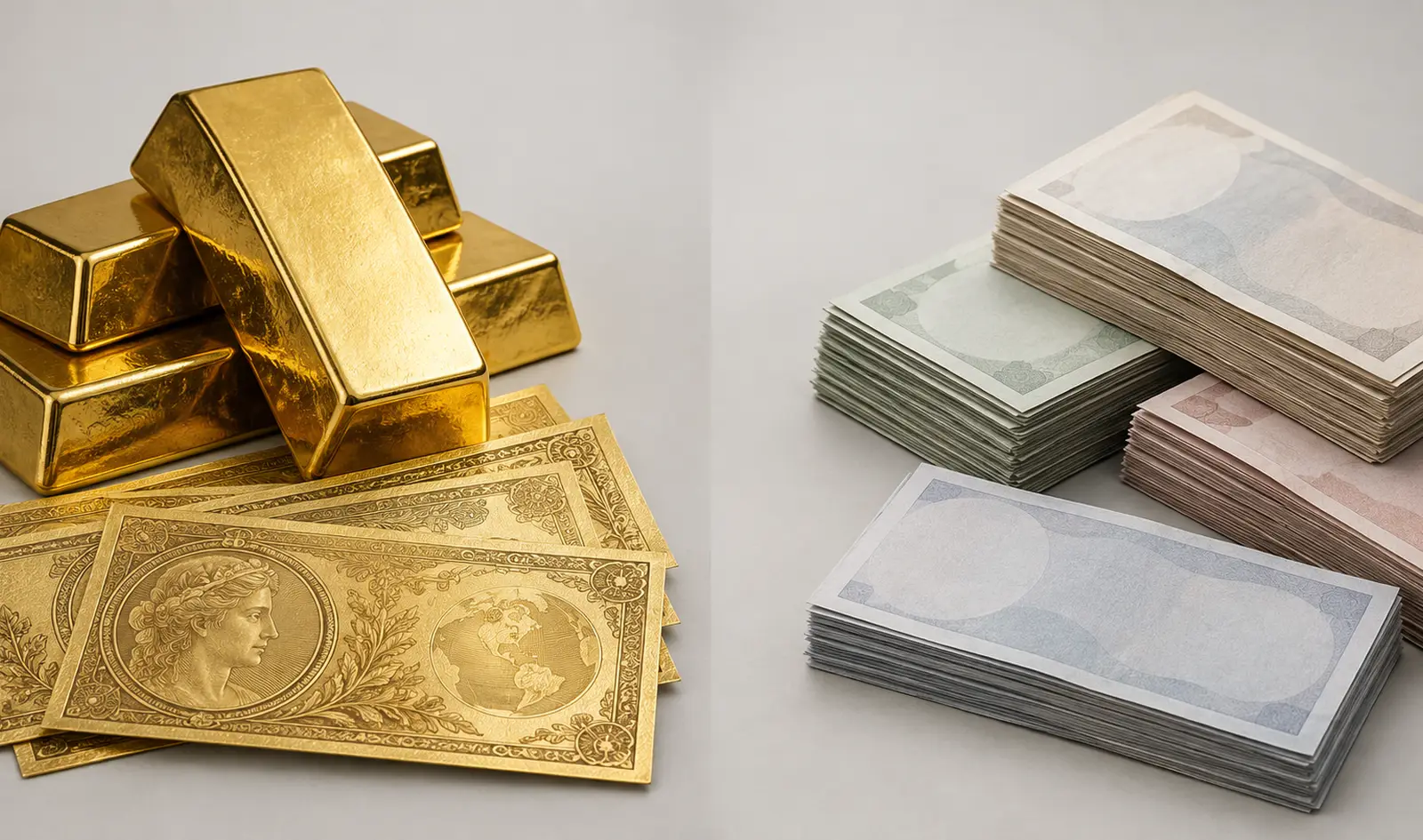
Goldbacks are physical 24-karat gold. IRAs allow physical gold. So the natural question is: can you hold Goldbacks inside a self-directed IRA the same way you'd hold Gold Eagles or gold bars?
The short answer is complicated, and most articles online skip the nuance. This guide gives you the honest breakdown — what the IRS actually requires, why Goldbacks sit in a gray area, and what your realistic options are if you want gold-currency exposure in your retirement account.
- Goldbacks pass the IRS purity test but fail the approved-form test. The metal is fine enough; the format is not recognised bullion.
- IRA-eligible gold must be bullion or coins of an approved form. A privately issued gold-foil note does not qualify.
- Confirm with your custodian before assuming anything. Custodians set their own additional restrictions beyond the IRS floor.
- Approved alternatives exist if IRA gold exposure is the goal — the restriction is on the format, not on gold itself.
- Holding Goldbacks personally, outside any retirement account, remains perfectly straightforward.
The Short Answer
Standard IRA rules require gold to meet specific IRS purity and form criteria — typically 99.5% pure and produced by approved refiners, in coin or bar form. Goldbacks meet the purity requirement (99.9% pure 24-karat gold) but their format as gold-infused polymer currency notes doesn't clearly fit the standard "gold coin or bar" IRA framework.
In practical terms:
- Most mainstream Gold IRA custodians do not currently accept Goldbacks as eligible IRA holdings
- The IRS has not issued explicit guidance classifying Goldbacks one way or the other
- Some self-directed IRA custodians may accept Goldbacks under specific structures, but this requires case-by-case review
- The safer path for gold in an IRA is standard IRS-approved coins and bars, held through a specialized Gold IRA provider
If you want Goldback exposure alongside retirement gold, the practical approach is often to hold approved gold in your IRA and hold Goldbacks separately through an account like UPMA. Both work together as part of a broader precious-metals strategy.
How Traditional Gold IRAs Work
A Gold IRA is a self-directed IRA that holds physical gold, silver, platinum, or palladium instead of stocks and bonds. To qualify, the metals must meet IRS standards:
Purity Requirements
- Gold: 99.5% pure minimum (24-karat is 99.9%, so it qualifies)
- Silver: 99.9% pure minimum
- Platinum/Palladium: 99.95% pure minimum
Approved Forms
- Certain government-minted coins (American Gold Eagles, Canadian Gold Maple Leafs, Austrian Gold Philharmonics, etc.)
- Gold bars produced by approved refiners (COMEX/NYMEX approved, LBMA member refiners)
- Some proof and bullion coin variations with specific certifications
Storage Requirements
- Must be held by an IRS-approved custodian in an approved depository
- Cannot be held at home (this triggers a "distribution" and immediate tax + penalty)
- Cannot be personally possessed during the IRA holding period
Standard Gold IRA providers like Goldco, Augusta Precious Metals, Birch Gold, and others handle this entire process — including selecting IRS-approved metals, arranging custodianship, and using approved depositories.
Why Goldbacks Are Different
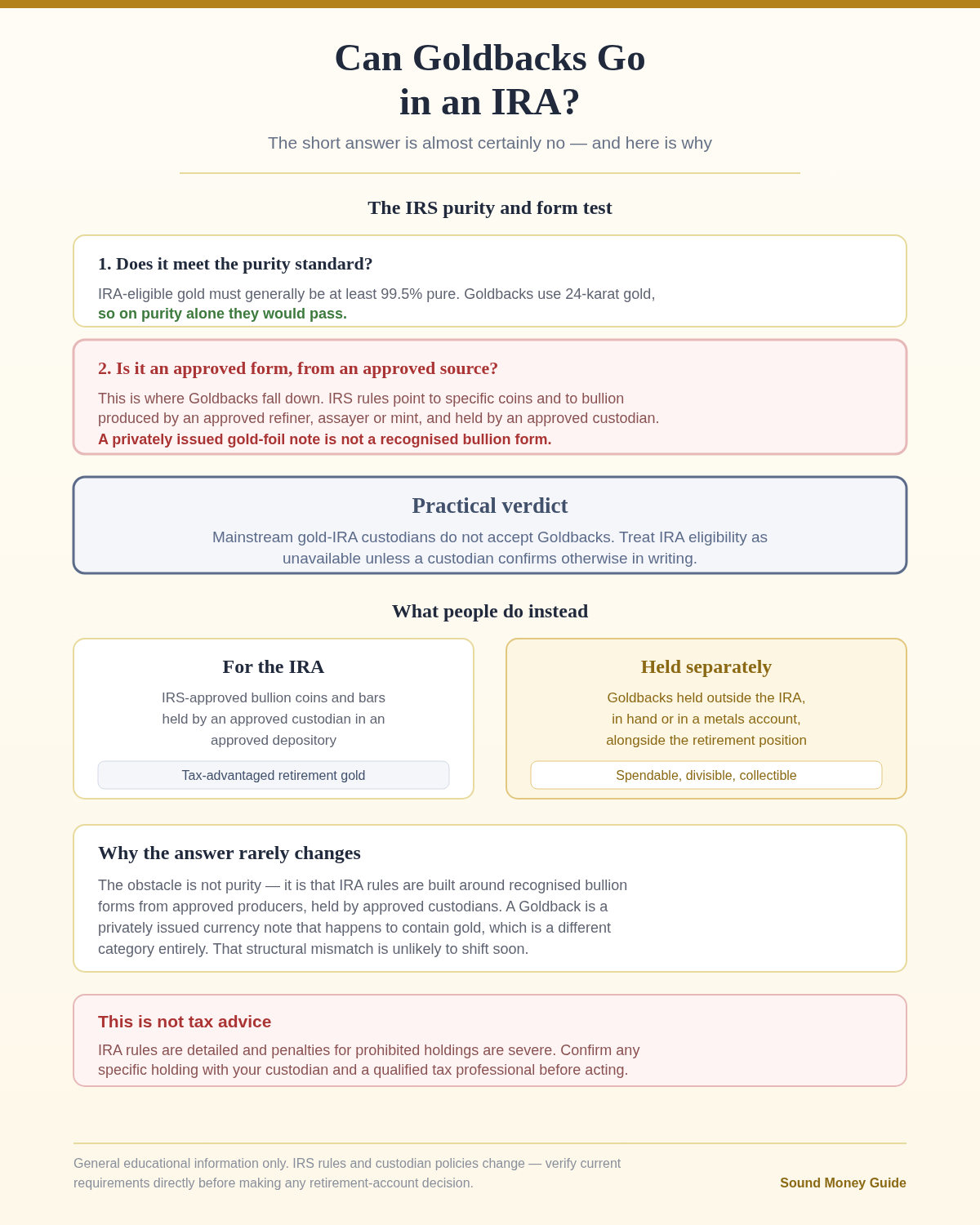
Goldbacks pass on purity but fail the approved-form test. Confirm with your custodian.
Goldbacks meet the purity requirement — they're 99.9% pure 24-karat gold. But they don't clearly fit the standard form requirement.
Here's the issue: IRA-approved gold traditionally means coins or bars. Goldbacks are neither. They're a novel format — 24-karat gold molecularly deposited onto polymer, sealed as spendable currency notes. That format didn't exist when the IRA rules were written.
The classification questions the IRS hasn't clearly answered:
- Are Goldbacks a "coin" (they function as currency but aren't minted like a coin)?
- Are they a "bar" (they contain gold but aren't a bar in any traditional sense)?
- Are they a "collectible" (a category that's specifically prohibited from IRAs)?
Because of this ambiguity, most mainstream Gold IRA custodians default to not accepting Goldbacks. It's not that they've been ruled ineligible — it's that they're not clearly ruled eligible, and custodians err on the side of caution.
Some more flexible self-directed IRA custodians may accept Goldbacks under specific structures, but this requires:
- Explicit custodian approval in writing
- Approved depository storage
- Clear documentation of the classification
- Willingness to take on regulatory risk
Most IRA holders don't want that complexity. Which is why the practical answer for most people is: hold approved gold in your IRA, and hold Goldbacks outside your IRA.
Alpine Gold Exchange IRA Services
Alpine Gold Exchange offers precious metals IRA services through its network. What's available:
Standard Gold IRA
- IRS-approved gold coins and bars
- Coordinated custodianship through partner custodians
- Depository storage (insured through Lloyds of London per Alpine; depository operator not published)
- Rollover support from existing 401(k) or IRA accounts
Silver IRA
- IRS-approved silver bullion
- Same custodian and depository structure
Roth IRA / Traditional IRA Compatibility
- Alpine works with both account types
- Full rollover support
On Goldbacks specifically: Alpine Gold does not currently market Goldbacks as an IRA-eligible product. If you want Goldbacks in your retirement strategy, the practical structure is holding them in a UPMA account separately, alongside your IRA gold.
👉 Contact Alpine Gold Exchange for IRA Services
Alternative: UPMA for Gold-Denominated Accounts
If your goal is holding gold outside of a bank in a formal account structure, and you're open to non-IRA options, UPMA (United Precious Metals Association) is the strongest available option in 2026.
UPMA advantages relevant here:
- Accepts Goldbacks natively as part of your account holdings
- 0% spread on liquidations by applying Deposit Rewards points, up to 2,500 points weekly, subject to daily capacity; beyond that, standard market spreads apply (captured 4 September 2026). On 22 September 2026 Alpine also established a daily buy-back “appetite” and changed the individual allowance from $10,000 per month to $2,500 per week, which Alpine says maintains approximately the same potential monthly allowance; Alpine names only “certain metals” and does not say whether Goldbacks are among them (captured 23 September 2026)
- Insured vaulting (insurer: Lloyds of London per Alpine; vault operator not published)
- Optional yield through the Alpine Gold leasing program (advertised 2%–5% APR depending on total leased value in USD, paid in gold, not guaranteed; captured 9 September 2026)
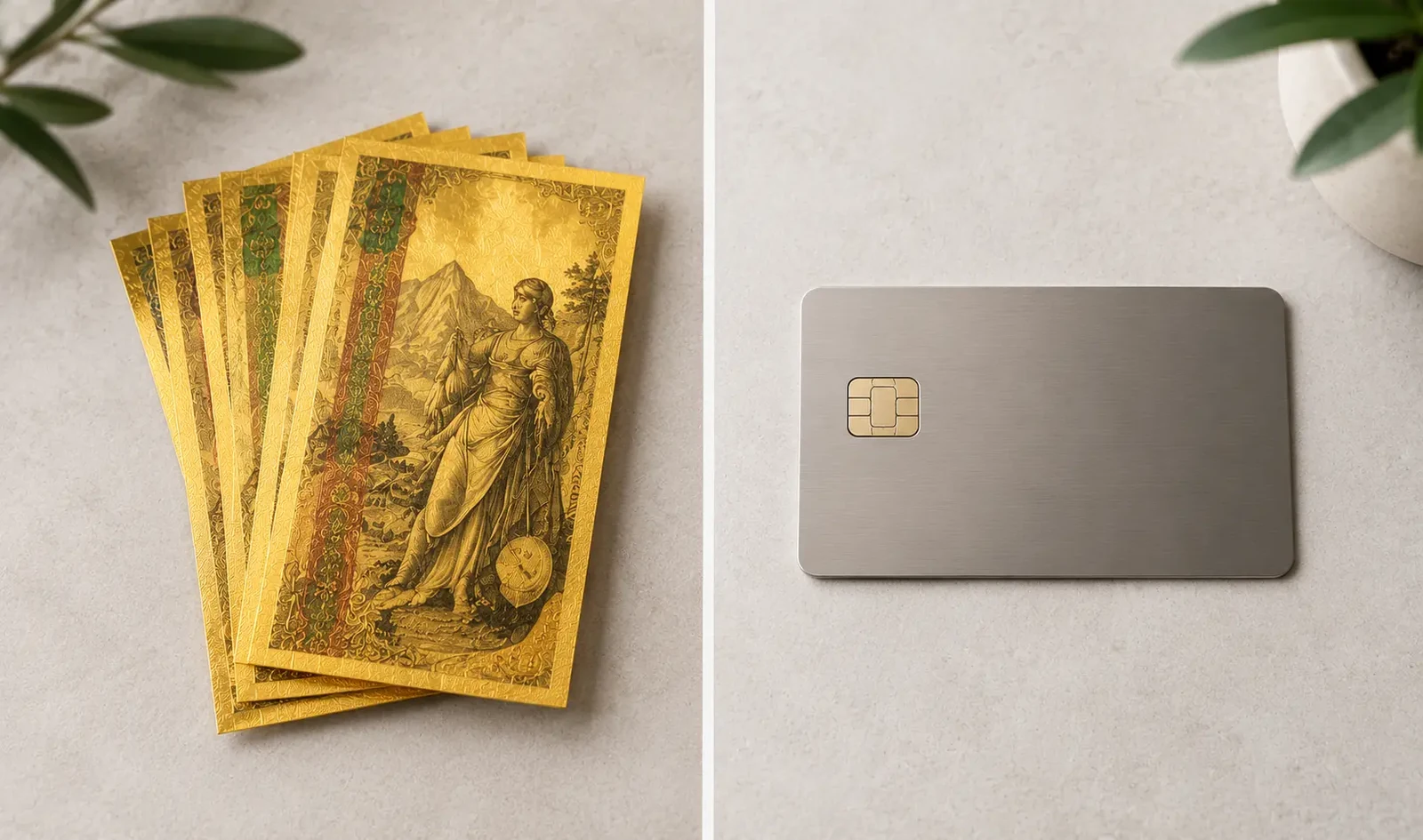
- Gold-backed debit card access (via TrueLink Visa)
UPMA isn't tax-advantaged like an IRA. But if you want flexibility, Goldback compatibility, and access to your gold, UPMA solves problems an IRA doesn't.
Common approach for serious precious-metals holders:
- Gold IRA for tax-advantaged retirement gold (approved coins/bars)
- UPMA account for flexible, accessible gold and Goldback holdings
- Personal physical holdings for direct-custody gold and Goldbacks
The three work together as complementary tools, not competing options.
🎯 Plan Your Retirement Gold Allocation
Enter your age, retirement target, savings, and desired gold percentage. Get a recommended split across Gold IRA, UPMA account, and physical holdings based on your time horizon.
Open the Gold Allocation Calculator →
The Practical Recommendation
If you're deciding how to hold gold in retirement plus want Goldback exposure, here's what makes sense in 2026:
Step 1: Standard Gold IRA for Tax-Advantaged Retirement Gold
Use IRS-approved gold coins/bars through a specialized Gold IRA provider like Alpine Gold Exchange. This gets you tax advantages and satisfies the IRS clearly.
Step 2: UPMA Account for Flexible Gold-Denominated Savings
Open a UPMA membership for your non-retirement gold savings. This gets you the rewards-based zero-spread benefit described above (0% spread on liquidations where Deposit Rewards points are applied, up to 2,500 points weekly and subject to daily capacity), Goldback compatibility, insured custody, and optional yield.
Step 3: Direct Goldback Holdings for Spendability
Buy physical Goldbacks through Alpine Gold Exchange to hold personally for actual spending, collecting, or gifting.
You don't have to force Goldbacks into an IRA to include them in your precious-metals strategy. Holding them in the right structure for each goal is more flexible and avoids regulatory ambiguity.
Frequently Asked Questions
Can I put physical gold in an IRA?
Yes. Physical gold that meets IRS purity and form requirements (99.5%+ pure, approved coins or bars) can be held in a self-directed IRA through an approved custodian. Storage must be at an approved depository — not at home.
Are Goldbacks IRA-eligible?
Ambiguously. They meet the purity requirement (99.9% pure) but their format as gold-infused polymer currency notes doesn't clearly fit the standard "coin or bar" IRA framework. Most mainstream Gold IRA custodians do not accept Goldbacks.
Can I hold Goldbacks in my UPMA account instead?
Yes. UPMA accounts natively support Goldbacks alongside standard bullion — you can hold both under one insured, vaulted account structure.
What are the IRS gold IRA rules?
Gold in an IRA must be 99.5%+ pure, in approved coin or bar form from approved sources, and held by an IRS-approved custodian at an approved depository. Personal possession triggers immediate tax and penalties.
Can I roll over my 401(k) into a Gold IRA?
Yes. Standard 401(k)-to-Gold-IRA rollovers are common and handled by specialized Gold IRA providers like Alpine Gold Exchange. The process usually takes 2-4 weeks.
What's the tax treatment on gold in an IRA vs UPMA?
Gold IRA: Tax-deferred (traditional) or tax-free (Roth), depending on account type. Distributions follow standard IRA rules.
UPMA: No tax advantages — treated as ordinary precious metals holdings. Selling triggers capital gains at the collectibles rate (28% max federal).
Different tools for different goals.
Is Alpine Gold Exchange an IRA provider?
Alpine Gold offers precious metals IRA services through its network, using approved custodians and depositories. Contact Alpine directly for current IRA setup and rollover procedures.
Bottom Line
Goldbacks aren't clearly eligible for standard Gold IRAs in 2026. Most custodians won't accept them, and the IRS hasn't issued clear guidance. If you want gold-currency exposure, the practical structure is to hold approved gold in your IRA and hold Goldbacks separately through a UPMA account or personal ownership.
That approach gives you:
- Tax advantages on retirement gold through the IRA
- Flexibility and Goldback compatibility through UPMA
- Personal spendability and gifting through direct Goldback ownership
Trying to force Goldbacks into an IRA creates regulatory complexity without benefits. Using the right structure for each goal is simpler and more effective.
👉 Contact Alpine Gold Exchange for Gold IRA Services
👉 Open a UPMA Account for Goldback Holdings
This article is for educational purposes only and does not constitute financial, tax, or legal advice. IRA rules are complex and change over time. Always consult a qualified financial advisor and tax professional before making decisions about your retirement accounts.
Continue Reading