Alpine Gold Account vs Bank Account — Which Protects Your Purchasing Power?

You keep some money in a bank savings account. The dollar figure stays the same, but inflation quietly reduces what that money can buy over time. An account denominated in physical gold — the Alpine Gold Account (formerly commonly called a "UPMA account") — takes a different approach: your gold quantity stays stable, and its purchasing power moves with gold rather than eroding with the dollar.
Which protects you better? Here's an honest comparison — educational, not financial advice, and without pretending anyone can predict what gold will do.
- A bank account gives you dollar-stable, FDIC-insured deposits (up to $250K) with easy liquidity — but the dollar's purchasing power erodes with inflation.
- An Alpine Gold Account holds physical gold; its purchasing power tracks gold, which can rise or fall. It is not FDIC-insured.
- The account is operated and serviced by Alpine Gold; the metals sit in a vault Alpine says is insured through Lloyds of London and audited quarterly, though Alpine does not publish who operates it; UPMA is the membership cooperative. Alpine is a dealer, not a bank.
- Physical-loss insurance is provided by Lloyd's of London (not a market-loss guarantee, not FDIC).
- Neither is universally "better" — they protect against different risks (bank failure vs inflation). Many people use both.
The Fundamental Difference
Bank Savings Account
- Denominated in US dollars
- Value tracks dollar purchasing power (which erodes with inflation)
- FDIC-insured up to $250,000 per depositor per bank
- Pays interest in dollars
- Immediate liquidity via debit card, checks, wire transfers
Alpine Gold Account
- Denominated in physical gold, silver, and Goldbacks
- Value tracks the metal price (which can rise or fall; gold has historically helped preserve purchasing power over long periods, but with no guarantee)
- Physical-loss insurance via Lloyd's of London (not FDIC)
- No interest by default; optional yield via leasing, paid in metal (not guaranteed)
- Liquidity via a linked debit card, physical withdrawal, or wire transfer
The core trade-off: bank accounts give you stable dollars that erode in real terms. An Alpine Gold Account gives you a metal holding whose purchasing power moves with gold — up or down. Different foundations, different risks.
Who Operates the Account?
Lease availability — verify before funding. Alpine listed the Goldback lease as "Available" on its Leases page as of July 30, 2026. That status field has changed at least twice in twelve months, and "Available" on a marketing page is not confirmation that a specific application will be funded. Confirm the current status in your account before transferring any metal.
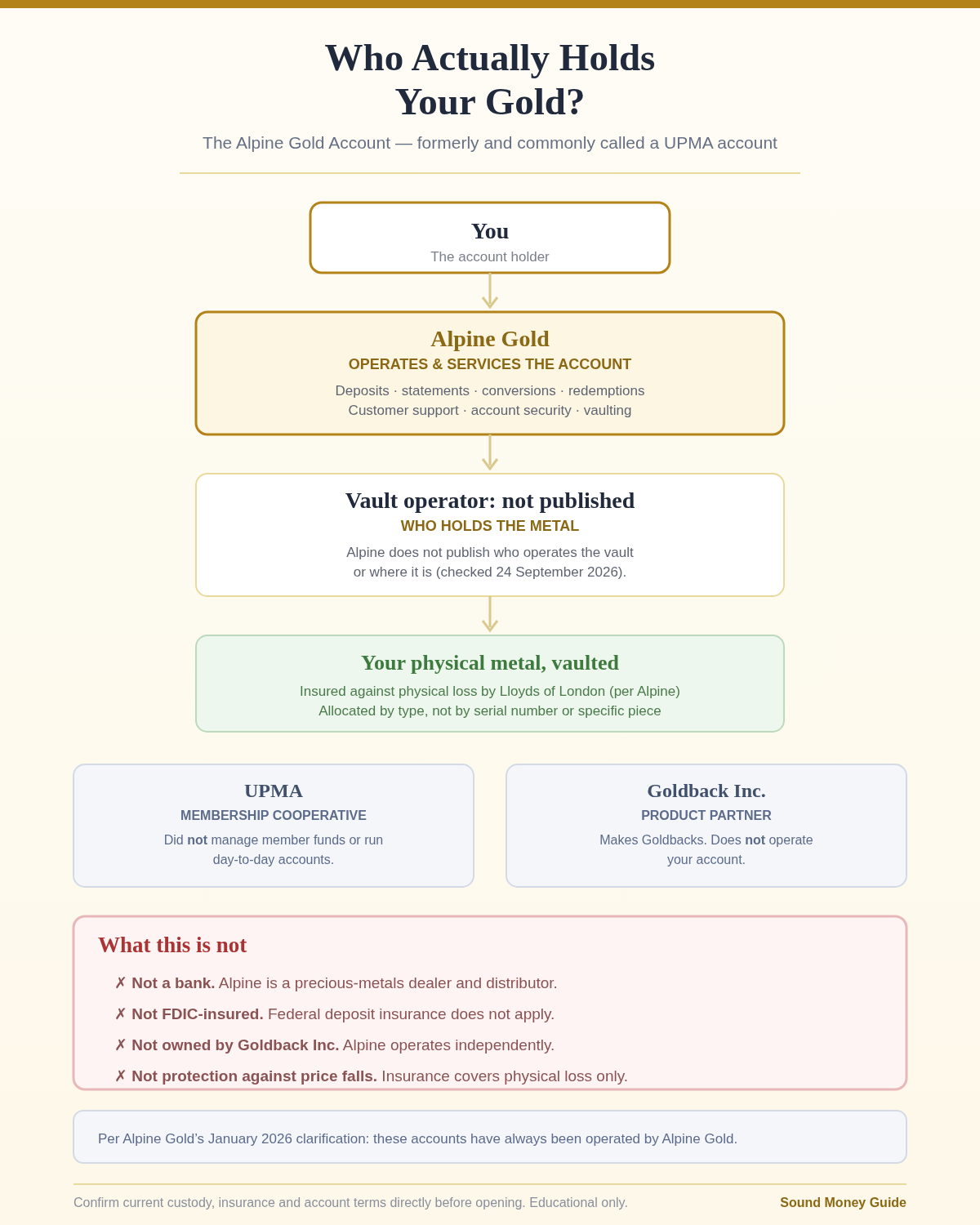
Who does what. Alpine operates and services the account; UPMA is the membership cooperative. Alpine does not publish who operates the vault.
The account formerly called a "UPMA account" is now the Alpine Gold Account. Per Alpine's January 2026 clarification, it has always been operated and serviced by Alpine Gold: deposits, statements, conversions, redemptions, support, security, and vaulting. The physical metals are held in a vault Alpine says is insured through Lloyds of London and audited quarterly; Alpine does not publish who operates the vault or holds the metal (checked across all 38 English pages of alpinegold.com, and on upma.org, on 24 September 2026). UPMA is the membership cooperative (now focused on accreditation and advocacy) and does not manage member funds. Alpine is an independent precious-metals dealer — not a bank, not FDIC-insured, and not owned by Goldback Inc. See our Alpine Gold Account Review for the full breakdown.
Alpine Gold Account vs Bank Account Calculator
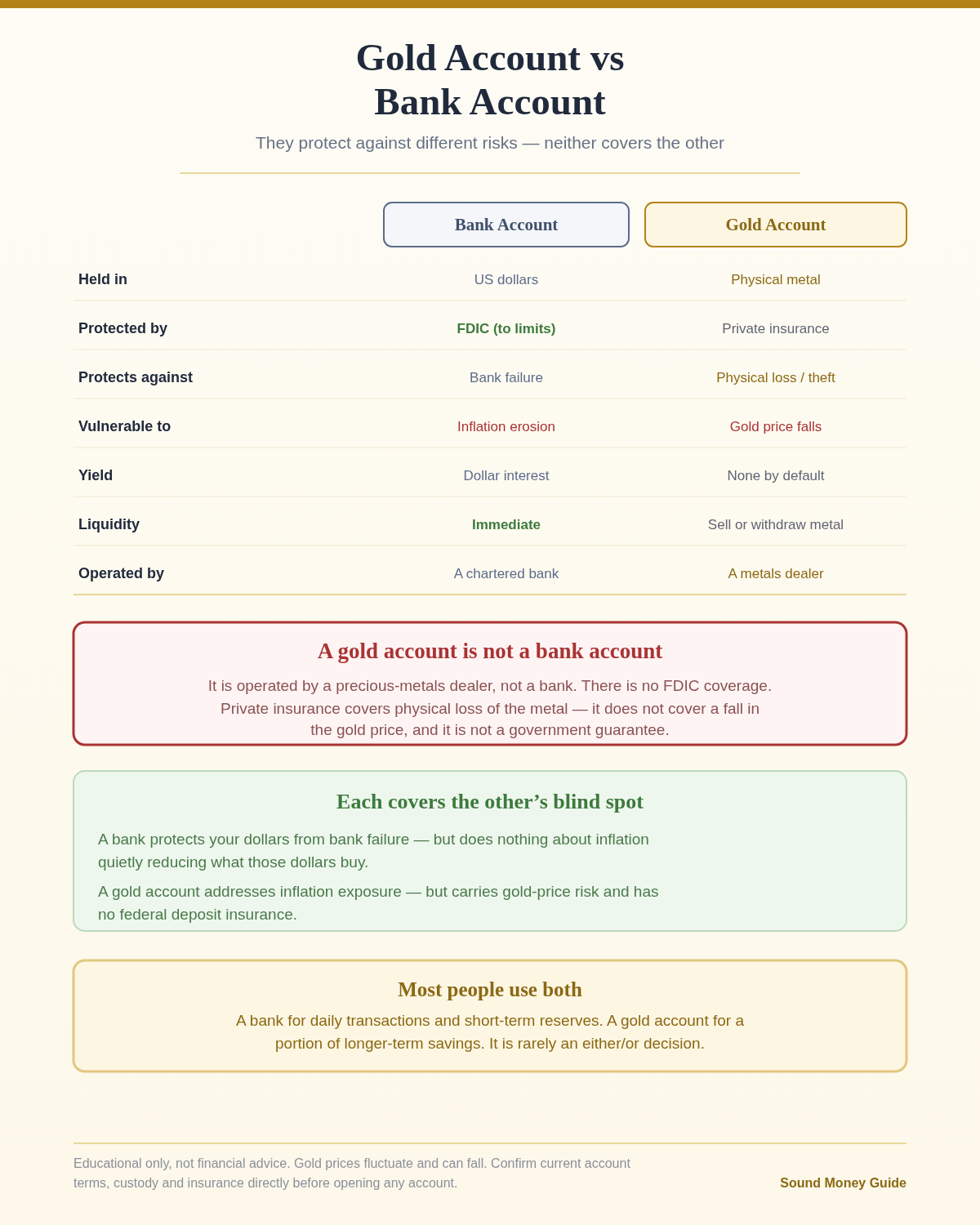
Different protections for different risks. Most people use both.
Compare a gold-denominated Alpine Gold Account with a bank savings account over time, using your own assumptions. This is a "what if" tool, not a forecast — you enter the bank rate, inflation, gold appreciation, and any leasing yield, and it does the math on your inputs. Gold can fall as well as rise; enter conservative or even negative figures if you want to stress-test.
Open the Gold Account vs Bank Calculator →
The Inflation Argument (Without the Fake Numbers)
The "sound money" case is simple: over long periods, a dollar buys less, while gold has often held or grown its purchasing power. That's a real, documented long-run pattern — the US dollar has lost a large share of its purchasing power since the early 1970s, and gold's dollar price is far higher today than it was then.
But we won't give you a precise "you'd have $X" figure, because the exact multiples depend on start and end dates, the gold price on a specific day, and assumptions about interest and reinvestment — and small changes swing the answer wildly. Any single headline number ("gold went up 700%," "dollars lost 87%") is cherry-picked to a date pair and shouldn't be treated as a promise about the future. Gold has also had long flat or falling stretches (for example, much of the 1980s and 1990s).
The honest takeaway: gold has historically been a reasonable long-term inflation hedge, but it is volatile and carries no guarantee. Use the calculator above with your own assumptions rather than trusting a dramatic single statistic.
See What Inflation Does to Your Dollars
Enter a dollar amount and your own assumed inflation rate and number of years to see the erosion in purchasing power. This tool uses your assumptions, not a fixed historical claim — so it won't tell you what any particular past decade "really" did, only what your chosen inflation rate implies.
Open the Inflation Purchasing Power Calculator →
Head-To-Head Feature Comparison
| Feature | Bank Savings Account | Alpine Gold Account |
|---|---|---|
| Denomination | US dollars | Physical gold/silver/Goldbacks |
| Inflation protection | No (dollar erodes) | Historically a hedge, but not guaranteed; gold can fall |
| Yield | Dollar interest | 0% default; optional leasing paid in metal (not guaranteed) |
| Insurance | FDIC ($250K limit) | Lloyd's of London (physical loss); NOT FDIC |
| Custody | Bank balance sheet | Vault operator not published by Alpine |
| Operator | Chartered bank | Alpine Gold (dealer, not a bank) |
| Debit card | Yes (dollar) | Yes (metal liquidated at point of sale) |
| Physical asset access | No | Yes (physical withdrawal available) |
| Setup complexity | Low | Moderate (membership + funding) |
| Fees | Often low/none | Membership + vaulting fees |
| Best for | Daily transactions, short-term reserves | Long-term savings, inflation hedge |
The Yield Question
Bank accounts pay interest; the Alpine Gold Account doesn't by default. Doesn't the bank win on income?
Not necessarily — but be careful how you frame it. A bank pays a stated dollar rate, and after inflation the real return may be small. An Alpine Gold Account earns nothing unless you lease (and leasing pays in metal, is capped at a low single-digit rate, and is not guaranteed), while the metal itself can rise or fall. Whether the account "beats" a bank depends entirely on what gold does over your holding period — which nobody can promise. Model it yourself with the calculator above rather than assuming an outcome.
The FDIC Question
FDIC insurance is real and meaningful up to $250,000 per depositor per bank. The Alpine Gold Account is not FDIC-insured.
What FDIC Covers
- Dollar deposits at insured banks, up to $250,000, against bank failure.
What FDIC Doesn't Cover
- Inflation erosion, amounts over the limit, or anything but dollar deposits.
What the Alpine Gold Account Provides Instead
- Lloyd's of London insurance for physical loss, theft, and damage to vaulted metal — not a guarantee against gold price declines, and not federal deposit insurance.
The honest reality: FDIC protects against a rare event (bank failure) but does nothing about inflation; the Alpine Gold Account addresses inflation exposure but carries gold-price risk and lacks federal deposit insurance. They protect against different things. Which matters more is a personal judgment, not a settled fact.
Who Should Use Each
Keep Money in a Bank Account If:
- You need daily transaction liquidity
- You're building an emergency fund
- You have short-term goals (under ~2 years)
- You value simplicity and dollar predictability
Consider an Alpine Gold Account If:
- You have long-term savings you don't need immediate access to
- Inflation protection matters more to you than FDIC insurance
- You want gold exposure without self-custody friction
- You accept gold-price risk and no guaranteed return
Use Both (Common Approach):
- Bank for daily life and short-term reserves
- Alpine Gold Account for longer-term, inflation-resistant savings
- Additional Goldbacks/physical gold via Alpine Gold Exchange for spendable metal
These complement each other; it isn't a binary choice.
How to Open an Alpine Gold Account
1. Open an Alpine Gold Account via the portal (link below) 2. Fund it with dollars, physical metals, or a rollover 3. Choose your holdings (gold, silver, Goldbacks, or a mix) 4. Set up optional features (card access, leasing, recurring purchases) 5. Standard identity verification applies
Setup typically completes in a few business days. Confirm current steps and terms directly with Alpine.
👉 Review the Current Alpine Gold Account Terms
👉 Browse Currently Available Goldbacks
Frequently Asked Questions
Is the Alpine Gold Account safer than a bank account?
Different risks. Banks protect against bank failure via FDIC (up to $250K). The Alpine Gold Account holds metal insured against physical loss by Lloyd's, and aims to sidestep dollar inflation — but it carries gold-price risk and is not FDIC-insured. Neither fully covers the other's risk.
Can I have both?
Yes, and many people do — a bank for daily transactions and short-term reserves, an Alpine Gold Account for longer-term inflation-resistant savings.
Does the account pay interest?
Not by default. Optional leasing pays a low single-digit rate in metal, not guaranteed. For interest-paying dollar savings, a bank or high-yield savings account is simpler.
What are the fees compared to a bank?
The account charges membership dues (often in silver) plus vaulting fees scaled to holdings; banks often have low or no savings fees. The account's 0% spread on liquidations, available by applying Deposit Rewards points up to 2,500 points weekly and subject to daily capacity, can offset costs for serious accumulators; liquidations beyond the rewards applied are processed at standard market spreads (captured 4 September 2026). Confirm current schedules with Alpine.
Can I spend gold from the account?
Yes, via a linked debit card that liquidates metal at the point of sale. See our Gold-Backed Debit Card guide.
Is gold guaranteed to beat inflation?
No. Gold has historically been a reasonable long-term inflation hedge, but it is volatile, has had long flat or falling periods, and carries no guarantee. Don't rely on a single dramatic statistic.
How do I withdraw?
Physical delivery of metal, wire transfer of dollars (converted from metal), or spending via the linked card.
Bottom Line
Bank accounts and the Alpine Gold Account solve different problems. Banks give you dollar-stable, FDIC-insured deposits for daily life and short-term reserves. The Alpine Gold Account gives you metal-denominated holdings aimed at preserving purchasing power over long periods — with gold-price risk, no FDIC insurance, and no guaranteed return.
For long-term savings, gold's historical role as an inflation hedge is a genuine argument in the account's favour, but it is not a promise — gold is volatile and can fall. For most people the sensible answer isn't one or the other: a bank for daily life, an Alpine Gold Account for a portion of long-term savings, sized to your own comfort with risk.
👉 Review the Current Alpine Gold Account Terms
👉 Browse Currently Available Goldbacks
For how the account works in detail, see our Alpine Gold Account Review 2026. For the broader "what is sound money" context, see our What Is Sound Money guide.
This article is for educational purposes only and does not constitute financial advice. The Alpine Gold Account is not FDIC-insured. Precious metals prices fluctuate and can fall. Past performance does not guarantee future results. Always consult a qualified financial advisor before making significant changes to how you hold savings.
Continue Reading