Gold-Backed Debit Card: How to Spend Gold Like Cash in 2026

The idea of spending gold as easily as tapping a debit card sounds like a marketing pitch, but in 2026 it's genuinely possible. A gold-backed debit card lets you hold your savings in physical gold and spend it at any merchant that accepts Visa — with the gold converted to dollars at the point of sale, automatically.
If you're searching for a gold-backed debit card in the US, wondering about the Texas Gold-Backed Debit Card, or looking at the UPMA / TrueLink Visa option specifically, this guide breaks down how these cards actually work, what fees to expect, and how to get one.
- A gold-backed card liquidates metal at the point of sale and settles in dollars. You are selling gold each time you spend, not paying in gold.
- Every transaction realises the spread between what your metal is worth and what you receive — that is the real cost of the convenience.
- Card services are provided by a third party under their own terms and fees, separate from the metals account itself.
- Spending metal is a disposal, which can carry tax consequences depending on your jurisdiction. Check before using it routinely.
- Best suited to occasional access rather than daily spending, where the spread compounds against you.
What Is a Gold-Backed Debit Card?
A gold-backed debit card is a standard Visa or Mastercard debit card linked to an account denominated in physical gold — not dollars.
When you swipe the card:
1. The merchant's payment terminal requests payment in dollars (like any card transaction) 2. Your card provider converts the required dollar amount from your gold holdings, at the current spot price 3. The merchant is paid in dollars 4. Your gold balance decreases by the equivalent amount
From the merchant's side, it looks like a normal card payment. From your side, you've just spent gold. You never converted your savings from gold to dollars manually — the conversion happens automatically at the moment of purchase.
The practical result: you can hold savings in inflation-resistant gold and still pay for coffee, groceries, gas, or anything else that takes a Visa card.
How Gold-Backed Debit Cards Work
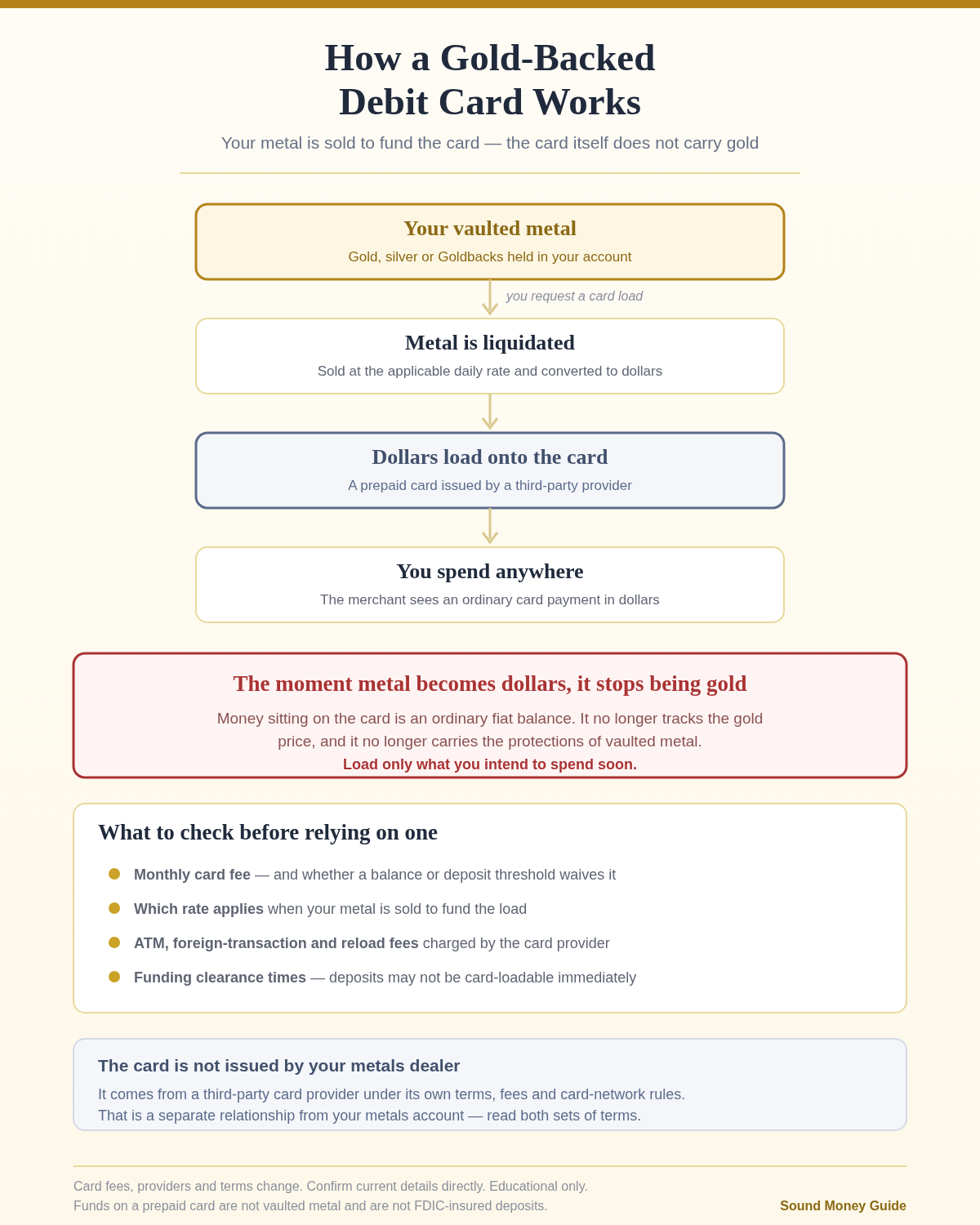
Metal is sold to fund the card. Once loaded, the balance is ordinary dollars.
Three components work together:
1. The Gold Custody Account
Somewhere, an organization holds physical gold on your behalf. In the US, the most established option is the United Precious Metals Association (UPMA), whose members' gold is vaulted and, per Alpine, insured through Lloyds of London. Neither Alpine nor UPMA publishes who operates that vault (checked 24 September 2026).
2. The Card Issuer
A payment processor (typically TrueLink for UPMA) provides the actual debit card, handles authorization, and manages the Visa network integration.
3. The Conversion Mechanism
When you swipe, the processor converts gold to dollars at the current spot price and pays the merchant. Some processors add a small conversion fee; others don't.
The whole flow happens in milliseconds — the merchant sees a normal card authorization.
Texas Gold-Backed Debit Card
Texas has been developing a state-backed gold-based payment system through the Texas Bullion Depository, established in 2015. The project — sometimes referred to as the "Texas Gold-Backed Debit Card" — would allow account holders at the state depository to spend their gold balances via a linked card.
Current status (as of 2026): The Texas system has been in development for years. Various private-sector implementations have launched, been paused, or been reworked. Verify current availability directly with the Texas Bullion Depository before assuming the specific state-branded card is operational.
For Americans wanting a gold-backed debit card available right now, the most established option is the UPMA / TrueLink Visa card, which has been operational for years.
UPMA / TrueLink Visa Card Review
This is the most widely used gold-backed debit card option available to US members currently.
How It Works
- You join UPMA and fund a gold-denominated account
- You apply for a TrueLink Visa debit card linked to your UPMA account
- You use the card anywhere Visa is accepted — swipe, tap, insert, or use online
- Gold is liquidated at the point of sale at current spot price
- Merchant is paid in dollars; your gold balance decreases
What's Good
- Works everywhere Visa works — no adoption barrier for merchants
- Spend gold without manually selling it — no trip to a dealer needed
- No separate dealer counter to visit — your gold-to-dollar conversion happens inside your Alpine account rather than at a bullion dealer's retail spread, subject to Alpine's published limits and its stated conditions. Loading the Linked Visa Card is itself a liquidation or a GoldELOC, so Alpine applies the same terms to it: the same weekly limit on applied Deposit Rewards points, the same daily availability, and the same market-rate terms. Loading the card is not a separate zero-fee route, and it draws on the same 2,500-point weekly ceiling as any other liquidation. Terms captured 4 September 2026. The underlying provision reads: Alpine Gold members can sell back vaulted Gold Dollars, Goldbacks and Silver Dollars at 0% spread by applying points from a Deposit Rewards balance, which builds on qualifying fiat and metal deposits made into the spending account. The metals must have been purchased and vaulted with Alpine Gold Exchange in an online precious metals account. Applying rewards is optional, and up to 2,500 points may be applied each week across all Deposit Reward Offers. Zero-spread liquidations are also subject to daily capacity, and Alpine states that large liquidations are available at market rate on a call-for-a-quote basis. Liquidations beyond the rewards a member applies are processed at standard market spreads. Terms captured from Alpine Gold's Rates & Fees page on 4 September 2026. On 22 September 2026 Alpine separately established a daily “appetite” for member sell-backs and changed the individual allowance from $10,000 per month to $2,500 per week, which Alpine says “maintains approximately the same potential monthly allowance”. Alpine states that where secondary-market demand is limited it “must temporarily restrict the amount we purchase each day”, and it has not published the daily figure. The announcement names only “certain metals” and does not say whether Goldbacks are among them. As at 23 September 2026 this appears only in Alpine’s CEO blog post; the Rates & Fees page still says large liquidations at market rate are available on a call-for-a-quote basis, and we do not know how Alpine reconciles the two (captured 23 September 2026). Alpine states that loading the card is itself a liquidation or a GoldELOC, so the same weekly limit, daily availability and market-rate terms apply to card spending.
- Backed by real physical gold — vaulted and, per Alpine, insured through Lloyds of London; vault operator not published
What to Watch For
- TrueLink has its own card fees — separate from UPMA membership. Verify current fee schedule before assuming what the card will cost you.
- Spot price at moment of transaction — the gold-to-dollar conversion happens at the exact moment you swipe. This is fair but means the exact amount of gold used depends on current spot.
- Not FDIC-insured — this isn't a bank account with a Visa card attached. It's a nonprofit precious-metals account with card access.
- Foreign transaction fees may apply — check the TrueLink fee schedule for international use.
Fees, Limits, and How to Apply
Fees to Understand
The UPMA / TrueLink debit card involves several potential fees:
- UPMA membership dues (annual, typically modest)
- UPMA vaulting fees (scaled to holdings)
- TrueLink card issuance and monthly fees (verify current schedule)
- ATM withdrawal fees (if using the card at an ATM)
- Foreign transaction fees (if using internationally)
None of these are outrageous, but they exist. Contact UPMA and TrueLink directly for the current fee schedule that will apply to your account.
Limits
Standard debit card daily spending and ATM withdrawal limits apply. UPMA account holdings themselves are not limited — you can hold as much gold as you want in the account. Card spending on any given day is subject to normal debit card limits.
How to Apply
1. Join UPMA — see the link below 2. Fund your account with dollars (which convert to gold), physical metals, or a rollover 3. Request the TrueLink Visa debit card through your UPMA member portal 4. Complete the TrueLink card application (standard KYC / identity verification) 5. Receive card, activate, and start spending
Typical timeline from initial application to receiving the card is 2-4 weeks.
💳 Compare Debit Card Fees: UPMA vs Bank vs Bitcoin
Enter your typical spending patterns and see estimated annual costs for each type of debit card — including the hidden cost of dollar inflation eroding your bank balance.
Open the Gold Debit Card Fees Calculator →
Gold Debit Card vs Bitcoin Debit Card
Both let you spend an alternative store of value like conventional money. Here's how they compare:
| Feature | Gold-Backed Debit Card (UPMA) | Bitcoin Debit Card |
|---|---|---|
| Underlying asset | Physical gold in vault | Bitcoin held on exchange or custody |
| Price stability | Lower short-term volatility | Higher short-term volatility |
| Inflation hedge | Historically strong (thousands of years) | Emerging (~15 years of data) |
| Physical asset | Yes | No (digital) |
| Custody model | Vaulted physical metal | Digital wallet or exchange custody |
| Regulatory framework | Precious metals cooperative | Crypto exchanges (regulatory landscape evolving) |
| Tax treatment | Precious metals sale (capital gains) | Bitcoin sale (capital gains) |
| Insurance | Lloyd's (physical loss) | Varies by exchange (often uninsured) |
Both work. Which one fits depends on how you view gold vs Bitcoin as a store of value. Some people hold both.
How to Get One
If you want to start spending gold via a debit card, the fastest and most established path is:
1. Join UPMA (link below) 2. Fund your gold-denominated account 3. Apply for the linked TrueLink Visa debit card 4. Wait 2-4 weeks for the card to arrive 5. Start spending gold like cash
👉 Join UPMA — the fastest way to get access to the TrueLink gold-backed Visa card
👉 Browse Alpine Gold Exchange — for buying physical gold and Goldbacks to fund your UPMA account
Frequently Asked Questions
What is a gold-backed debit card?
A standard Visa or Mastercard debit card linked to an account denominated in physical gold. When you swipe, gold is converted to dollars at the point of sale, and the merchant is paid in dollars. Your gold balance decreases.
Is there a Texas gold-backed debit card?
The Texas Bullion Depository has been developing gold-based payment systems for years. Various implementations have launched, paused, or been reworked. Verify current availability directly with the Texas Bullion Depository. For a working gold-backed debit card available now, UPMA / TrueLink is the most established option.
Where can I use a gold-backed debit card?
Anywhere Visa (or Mastercard, depending on the card) is accepted — restaurants, groceries, gas stations, online retailers. From the merchant's side it's a normal card transaction.
Do I pay a fee every time I swipe?
The gold-to-dollar conversion happens at the current spot price. Some card providers charge a small conversion fee; others don't. Check the specific card's fee schedule.
Is my gold safe if I have a debit card linked to it?
Your gold sits in insured vaults (insurer: Lloyds of London per Alpine; vault operator not published). The card is just an access mechanism — it doesn't affect custody or insurance. Standard debit card fraud protections apply to the card itself.
Can I withdraw physical gold or just spend it?
With UPMA, you can do both. Request physical delivery when you want it, or spend it via the debit card when convenient.
Is a gold-backed debit card FDIC-insured?
No. FDIC insurance applies to bank deposits in dollars. Gold-backed accounts (like UPMA) are covered by private insurance (Lloyd's of London) for physical loss, not by FDIC.
Bottom Line
A gold-backed debit card solves the last problem people have with holding savings in gold: spendability. You get inflation-resistant physical gold in insured custody, plus the convenience of swiping a Visa card anywhere.
The UPMA / TrueLink Visa card is the most established option available to Americans in 2026. It's not fee-free, and it's not a bank account replacement, but for anyone wanting to genuinely hold their savings in gold and still function in a dollar-based economy, it's the closest thing to a modern gold standard on a personal level.
Start with a UPMA membership — the card is available as part of the ecosystem.
👉 Buy Gold and Goldbacks to Fund Your Account
This article is for educational purposes only and does not constitute financial advice. Gold-backed debit cards are not FDIC-insured. Precious metals prices fluctuate. Always verify current fees, terms, and availability directly with UPMA and TrueLink before applying.
Continue Reading