Are Goldbacks Legal Tender? State-by-State 2026 Guide

The short answer: Goldbacks are not legal tender anywhere in the United States. They circulate as voluntary currency, accepted by merchants who choose to take them. Several states have general precious-metals specie laws, but none of them reaches privately issued Goldback notes. Here's what actually applies in 2026.
- No US state has an authoritative Goldback-specific legal-tender ruling. Claims otherwise usually misread a general specie law.
- Utah's only Goldback-specific statute is a 2022 sales-tax exemption (HB268), which grants relief precisely because Goldbacks do not constitute legal tender.
- Idaho's Constitutional Money Act covers gold and silver coin and specie minted domestically. Goldbacks are polymer notes rather than coin or bullion, and are valued well above their metal content, so the Act does not reach them.
- Federal law (31 U.S.C. 5103) defines US coins and currency as legal tender. Goldbacks are not in that category.
- Merchant acceptance is voluntary everywhere. No business is legally required to accept Goldbacks in any state.
What "Legal Tender" Actually Means
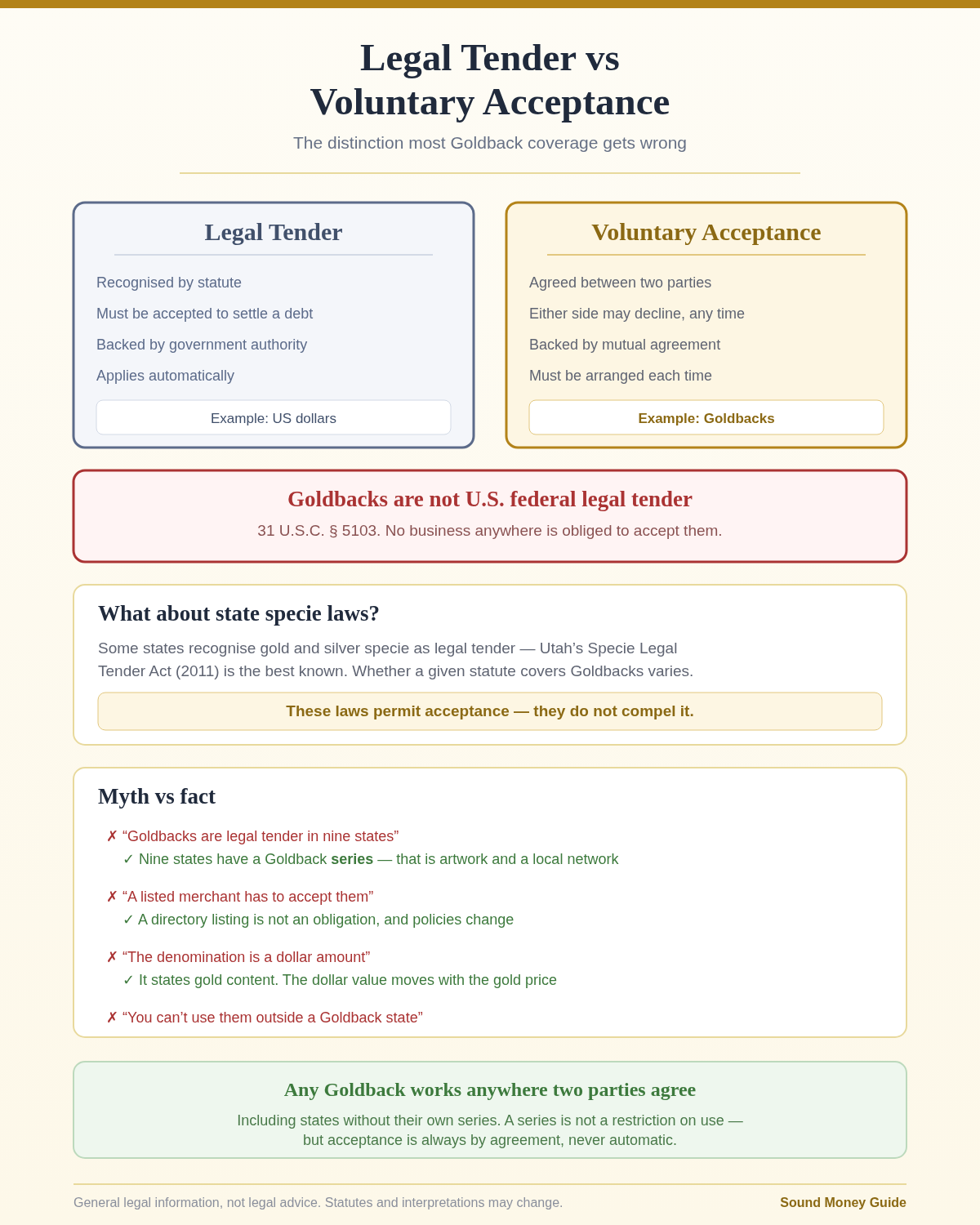
Legal tender must be accepted; voluntary acceptance is agreed each time. Goldbacks are the latter.
Before diving into state specifics, understand what legal tender means practically:
Legal tender status means a currency must be accepted for the payment of debts. In the US, only the US dollar has universal legal-tender status at the federal level.
"Voluntary currency" means businesses can choose to accept it. Nothing prevents a business from accepting Goldbacks, Bitcoin, or any other alternative — but they aren't required to.
For Goldbacks specifically, the practical distinction matters less than most people think:
- Legal tender status doesn't guarantee acceptance — Utah Code 59-1-1502(2) provides that, except as expressly provided by contract, no person can be compelled to accept even genuine specie legal tender
- Voluntary currency status doesn't prevent acceptance — Goldback reported 5,491 participating merchants in its July 2026 update (company-reported, point-in-time)
The 2011 Utah Specie Legal Tender Act recognises gold and silver coin issued by the federal government. It does not reach privately issued notes, so Goldback circulation in Utah rests on the same voluntary acceptance as everywhere else.
Utah: A Sales-Tax Exemption, Not Legal Tender
Utah passed the Specie Legal Tender Act in 2011, recognizing US-minted gold and silver coins as legal tender within the state. This legal framework became the foundation for the Goldback concept when it launched in 2019.
What Utah actually provides for Goldbacks:
- A sales-and-use-tax exemption under Utah Code 59-12-104(90), available only to items that do not constitute legal tender
- The densest merchant network of any Goldback state (848 participating Utah merchants reported by Goldback on 23 July 2026, and "over 870" in its launch article of 25 August 2026 — company-reported figures, not an audited count)
- A long-established local dealer and sound-money community
Utah is where the Goldback ecosystem began, and the state's sound-money environment is part of why. None of that makes a Goldback legal tender.
An important nuance, though. Utah is the only state with Goldback-specific statutory recognition — but that recognition takes the form of a 2022 sales-tax exemption (HB268, effective July 1, 2022), and the statute grants that exemption expressly because a Goldback "does not constitute legal tender of a state, the United States, or a foreign nation."
In other words, Utah's own statute treats Goldbacks as not legal tender, while giving them favourable tax treatment. Utah Code 59-1-1501.1, "subject to Subsection 59-1-1502(3)", defines specie legal tender as gold or silver coin issued by the United States. Section 59-1-1502(3) allows other gold or silver coin or bullion to be treated as specie legal tender by one of two routes: a final, unappealable court judgment under (3)(a), or an Act of Congress under (3)(b). Neither has occurred, and a polymer note is in any case not obviously "coin or bullion". Goldback's counsel applied to the Utah State Tax Commission for a private letter ruling in November 2019; no granted ruling, court judgment, attorney-general opinion or revenue ruling establishing Goldbacks as legal tender has been located.
So the honest position is: Goldbacks circulate in Utah, as everywhere else, as voluntary currency — with a Utah tax advantage that exists precisely because they are not legal tender.
Idaho: A 2025 Specie Law — But It Does Not Cover Goldbacks
Idaho passed the Idaho Constitutional Money Act (H0177), signed in March 2025 and effective July 2025. (An earlier 2024 bill, H0627, was a different and non-operative measure — it is often misreported as the enacted law.)
What the Idaho Act covers:
- Legal-tender recognition for gold and silver coin and specie minted domestically
- Reduced tax burden on precious-metals transactions
- A growing local dealer and merchant network as adoption expands
Crucially, the Act turns on the statutory definition of "specie". Idaho Code 67-9802(6) covers stamped or imprinted coin with gold or silver content, or refined bullion "valued primarily based on its metal content and not its form". A Goldback is a polymer note rather than coin or bullion, and it trades far above its metal content, so the Act does not reach it — and no authoritative Idaho interpretation says otherwise. Treat any claim that Idaho made Goldbacks legal tender as unsupported.
States With Related Precious-Metals Legislation
Beyond Utah and Idaho, several states have passed legislation that provides related (though not identical) protections:
Alabama
Recognized US-minted gold and silver coins as legal tender. Extends similar treatment to some precious-metals holdings.
Missouri
Passed legislation providing tax treatment for precious metals similar to Utah's approach.
Wyoming
While not passing a specific Goldback legal-tender act, Wyoming has removed sales tax on precious metals and built one of the most crypto-and-metals-friendly regulatory environments in the US.
Texas
Established the Texas Bullion Depository in 2015 and has developed related payment infrastructure. The regulatory framework is favorable to precious-metals holders.
New Hampshire
No specific legal-tender act for Goldbacks, but the Free State Project has created one of the densest voluntary Goldback acceptance networks in the US.
None of these states, and neither Utah nor Idaho, gives Goldbacks legal-tender status. Their broader precious-metals-friendly frameworks still make them practical operating environments for Goldback commerce.
What "Legal Tender" Means in Practice for Goldback Buyers
The answer is the same in every state, but the reason it rarely matters depends on how you plan to use your Goldbacks:
If You're Buying to Hold as Savings/Investment
Legal-tender status is not in play at all. Your Goldbacks contain real gold. Their value is tied to gold spot plus collector premium, and that is the same in every state.
If You're Buying to Spend as Currency
Merchant acceptance matters more than legal status. Utah has the densest participating-merchant network of any Goldback state (848 reported on 23 July 2026, and "over 870" on 25 August 2026, both company-reported) — the legal framework helped build that network, but the acceptance itself is what enables spending. In other states, voluntary merchant acceptance is what determines spendability.
If You're a Business Owner Considering Accepting Goldbacks
Accepting Goldbacks is a voluntary business decision in every state, including Utah. No state law obliges a business to take them, and none gives them legal-tender status. Tax treatment does differ by state: Utah exempts them from sales tax precisely because they are not legal tender. Consult a business attorney for state-specific guidance.
State-By-State Summary (Mid-2026)
| State | State Specie Law (None Covers Goldbacks) | Goldback Series | Merchant Density |
|---|---|---|---|
| Utah | 2011 Specie Act (federally issued coin only) | ✅ 2019 (original) | Highest |
| Idaho | 2025 Constitutional Money Act (coin and specie only) | ✅ 2026 (newest) | Growing rapidly |
| Alabama | ✅ Related legislation | ❌ No state series | Low |
| Missouri | ✅ Related legislation | ❌ No state series | Low |
| Wyoming | ⚠️ Related tax laws | ✅ 2022 | High |
| Texas | ⚠️ TX Bullion Depository | ❌ No state series | Moderate |
| Nevada | ❌ No specific act | ✅ 2020 | Moderate |
| New Hampshire | ❌ No specific act | ✅ 2021 | High (via FSP) |
| South Dakota | ❌ No specific act | ✅ 2023 | Moderate |
| Arizona | ❌ No specific act | ✅ 2025 | Growing |
| Florida | ❌ No specific act | ✅ 2025 | Growing |
| Oklahoma | ❌ No specific act | ✅ 2025 | Growing |
| All other states | ❌ No specific act | ❌ No state series | Voluntary only |
Federal Perspective
Federal law recognizes US coins and currency as legal tender, under 31 U.S.C. 5103. Federal law does not prevent states from recognizing gold and silver coin as legal tender within their borders, which is the basis for Utah's 2011 Act and Idaho's 2025 Act. Neither Act reaches privately issued notes.
Constitutional basis: the US Constitution allows states to make gold and silver "a tender in payment of debts" (Article I, Section 10). This is the legal foundation the states use to enable Goldback recognition.
Goldback Inc. and UPMA operate lawfully as private businesses. That is a different question from whether any state recognises their notes as money, and none does.
Practical Implications by Buyer Type
If You Live in Utah
- Merchant acceptance is highest
- Sales-tax treatment is most favorable, under the 59-12-104(90) exemption
- Everyday spending is easiest, because the network is densest rather than because of any legal status
If You Live in Idaho
- Merchant network is growing rapidly
- A newly launched state series with expanding dealer coverage
- The 2025 Constitutional Money Act does not cover Goldbacks, so acceptance remains voluntary
If You Live in Wyoming, New Hampshire, or Nevada
- No Goldback-specific legislation, and state environments are otherwise favorable
- Merchant acceptance varies but is growing
- Business and tax questions require careful local review
If You Live Elsewhere in the US
- Goldbacks function as voluntary currency
- You can hold them, spend them at accepting merchants, and use them for gifts or investment
- Legal protections come from Goldback Inc.'s corporate structure and UPMA's cooperative framework, not from state legal-tender status
Should Legal-Tender Status Affect Your Buying Decision?
Rarely, and not in the way most buyers expect:
It Matters If:
- You are relying on a claim that some state has made Goldbacks legal tender, in which case the answer is that none has
- You're a business owner considering accepting Goldbacks commercially
- You're structuring a large-scale Goldback commercial operation
It Doesn't Matter (Much) If:
- You're buying Goldbacks to hold as savings or investment
- You want to spend Goldbacks at existing merchants
- You're building a Goldback collection
- You're gifting Goldbacks
For most individual buyers, legal-tender status is interesting background — not a decision driver. Your Goldbacks have the same gold content and value in every state.
Frequently Asked Questions
Are Goldbacks legal tender in the US?
No. Goldbacks are not legal tender in any state or under federal law. They circulate as voluntary currency, accepted by merchants who choose to take them.
Can I spend Goldbacks outside Utah and Idaho?
Yes, at any merchant that voluntarily accepts them. Goldback reported 5,491 participating merchants in its July 2026 update — a company-reported, point-in-time figure, not an audited count — with acceptance denser in states that have their own series.
Does legal-tender status affect the value of my Goldbacks?
No. Goldback value comes from gold content and collector premium. No state grants Goldbacks legal-tender status, so it is not a factor in their value anywhere.
Are Utah Goldbacks more valuable because of Utah's Specie Legal Tender Act?
No. The Act does not cover Goldbacks at all. Utah notes are the original 2019 series, and collector demand for early prints and Alphas is priced accordingly, but the underlying gold content is identical across all state series.
Can businesses in my state accept Goldbacks?
Yes. Any US business can voluntarily choose to accept Goldbacks, regardless of state law. Business owners should consult a local attorney about tax and legal implications specific to their state.
Will more states pass Goldback legal-tender acts?
Unknown. Several states have passed general gold and silver specie legislation, including Utah, Idaho, Alabama and Missouri, but none of those laws covers privately issued notes, and no state has enacted a Goldback-specific legal-tender measure. Any view on future legislation is speculation.
Does the US Constitution allow Goldbacks?
Nothing prohibits them. Article I, Section 10 allows states to make gold and silver "a tender in payment of debts", which is the basis for state specie laws. Those laws address gold and silver coin, not privately issued notes, so none of them recognises Goldbacks.
Bottom Line
Goldbacks are not legal tender under federal law (31 U.S.C. 5103) or under any state law, including Utah's Specie Legal Tender Act. They circulate as a voluntary currency that merchants accept by choice, and Utah's sales-tax exemption for them under 59-12-104(90) applies precisely because they do not constitute legal tender.
For most individual buyers, this legal status is interesting context but doesn't materially affect purchasing decisions. Your Goldbacks contain real gold, have real value, and function as savings, collectibles, or spendable currency regardless of where you live.
For business owners considering commercial Goldback acceptance, or for anyone structuring larger-scale operations, the point to understand is that acceptance is voluntary everywhere and no state law changes that.
Whichever state you live in, Goldbacks work as a legitimate physical asset backed by real 24-karat gold. The legal framework matters most for commercial applications, less for individual buyers.
👉 Browse Goldbacks at Alpine Gold Exchange
👉 Explore UPMA for Vaulted Goldback Holdings
For the full breakdown of Utah's role as the flagship Goldback state, see our Utah Goldbacks Review 2026.
This article is for educational purposes only and does not constitute legal or financial advice. Legal-tender status and precious-metals regulations vary by state and change over time. Always consult a qualified attorney about state-specific legal implications, and a tax professional about tax implications.
Continue Reading