What Is Sound Money? Complete 2026 Guide (And Why It Matters Now)

You've probably heard the phrase "sound money" in a podcast, a financial blog, or somewhere on X. Maybe it came up alongside inflation, gold, or Bitcoin. But what does sound money actually mean, and why has interest in it grown in 2026?
This guide breaks down sound money in plain English, walks through its history, explains the six properties that define it, and shows the practical options available to Americans who want to hold value that fiat currency can't easily erode.
- Sound money is defined by properties, not by decree: durability, portability, divisibility, uniformity, limited supply and general acceptability.
- Gold has historically satisfied those properties, which is why it recurs across unrelated civilisations rather than by coordination.
- Fiat currency fails the limited-supply test by design. That is the mechanism behind long-run purchasing-power erosion.
- Goldbacks are an attempt to restore divisibility and portability to physical gold, which coins and bars handle poorly at small values.
- Holding sound money is a purchasing-power strategy, not an income strategy. Metal pays no yield and its price can fall.
What Is Sound Money? (Plain English Definition)
Sound money is money that cannot be easily debased by governments or central banks.
The core idea: real money should hold its value over time. If you save $10,000 today, you should be able to buy roughly the same amount of goods and services with it in 20 years. That's the promise money is supposed to keep.
Fiat currency — dollars, euros, yen, any paper money not backed by a physical commodity — strains that promise. Governments can print more of it, and every new unit created tends to reduce the purchasing power of every existing unit. That's inflation. Over long periods, it adds up.
Sound money is the opposite of that. It's money that can't be printed on demand. Historically that meant gold and silver. Increasingly in 2026, it also includes gold-backed currencies like Goldbacks, and in some views, Bitcoin.
The philosophical bet behind sound money is simple: if money can't be created out of thin air, governments can't quietly tax you through inflation.
Sound Money vs Fiat: The Core Difference
The clearest way to see the difference:
| Feature | Fiat Currency (USD, EUR, etc.) | Sound Money (Gold, Silver, Goldbacks) |
|---|---|---|
| Can be printed at will | Yes, effectively unlimited | No — supply is physically constrained |
| Loses value to inflation | Historically, yes | Aims to retain purchasing power over time |
| Backed by a physical commodity | No | Yes (gold, silver) |
| Counterparty risk | Yes (banks, government) | Minimal (if self-custodied) |
| Controlled by | Central bank | Physics and mining production |
| Long-term purchasing power | Tends to erode | Aims to preserve, but can still fluctuate |
A note on the comparison: gold has historically held purchasing power far better than fiat over long periods, but it is volatile and has had long flat or falling stretches. Sound money is not a guaranteed return — it's a different foundation with a different risk profile.
A Brief History of Sound Money
Understanding where sound money went helps explain the current interest in bringing it back.
The Gold Standard Era (Before 1971)
For most of American history, the dollar was directly tied to gold. You could take a dollar to a bank and demand its equivalent in gold. This kept inflation low for long stretches.
Bretton Woods (1944-1971)
After World War II, the world established the Bretton Woods system: the US dollar was backed by gold at $35 per ounce, and every other major currency was pegged to the dollar. Gold was the anchor.
The 1971 Nixon Shock
On August 15, 1971, President Nixon announced the US would "temporarily" suspend the dollar's convertibility to gold. That suspension became permanent. From that day forward, no major world currency has been backed by anything physical.
The Fiat Era (1971 to Now)
Since 1971, every dollar has been pure fiat — its value comes from government decree and public trust. The US M2 money supply has expanded enormously over that period, and the dollar's purchasing power has fallen substantially. (Exact figures depend on the start and end dates and the measure used, so treat any single headline percentage as illustrative rather than precise.)
The 2020s Renaissance
Large money creation during and after COVID triggered inflation not seen since the 1970s. That renewed interest in sound money — gold, silver, Bitcoin, and physical gold currencies like Goldbacks — and that interest has continued into 2026.
The 6 Properties of Sound Money
For something to function as sound money, it needs to check all six of these boxes. This framework traces back to Aristotle and was expanded by economists over centuries.
1. Durable
It has to physically last. Gold and silver last effectively forever — ancient coins still function today. Fresh fruit, no matter how valuable, cannot be sound money.
2. Portable
It has to be transportable without extreme difficulty. Gold and silver score high. Real estate, no matter how valuable, is not portable enough to function as money.
3. Divisible
It has to be divisible into smaller units without losing value. Full-size gold coins are hard to use for small transactions. This is where Goldbacks address an old problem: they make gold divisible in fractions as small as 1/1000th of an ounce.
4. Fungible
Every unit has to be interchangeable with every other unit. One ounce of pure gold equals every other ounce of pure gold. Rare art fails this test — every painting is unique.
5. Scarce (Naturally Constrained Supply)
Supply cannot be arbitrarily increased. This is where fiat currency fails hardest — governments can always print more. Gold's supply grows only slowly through mining. Bitcoin's is mathematically fixed. That scarcity supports value.
6. Recognizable
People need to be able to verify authenticity. Gold's density and hallmarks make it recognizable. Modern Goldbacks use serialization, microprinting, and UV-reactive ink to make counterfeiting difficult.
Fiat currency fails on scarcity — the most important property of the six. That's the core weakness sound-money advocates focus on.
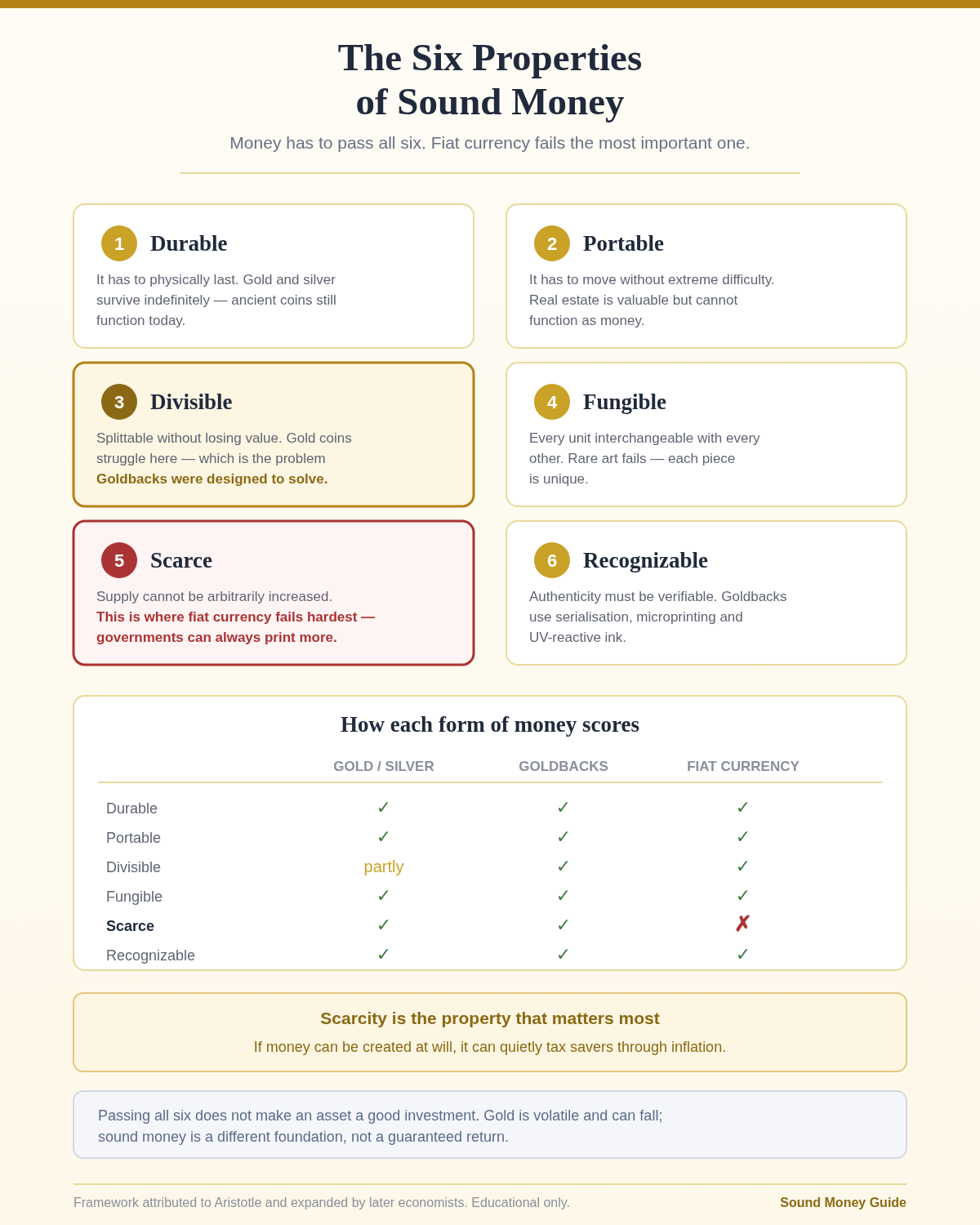
All six properties, scored across gold, Goldbacks and fiat. Scarcity is where fiat fails.
See What Inflation Does to Your Dollars
Enter a dollar amount, your own assumed inflation rate, and a number of years to see the erosion in purchasing power. This tool uses your assumptions, not a fixed historical claim — it won't tell you what any particular past decade "really" did, only what your chosen inflation rate implies.
Open the Inflation Purchasing Power Calculator →
Why Sound Money Matters in 2026
A few forces have kept sound money relevant:
1. Sustained Inflation
Post-COVID monetary expansion pushed US inflation to multi-decade highs. Even with recent moderation, the cumulative effect on purchasing power is real for anyone holding dollars through that period.
2. Government Debt Levels
US federal debt has climbed to historic levels. When debt reaches this scale, governments historically face three options: default, austerity, or inflate the debt away. The third has often been the path of least resistance, and it acts as a quiet tax on savers.
3. Currency Debasement Globally
The US isn't alone — every major economy has expanded its money supply significantly. Some countries have shown what late-stage fiat looks like. That awareness has driven interest in alternatives.
The practical result: more Americans are asking a simple question: "Is there a way to hold savings in something that can't be printed?" The answer, increasingly, is yes.
Save in Gold vs Cash Calculator
Compare a cash-savings scenario with a gold-based one over time, using your own assumptions. This is a "what if" tool, not a forecast — you enter the inflation, cash rate, and gold-growth assumptions, and it does the math on your inputs. Gold can fall as well as rise; enter conservative or even negative figures to stress-test.
Open the Save in Gold vs Cash Calculator →
Modern Sound Money Options
Here are the practical ways to hold sound money in 2026:
Physical Gold and Silver Bars/Coins
The classic option. Gold Eagles, Krugerrands, silver rounds, gold bars. Pros: universal recognition, high liquidity, deep markets. Cons: hard to divide for small transactions, requires secure storage.
Goldbacks
Physical gold currency notes containing precise fractions of an ounce of 24-karat gold. They address the divisibility problem — you can hold gold in denominations as small as a few dollars. As of July 2026, Goldback's own buying guide lists nine states with full series (Arizona, Florida, Idaho, Nevada, New Hampshire, Oklahoma, South Dakota, Utah, Wyoming). Goldbacks can also be exchanged anywhere two parties voluntarily agree, even in states without a series.
Goldbacks are not legal tender in any state: Utah's Specie Legal Tender Act covers federally issued gold and silver coin, not privately issued notes. Everywhere, including Utah, they are voluntary currency — accepted by merchants who choose to, not required.
Gold Savings Accounts
Accounts denominated in physical gold rather than dollars. An Alpine Gold Account (formerly commonly called a UPMA account) is one example — you deposit dollars or gold, your balance is held in metal, and you can spend it via a linked debit card or withdraw physical gold. It's operated by Alpine Gold (a dealer, not a bank; not FDIC-insured), with the metals held in a vault Alpine says is insured through Lloyds of London; Alpine does not publish who operates that vault (captured 24 September 2026).
Gold Leasing Programs
An advanced option for holders wanting a return on their gold. Alpine Gold's leasing program lets you earn a metal-paid return on stored gold, paid in more metal. Returns are not guaranteed and carry counterparty risk — see our Alpine Gold Leasing Review.
Bitcoin
Not physical, but many consider it sound money on the scarcity criterion (fixed supply of 21 million). Different risk profile than physical metals. A complement, not a replacement.
How to Start Saving in Sound Money
If you're new to sound money and want to actually start, here's a practical progression:
1. Learn the Basics (You're Doing That Now)
Read a few articles, understand the concept, decide it makes sense for you.
2. Buy a Small Amount of Physical Gold or Goldbacks
Start with Goldbacks. They're the most affordable entry — you can buy a single 1 Goldback note for a few dollars and hold physical 24-karat gold. If you'd rather start with traditional bullion, a 1/10 oz Gold Eagle is a solid entry.
3. Consider a Gold Savings Account
If you want gold balances you can grow over time and spend via a debit card, look at an Alpine Gold Account. It's one of the more practical ways to hold some of your savings in metal rather than dollars.
4. Advanced: Consider a Leasing Program
Once you hold meaningful gold, look at yield options like Alpine Gold's leasing program — earning a metal-paid return on otherwise-idle gold, with the counterparty risk understood.
5. Understand the Legal Environment
Several states, Utah and Idaho among them, recognise gold and silver coin as legal tender. Those laws cover coin and specie rather than privately issued notes, so they do not make Goldbacks legal tender anywhere. Sound-money-friendly tax treatment is real and worth understanding; legal-tender status for Goldbacks is not something any state offers.
The goal isn't to abandon dollars. Sound money works alongside conventional finance, not against it. Most people who adopt sound money hold both — dollars for daily transactions, sound money for long-term savings.
Frequently Asked Questions
Is sound money the same as gold?
Gold is the classic example of sound money, but the term applies to any money that meets the six properties (durable, portable, divisible, fungible, scarce, recognizable). Silver qualifies. Goldbacks qualify. Bitcoin qualifies on most criteria. Fiat currencies don't.
Are Goldbacks legal tender?
No. Goldbacks are not legal tender in any state or under federal law. They function as voluntary currency — accepted by merchants who choose to take them. Goldback reports a growing (company-reported) network of accepting businesses; see our Goldback Statistics guide for the dated figures.
How is a gold savings account different from a bank account?
A bank account holds dollars, which lose value to inflation over time, but is FDIC-insured. An Alpine Gold Account holds metal, whose purchasing power tracks gold (up or down), and is not FDIC-insured. Different risks, different foundations.
Can I actually spend sound money?
Yes. Goldbacks are accepted at merchants that voluntarily take them, and can be spent directly. Gold savings accounts often include a debit card that lets you spend gold-backed dollars anywhere the card network is accepted.
Do I have to give up my regular bank account?
No. Sound money works alongside conventional finance. Most people hold both — dollars for transactions, gold-based holdings for savings.
Is this financial advice?
No. This is educational content about how sound money works. Consult a financial advisor before making significant changes to how you hold savings.
Bottom Line
Sound money is money that can't be printed at will — money that aims to preserve purchasing power over time rather than erode it. Historically that meant gold and silver. In 2026, it includes gold-backed currencies like Goldbacks, gold savings accounts, and advanced products like gold leasing.
You don't have to become a sound-money purist to benefit from it. Adding some sound money to your savings alongside your dollars is a practical hedge against currency debasement — one that many Americans have been rediscovering since 2020. Just remember gold is volatile and carries no guarantee; size any position to your own comfort.
The easiest place to start is with Goldbacks (physical gold you can hold for a few dollars per note) or an Alpine Gold Account (dollars converted to gold, spendable via debit card).
👉 Browse Goldbacks at Alpine Gold Exchange
👉 Review the Alpine Gold Account
This article is for educational purposes only and does not constitute financial advice. Consult a qualified financial advisor before making significant changes to how you hold savings. Precious metals prices fluctuate. Past performance does not guarantee future results.
Continue Reading