How Much Gold Is in a Goldback? Denominations, Gold Content, and Value Explained

A 1 Goldback contains 1/1,000 of a troy ounce of 24-karat gold. Every other denomination is a fixed multiple of that base unit.
Gold content is embedded, not printed as a dollar face value. The dollar figure you pay changes with the live gold price and the current Goldback reference exchange rate.
Key takeaways
- The base unit is 1 Goldback = 1/1,000 troy ounce of 24k gold.
- Goldback's own live pages give different denomination counts: the buying guide lists eight (and omits the 100) while the About page lists nine values including the 100 — so we name the values and cite the page, not a single count.
- The 100 Goldback is being discontinued — Goldback confirmed on 23 March 2026 that no new 100s will be produced and upcoming releases will not include it, so treat it as a legacy denomination available while inventory lasts; existing 100s remain accepted in the network; availability varies by series, edition, and seller. Florida carries the full set; the refreshed Utah series lists ¼, ½, 1, 2, 5, 10, 25 and 50; Nevada, New Hampshire and Idaho list 1, 5, 10, 25, 50.
- Melt value = live spot ÷ 1,000 × the denomination. Nothing is hard-coded.
- Retail price sits above melt because of the manufacturing premium — the smaller the denomination, the higher the premium per ounce.
How much gold is in one Goldback?
A single 1 Goldback holds 1/1,000 of a troy ounce of .999 fine 24-karat gold. That is the base unit of the whole system, and every other denomination scales directly from it.
The gold is real and embedded in the note through Valaurum's Aurum vacuum-deposition process, not printed ink or plating. What a Goldback does not have is a fixed dollar face value — the denomination number tells you how many "Goldback units" of gold it holds, and the dollar figure comes from the live gold market and the current reference exchange rate.
Gold Content by Denomination
Goldback's own pages currently give different denomination counts, so we name the values with an as-of date and cite the specific page rather than publishing a single number:
- Buying guide (goldback.com/where-to-exchange/, captured 6 September 2026): states “five standard denominations: 1, 5, 10, 25, and 50” plus “the 1/4, 1/2, and 2 denominations for series released in 2025 and on” — eight in total, omitting the 100.
- About page (goldback.com/about-goldbacks/, captured 6 September 2026): reads “Goldbacks are available in eight denominations for easy exchange” and lists exactly eight (¼, ½, 1, 2, 5, 10, 25, 50).
When we captured these pages on 24 July 2026 they disagreed: the About page then listed nine values including the 100, under a heading that already said “eight denominations.” On recapture the 100 has gone and the two agree. The earlier disagreement is recorded here because it explains why older coverage cites nine.
| Denomination | Gold content (troy oz) | Multiple of 1 Goldback |
|---|---|---|
| ¼ Goldback | 1/4,000 | 0.25× |
| ½ Goldback | 1/2,000 | 0.5× |
| 1 Goldback | 1/1,000 | 1× |
| 2 Goldback | 1/500 | 2× |
| 5 Goldback | 1/200 | 5× |
| 10 Goldback | 1/100 | 10× |
| 25 Goldback | 1/40 | 25× |
| 50 Goldback | 1/20 | 50× |
| 100 Goldback | 1/10 | 100× |
As of July 2026, per Goldback's official About page and buying guide (captured July 24, 2026). The 100 Goldback is being discontinued — Goldback confirmed on 23 March 2026 that no new 100s will be produced and that upcoming releases will not include the denomination. It may remain available while inventory lasts, but should not be expected in future series, and discontinuation alone does not establish collector value. Verify current specs against official sources before purchase.
Each denomination holds a fixed amount of gold. A 1 Goldback from Utah has the same 1/1,000 troy ounce as a 1 Goldback from Florida — only the artwork differs.
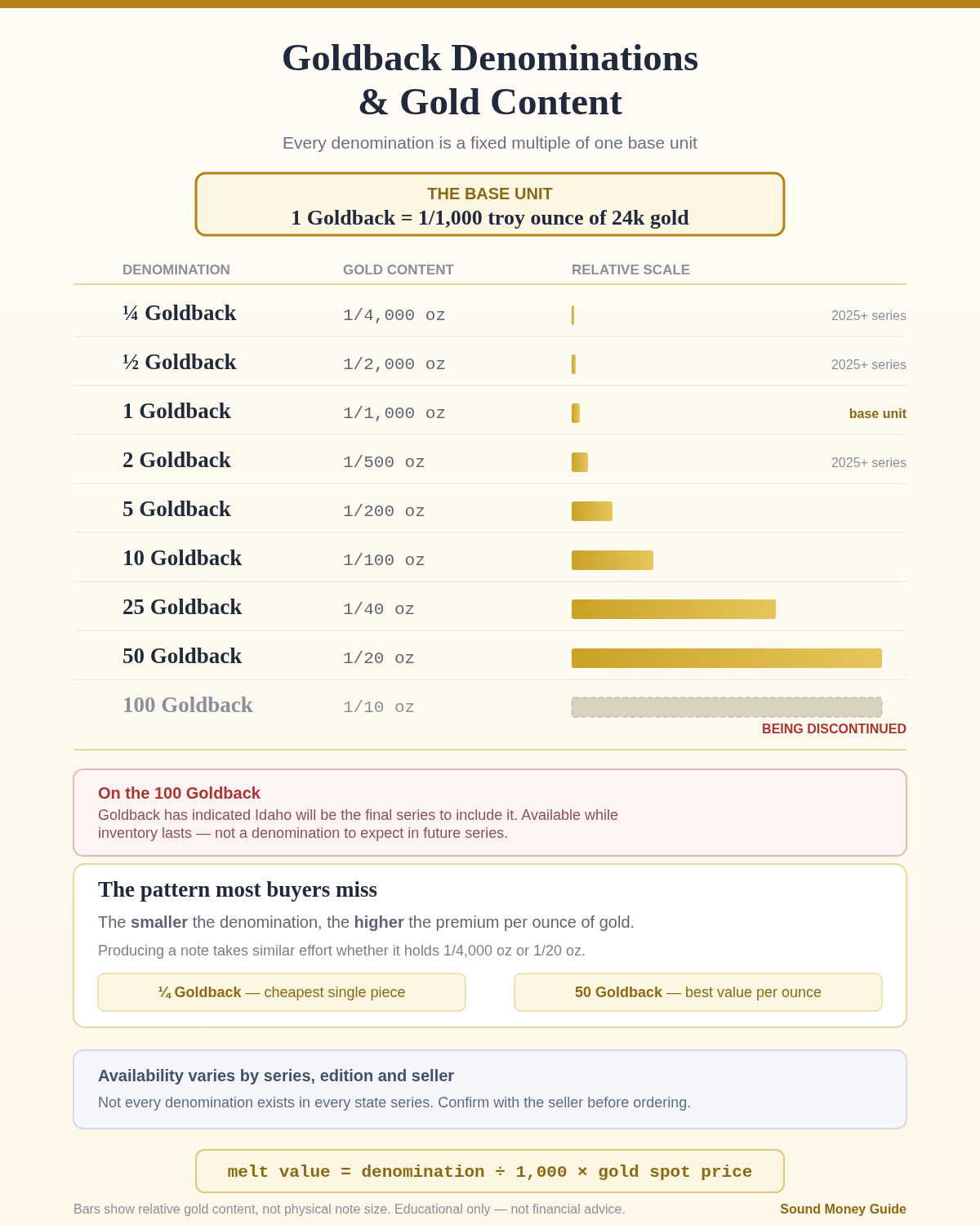
Relative gold content by denomination. The smaller the note, the higher the premium per ounce.
Which denominations are actually available?
This is where most guides get it wrong. Availability varies by series, edition, and seller — not every denomination exists in every series.
| Series | Standard / current denominations (as of July 2026) |
|---|---|
| Florida | ¼, ½, 1, 2, 5, 10, 25, 50, 100 (full listed set, incl. the 100) |
| Utah | ¼, ½, 1, 2, 5, 10, 25, 50 (refreshed series; earlier notes listed 1, 5, 10, 25, 50) |
| Nevada | 1, 5, 10, 25, 50 |
| New Hampshire | 1, 5, 10, 25, 50 |
| Idaho | 1, 5, 10, 25, 50 (standard) |
| Other series | Confirm before purchase |
Three important edition notes:
- The 100 Goldback is being discontinued (as of July 2026). It is a real denomination (1/10 troy ounce), but Goldback confirmed on 23 March 2026 that no new 100s will be produced and that upcoming releases will not include the denomination. Existing notes may remain available while inventory lasts — do not assume it will appear in future series, and do not assume discontinuation alone creates collector value.
- Idaho Alpha fractionals. Alpine's live collection separately lists Idaho ¼, ½, and 2 Alpha products (captured July 22, 2026). Those are collectible Alpha editions, not the standard Idaho circulating set. Track standard and Alpha availability separately.
- The ¼ denomination launched with the Florida ¼ on July 7, 2026 (1/4,000 troy ounce). Other state quarters roll out over time. See the Quarter Goldback Denomination Guide.
- Limited Early Releases such as the Utah 3 LER are graded collectibles, not standard denominations. See the Utah 3 Goldback LER guide.
How the Denomination System Works
The system is built on 1/1,000 of a troy ounce as the base unit. Every denomination is a whole or fractional multiple of that base:
- ¼ Goldback = one quarter of the base (1/4,000 oz)
- ½ Goldback = half the base (1/2,000 oz)
- 2 Goldback = double the base (1/500 oz)
- 100 Goldback = one hundred times the base (1/10 oz)
Because the ratios are fixed, you can always work out the gold content from the denomination number: divide the denomination by 1,000 to get the troy ounces of gold.
Calculate the Value Yourself
Use the calculator below to see the embedded gold (melt) value, the reference exchange value, and how any quoted price compares. Enter today's live figures — nothing is hard-coded.
Open the Goldback Value Calculator →
Why does retail cost more than the melt value?
Every Goldback trades above its raw gold value. That gap is the manufacturing premium, and it exists because:
- putting a precise fraction of a gram of gold into a durable, spendable note is a specialized process;
- the note carries artwork, security features, and a state-series design;
- distribution and dealer margins are built in.
The key pattern: the smaller the denomination, the higher the premium per ounce of gold. The manufacturing effort is broadly similar whether a note holds 1/4,000 oz or 1/20 oz, so the smallest notes cost the most relative to their gold content. A quarter Goldback is the cheapest single piece you can buy, but the least gold-efficient by weight.
To see how the three numbers — melt, reference exchange value, and retail — relate, use the Goldback Exchange Rate vs Melt Value guide.
Which denomination should you buy?
It depends on your goal, not on a single "best" answer:
- Smallest cost / gifting / change: ¼ or ½ Goldback (where available) or a 1 Goldback. Highest premium per ounce, lowest absolute price.
- Everyday balance: 1, 5, and 10 Goldbacks give a practical spread.
- Most gold per dollar: larger denominations like 50 carry the lowest premium per ounce.
- Collecting: state-series and Alpha editions, understood as collectibles rather than gold-accumulation vehicles.
For most people starting out, a mix of 1, 5, and 10 Goldbacks covers the range without over-committing.
Frequently Asked Questions
How much gold is in a 1 Goldback?
1/1,000 of a troy ounce of .999 fine 24-karat gold. That is the base unit of the denomination system.
How much gold is in a 50 Goldback?
1/20 of a troy ounce (0.05 troy oz) of 24-karat gold — fifty times the base unit.
What is the smallest Goldback denomination?
The ¼ Goldback (1/4,000 troy ounce), which launched with the Florida ¼ on July 7, 2026. Availability by state and edition varies — see the Quarter Goldback guide.
How many Goldback denominations are there?
Goldback's own pages differ: its buying guide lists eight values (1, 5, 10, 25, 50 standard, plus ¼, ½, 2 for 2025+ series) and omits the 100, while its About page lists nine values including the 100 under an "eight denominations" heading. Because the official source is internally inconsistent, name the values with a date rather than a fixed count. The 100 is being discontinued — Goldback confirmed on 23 March 2026 that no new 100s will be produced and that upcoming releases will not include the denomination — so treat it as a legacy denomination available while inventory lasts; availability also varies by series and edition.
Do all state series have the same gold content per denomination?
Yes for the same denomination — a 1 Goldback is 1/1,000 troy ounce regardless of state. Only the artwork and which denominations are offered differ by series (for example, the 100 is currently Florida-only).
Can I calculate a Goldback's value myself?
Yes. Multiply the denomination by 1/1,000 of a troy ounce to get the embedded gold, then multiply by the live spot price for melt value. Use the calculator above, and compare against the current Goldback reference exchange rate and dealer listings.
Bottom Line
A Goldback's gold content is precise and fixed: 1 Goldback = 1/1,000 troy ounce of 24-karat gold, with every denomination a set multiple of that base. What changes is the dollar figure — driven by the live gold price and the current reference exchange rate — and which denominations a given series and seller actually offer (the 100, for instance, is being discontinued — Idaho is indicated as the final series to include it — and Goldback's own pages differ on the total count). Name the verified values, calculate with live inputs, and treat collectibles and Alpha editions separately from standard denominations.
👉 Browse Goldbacks at Alpine Gold Exchange
Educational content only, not financial advice. Gold prices and the Goldback reference exchange rate change constantly; figures should be confirmed live. Availability and specifications vary by series, edition, and seller and should be verified against official Goldback sources before purchase. Past performance does not guarantee future results.
Methodology
Gold content is the most stable fact in this niche, which is exactly why it is worth recording precisely.
- Gold content is a published specification, read directly from Goldback Inc. material. It is not measured by us, not estimated, and does not change: a 1 Goldback holds 1/1000 of a troy ounce of 24-karat gold, and every other denomination is a stated multiple of that unit.
- Denomination availability is not fixed and varies by state series and over time. Each availability statement here carries the date its source page was read, principally July 24, 2026.
- Where Goldback’s own pages disagree, both readings are shown. Their buying guide and About page have listed different denomination counts, and we cite each page rather than choosing one silently or averaging them.
- Gold content is not price. Nothing in this table is a value, a rate or a dealer price. What a denomination costs depends on the spot gold price, the published reference exchange rate and the individual seller, all of which move independently of the fixed metal content.
How to Cite This Page
Gold content can be cited directly, since it is a fixed specification. Availability and denomination counts should be re-checked, as series change.
The Goldback Guide, “How Much Gold Is in a Goldback? Denominations, Gold Content, and Value Explained.” Specifications read from Goldback Inc. sources, July 24, 2026. Available at: https://thegoldbackguide.com/how-much-gold-is-in-a-goldback/
Denomination availability varies by state series and changes as new series launch; verify against Goldback’s live pages before republication.
Continue Reading