Are Goldbacks a Good Investment? An Honest 2026 Look

Goldbacks look interesting, but are they actually a good investment — or are you paying a large premium for pretty gold notes? This is an honest, educational walk-through, not a return forecast. The honest answer depends on what "investment" means to you, your holding period, and what you're comparing them to. We won't quote you an appreciation rate, because no audited one exists.
- Goldbacks are first a currency format, second a collectible — and only incidentally an investment. Judge them accordingly.
- The premium over melt is the central question. You pay it on entry and may not recover it on exit.
- No yield. Metal pays nothing unless separately leased, and any lease return is contractual, not guaranteed.
- Resale markets are thin relative to standard bullion. Verify completed sales, not asking prices, before assuming a value.
- If the goal is pure gold exposure at the lowest cost, conventional bullion is cheaper. Goldbacks buy divisibility and spendability instead.
The Short Answer
Goldbacks can suit a specific type of buyer — and are a poor fit for others. They are a physical collectible with real gold content, not a guaranteed-return instrument.
They may fit if you want:
- Physical gold exposure in a small, divisible, spendable format
- A collectible tied to a growing sound-money ecosystem
- To hold real gold you can also spend at participating merchants
- A long holding horizon and money you won't need back quickly
They're a poor fit if you want:
- Maximum gold-per-dollar (bars and 1 oz coins are far more efficient)
- Short-term trading or speculation
- Any guaranteed or government-insured return
- Instant, deep liquidity like a Gold ETF or a Gold Eagle
The rest of this is about understanding the trade-offs honestly.
Why We Won't Quote You a Return Figure
You'll see confident "Goldbacks have returned X% per year" claims, and especially eye-catching Alpha figures (85%, 250%, 800%). Here's why we don't republish them as fact:
- They come from thinly traded secondary-market asking prices, not audited transaction data.
- An asking price is not a completed sale. Unsold listings can sit far above what notes actually change hands for.
- The Alpha market is small and illiquid, so a handful of high listings can distort any "average."
- Goldback's own ecosystem figures (total value produced, merchant counts) are company-reported and not independently audited.
So instead of a fabricated rate, here's the honest structure of where value comes from — and where the risk sits.
The Two Things That Drive Goldback Value
1. Gold Content
Every Goldback contains a precise, verifiable amount of 24-karat gold. As gold moves, the melt value of your notes moves with it. That's the floor — but you pay a large premium over melt, so a Goldback is not a cheap way to accumulate raw gold. You also carry ordinary gold-price risk, which is real and can be negative.
2. Collector Premium
Alpha (first-print) editions, and to a lesser extent standard notes, can trade above melt because of collector demand and finite print runs. That premium can widen or narrow with demand, condition, and how many buyers are active. It is not a yield, not a schedule, and not guaranteed. Any specific "past appreciation" figure is an unaudited secondary-market number, not a documented or repeatable return.
What You're Actually Paying For (Cost Breakdown)
For a 1 Goldback at roughly $5–$7 in 2026, most of the price is premium over the gold content, not the gold itself. Compared with a gold bar (often a single-digit percent premium), a Goldback's premium over melt is large.
That premium buys you:
- Fractional gold ownership at accessible price points
- Spendability at participating merchants
- State-specific artwork
- Collector interest (especially Alphas)
- Portability and easy storage
If those features are worth it to you, the premium can be justified. If your only goal is gold content per dollar, bars or 1 oz coins are more efficient — that's not a knock on Goldbacks, just a different tool for a different job.
On merchant and ecosystem figures: Goldback's totals for value produced and accepting merchants are company-reported and change over time. Treat any figure like "$300M+ produced" or "3,000+ merchants" as a Goldback-reported, point-in-time number rather than an independently audited or evergreen fact.
Goldbacks vs Other Options (Qualitative)
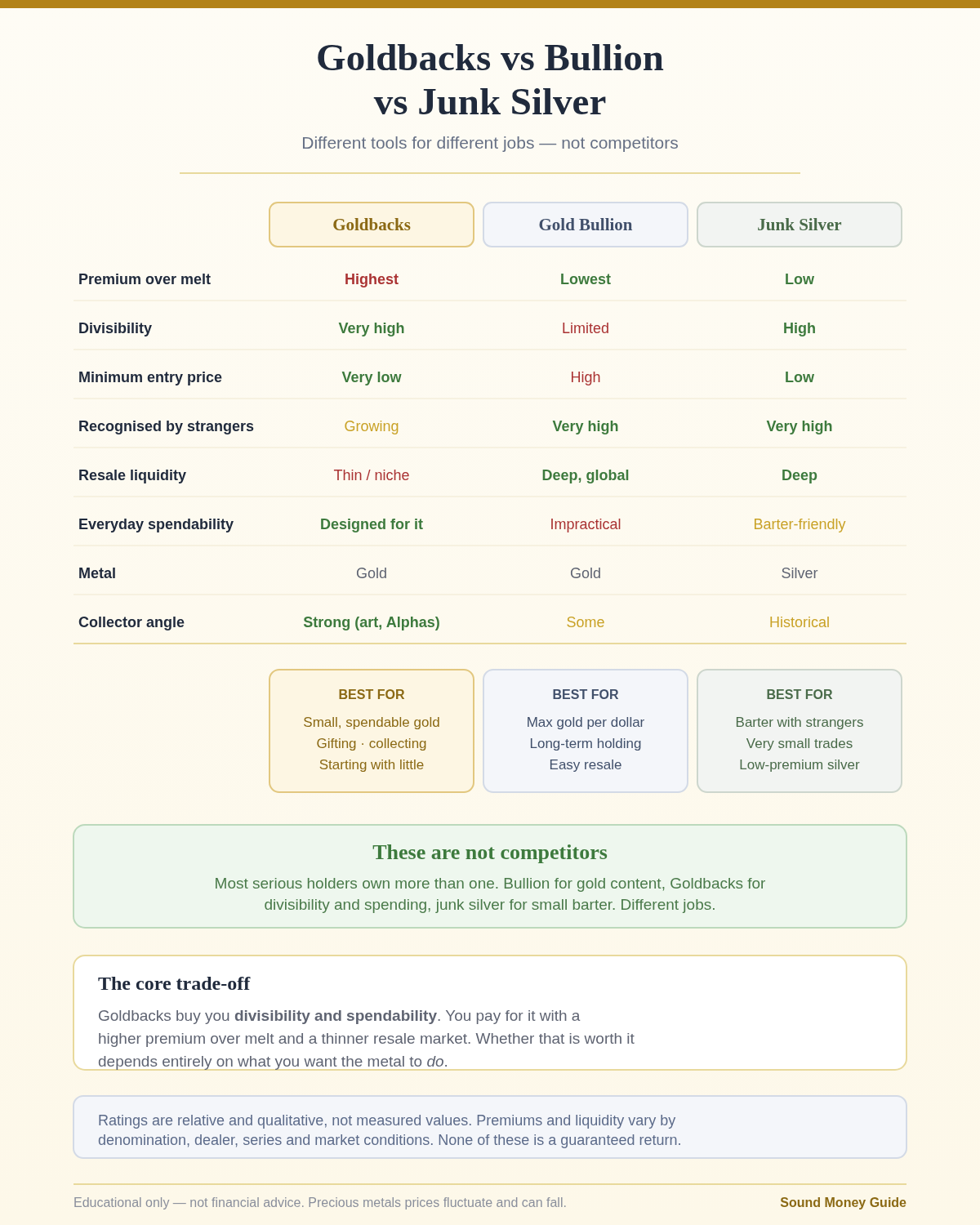
Different tools for different jobs. Most serious holders own more than one.
| Option | What it's best at | Trade-off |
|---|---|---|
| Standard Goldbacks | Small, divisible, spendable gold | Large premium over melt; collector market is thin |
| Goldback Alphas | First-print collectibility | Thinly traded; premium not guaranteed |
| Gold bars | Most gold per dollar | Not divisible or spendable |
| Gold coins (Eagles) | Liquidity + recognition | Higher entry price; limited divisibility |
| Gold ETFs | Easy, liquid gold exposure | Not physical; carries fees |
| Broad equities | Long-run growth | Not a physical asset; volatile; different risk |
The honest placement: Goldbacks are a niche physical collectible with a gold floor, best held alongside a core precious-metals or investment position, not instead of one. Neither Goldbacks nor gold generally carries a guaranteed return.
The Real Risks
- Gold price decline — melt value tracks gold; a gold drop lowers that floor. A collector premium may cushion Alphas somewhat, but not reliably.
- Thin liquidity — selling one or two notes is easy; moving a large collection quickly is not, and completed-sale prices often sit below asking prices.
- Premium compression — if supply expands or demand cools, the collector premium can shrink.
- Regulatory uncertainty — future IRS guidance or state legislation could change treatment.
- Storage and loss — physical notes need secure storage; fire, theft, and damage are real; insurance is not automatic.
The honest downside: worst realistic case, you hold gold worth roughly its melt value — which is less than you paid once the premium is stripped out. Whether the collectible upside is worth that risk is a personal decision, not a math certainty.
Why Marketplace Auction Prices May Differ From Dealer Prices
There's a specific trap worth knowing about before you buy, especially with the smallest denominations.
Alongside ordinary dealers, Goldbacks also change hands on livestream selling apps and auction-style marketplaces — the kind of fast-paced "buy it now while it's on screen" formats where emotion and competition drive bids. In buyer discussions online, some people have reported paying far more than ordinary dealer prices for very small Goldbacks (¼ notes in particular) bought in those live-auction settings.
Two honest caveats on that:
- This is anecdotal buyer concern, not verified market-wide pricing. The reports come from community discussion (for example, a Reddit thread), not an audited price dataset. Treat them as a reason to check prices yourself, not as proof of what "the market" charges.
- A high auction price is not a Goldback's value. As covered above, a Goldback has several different numbers attached to it — melt value, the reference exchange value, a normal dealer asking price, and whatever someone paid in the heat of an auction. The last of those is the least reliable guide to what a note is actually worth.
How to protect yourself: before buying any Goldback — but especially a small denomination in a live-auction format — compare the price you're being asked against:
1. the embedded melt value (denomination ÷ 1,000 troy ounce × the live gold spot price), 2. the current Goldback reference exchange value, and 3. a normal dealer asking price for the same note.
If a live-auction price sits well above what a regular dealer charges for the identical denomination and series, that's a signal to slow down, not a deal to grab. The smallest notes already carry the highest premium per ounce, so paying an extra auction markup on top can mean paying several times the embedded gold value. Use the Goldback Value Calculator and the exchange-rate vs melt guide to check any quoted price against these reference points, and remember that an asking price — auction or otherwise — is not a guaranteed resale value.
Should You Buy Goldbacks?
They May Fit If:
- ✅ You have a long holding horizon and won't need the money back quickly
- ✅ You want physical gold in a divisible, spendable format
- ✅ You value collectibility alongside gold content, with eyes open about no guaranteed return
- ✅ You already have a core bullion or investment position and want a small, distinct piece
- ✅ You accept a large premium over melt in exchange for the format's features
They're Probably Not for You If:
- ❌ You want maximum gold-per-dollar (buy bars)
- ❌ You need immediate liquidity for a large position
- ❌ You're looking for a short-term trade
- ❌ You want a guaranteed or insured return
- ❌ You have no other precious-metals base yet
A Sensible Middle Path for Many Buyers:
- A small standard-edition position for spendability and gold content
- Optionally a modest Alpha position for collectibility (with the caveats above)
- Held as a complement to broader holdings, sized to your overall allocation
If You Decide to Buy
For Goldback purchases, Alpine Gold Exchange offers:
- Full state series and Alpha inventory, including harder-to-find state Alphas
- UPMA partnership for insured, vaulted custody if you'd rather not store notes yourself
- Store-credit offers on qualifying orders (see current terms and thresholds)
- BBB accredited, A+ rating (BBB, captured 24 Sep 2026)
If you want vaulted, long-term custody instead of physical notes, you can open a UPMA account. Review their current spread, storage, and any leasing terms directly before committing — those are account features to evaluate, not guaranteed returns.
Frequently Asked Questions
Are Goldbacks a good long-term investment?
They can suit a buyer who wants physical, divisible, spendable gold with a collectible angle and is comfortable with no guaranteed return and a thin resale market. They're a poor fit for maximizing gold-per-dollar or for liquidity. There's no audited "annual return" for Goldbacks — any figure you see is an unaudited secondary-market number.
Are Goldbacks better than gold bars?
For pure gold-per-dollar, no — bars have far lower premiums. For fractional ownership, spendability, and collectibility, Goldbacks offer things bars don't. Different tools.
What's the minimum I should buy?
There's no minimum. Small amounts are more starter-collectible than "investment." Only commit money you can hold long term, as part of a broader allocation.
Should I buy Alphas or standard editions?
Alphas for first-print collectibility (thin market, no guaranteed premium); standard editions for lower-cost gold exposure with spendability. Many collectors hold both.
How long should I hold?
If you buy at all, treat it as a long hold. Collector premiums are slow-moving and may not develop at all.
What's the biggest risk?
A gold-price decline lowering the melt floor, combined with a thin resale market where asking prices exceed completed sales. Size the position accordingly.
Can I lose money?
Yes. Between the large premium over melt and gold-price risk, you can absolutely end up with notes worth less than you paid. The gold content gives a floor, not a guarantee against loss.
Bottom Line
Goldbacks are a physical collectible with a real gold floor — a way to own small, divisible, spendable gold tied to a growing sound-money ecosystem, with a first-print Alpha option for collectors. They are not a guaranteed-return investment, not a cheap way to stack raw gold, and not a liquid trading vehicle, and we won't quote you an appreciation rate because no audited one exists.
For many precious-metals holders, the sensible framing is "alongside other gold, in a small, deliberate amount," bought for the format and the collecting rather than a predicted payout. Verify authenticity, compare current dealer bids and completed sales (not unsold listings), factor in selling costs, and ignore headline appreciation claims.
👉 Shop Goldbacks at Alpine Gold Exchange
👉 Open a UPMA Account for Vaulted Long-Term Holdings
This article is for educational purposes only and does not constitute financial advice. Precious metals prices fluctuate. Goldbacks are thinly traded collectibles; an asking price is not a completed sale, and past collector premiums do not guarantee future results. Always consult a qualified financial advisor before making financial decisions.
Continue Reading