Goldbacks vs Fractional Gold Coins: Which Is Better for Small Buyers?
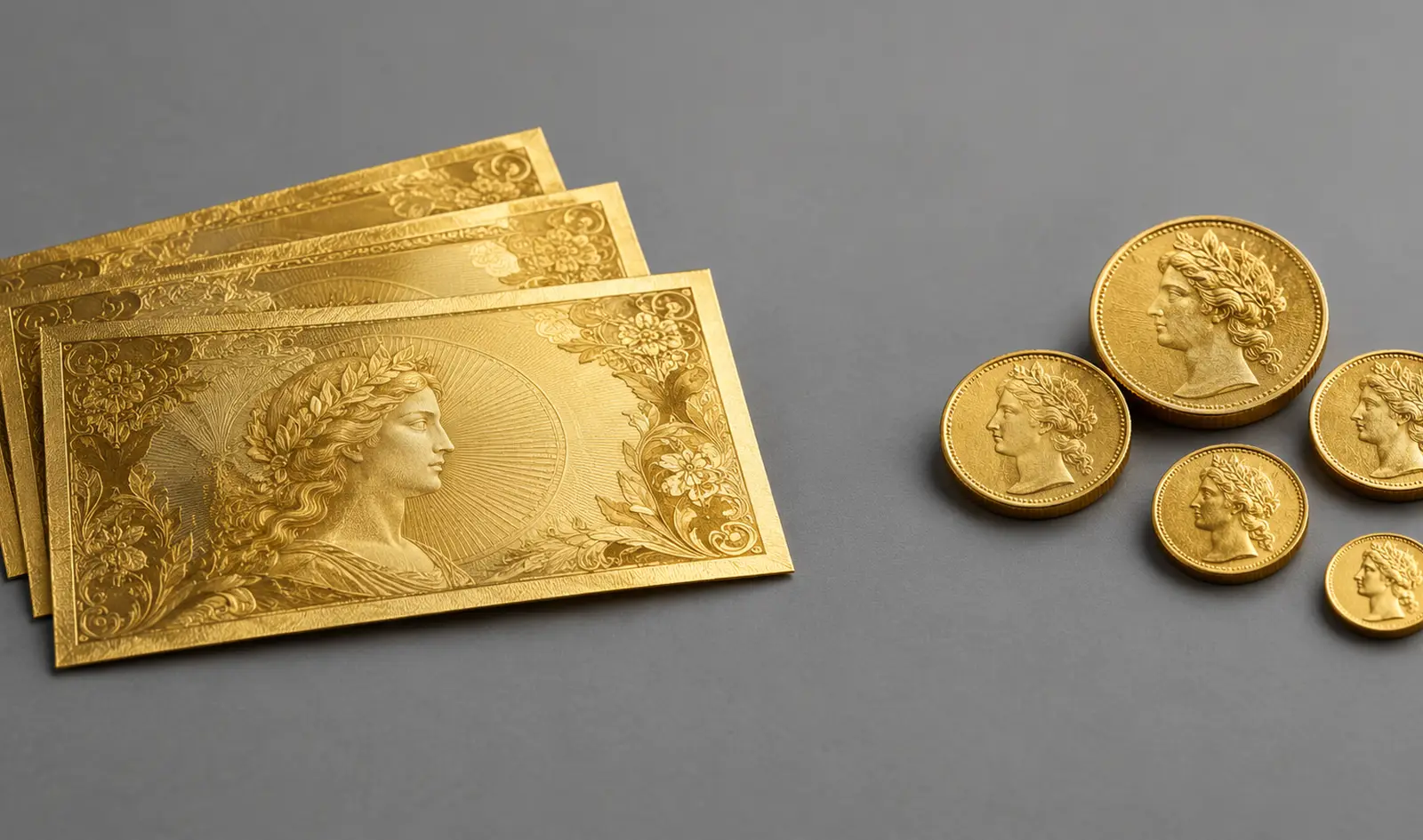
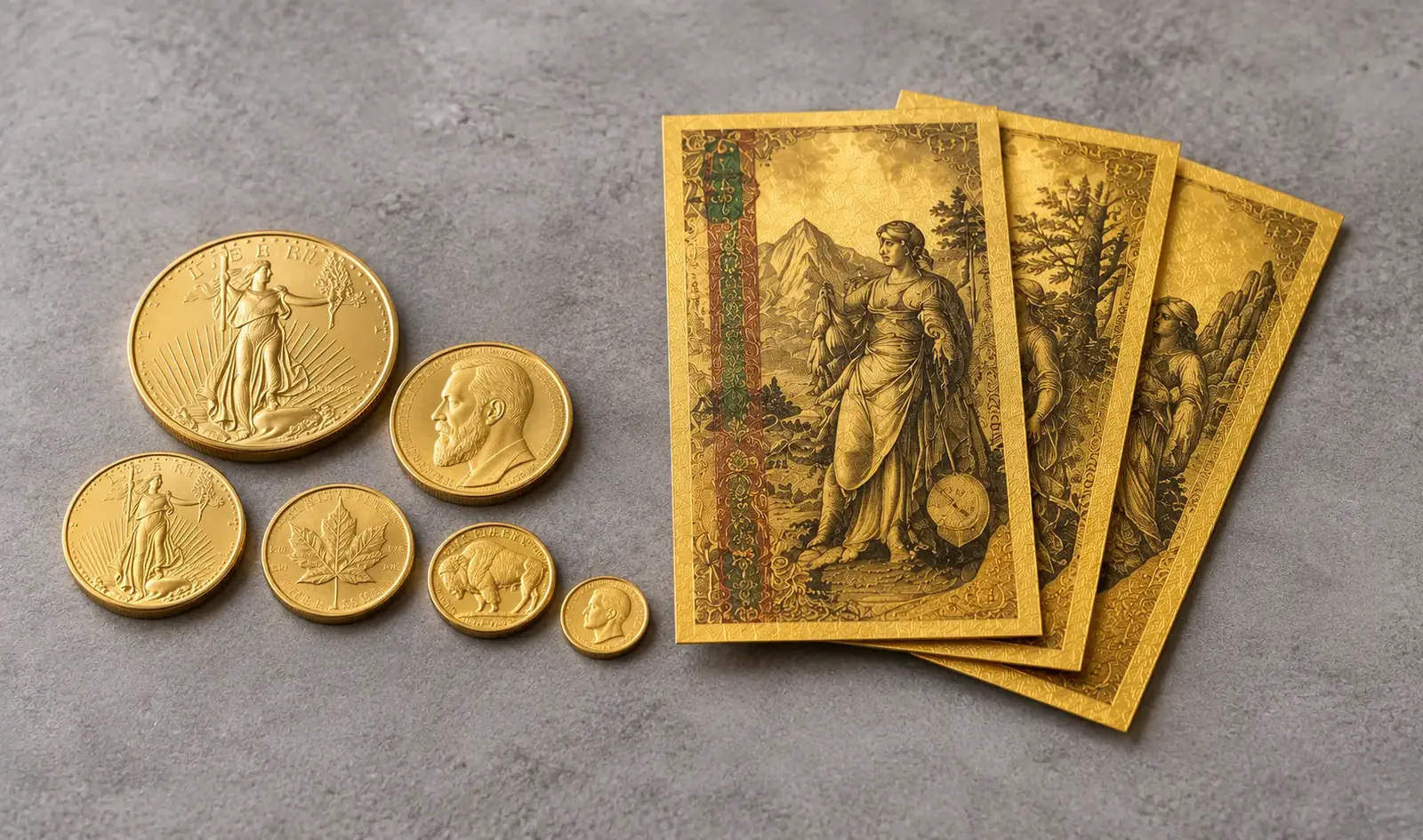
Fractional gold coins (like 1/10 oz Gold Eagles) and Goldbacks both solve the same problem: how to own physical gold without needing the price of a full one-ounce coin. But they solve it very differently. Here's the honest comparison to help you decide which fits your goals.
- Both solve the same problem — small-denomination gold — by different means. Fractional coins are recognised bullion; Goldbacks are a spendable note format.
- Fractional coins carry a high premium too. The smaller the coin, the worse the premium per gram, so this is not a premium-free alternative.
- Coins have deeper, more liquid markets and near-universal dealer recognition. Goldbacks depend on a smaller, voluntary network.
- Goldbacks go far smaller than any practical coin, which is the genuine gap they fill.
- If the goal is lowest cost per gram of gold, larger bullion beats both. Both formats are paying for divisibility.
What Are Fractional Gold Coins?
Fractional gold coins are government-minted gold coins containing less than one full troy ounce of gold. Common options:
- 1/10 oz American Gold Eagle — most popular US fractional coin
- 1/10 oz Canadian Gold Maple Leaf — .9999 fine gold
- 1/10 oz Austrian Gold Philharmonic — .9999 fine gold
- 1/4 oz and 1/2 oz coins — larger fractional options
Fractional coins typically carry higher premiums per ounce than 1 oz coins because manufacturing costs don't scale down proportionally with gold content.
What Are Goldbacks?
Goldbacks are physical gold currency notes containing precise fractions of a troy ounce of .999 fine 24-karat gold, produced via Valaurum's vacuum deposition process. Available denominations:
- 1/2 Goldback (some states) — 1/2000 oz
- 1 Goldback — 1/1000 oz
- 5 Goldback — 1/200 oz
- 10 Goldback — 1/100 oz
- 25 Goldback — 1/40 oz
- 50 Goldback — 1/20 oz
Head-To-Head Comparison
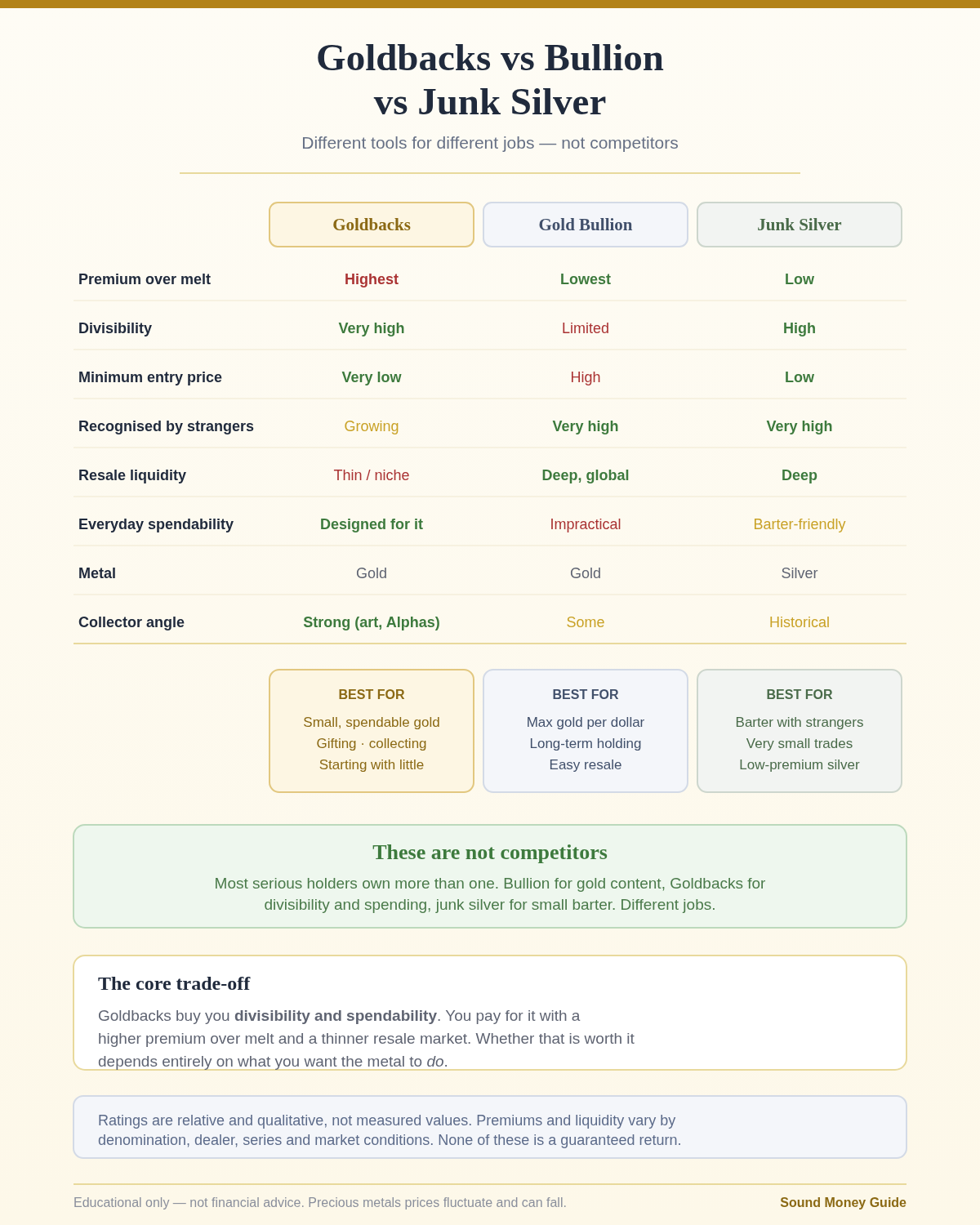
Different tools for different jobs. Most serious holders own more than one.
| Factor | 1/10 oz Gold Eagle | Goldbacks (various) |
|---|---|---|
| Minimum gold content | 1/10 oz | 1/2000 oz (1/2 Goldback) |
| Minimum price entry | One tenth of the gold price, plus premium | One two-thousandth of the gold price, plus premium |
| Premium over spot | Lower, and falls as the coin gets larger | Substantially higher, and climbs sharply as the denomination gets smaller |
| Divisibility | Fixed at 1/10 oz | Highly divisible (from 1/2000 oz upward) |
| Legal tender status | Yes (US, $5 face value) | No; voluntary acceptance everywhere |
| Global recognition | Very high | Growing (US-focused ecosystem) |
| Liquidity | Very high (worldwide dealer market) | Moderate (Goldback dealer network) |
| Aesthetic value | Standard mint design | State-specific artwork, collector premium |
| Counterfeit resistance | High (government-minted) | High (serialization, UV features) |
| Physical form | Metal coin | Polymer-sealed note |
| Storage | Coin capsules/tubes | Flat, paper-thin |
| Historical track record | Decades (Gold Eagle since 1986) | Newer format (Goldbacks since 2019) |
We do not publish fixed dollar prices or premium percentages here. Both move with the gold price, with each dealer’s own pricing, and with the series you buy, so any figure printed on this page would be wrong within weeks. Put today’s numbers into the Goldback Exchange Rate vs Melt Value Calculator or the Fractional Gold Comparison Calculator and you will get the comparison for the day you are actually buying.
Where Fractional Gold Coins Win
1. Better Gold-Per-Dollar
A 1/10 oz Gold Eagle carries a lower premium over spot than a Goldback of equivalent gold content. Coins are meaningfully more efficient for pure gold accumulation.
2. Universal Liquidity
Gold Eagles are recognized by every bullion dealer in the world. Selling is fast and universal. Goldbacks have a growing dealer network but not universal reach.
3. Government Backing
Legal tender status backed by the US government. Counterfeiting is a federal crime with heavy penalties, adding to trust.
4. Long Track Record
Gold Eagles have been minted since 1986. Established price history, recognized quality, deep market.
Where Goldbacks Win
1. Much Lower Entry Point
A 1/10 oz Gold Eagle costs roughly a tenth of the gold price plus its premium, which puts it in the hundreds of dollars. A single Goldback costs a few dollars.
For someone with $10 to $50 to spend, Goldbacks work and fractional coins do not. That is the clearest practical difference between the two formats.
2. True Divisibility
Fractional coins are fixed at 1/10 oz. Goldbacks span from 1/2000 oz up to 1/20 oz in six denominations. You can build far more granular positions with Goldbacks.
3. Spendability
A growing network of US merchants accepts Goldbacks as voluntary currency (a company-reported, point-in-time figure — see note below). Try paying for coffee with a 1/10 oz Gold Eagle — the merchant probably won't know what to do with it. Goldbacks are designed to be spent.
4. Collector Appeal
Goldback Alpha (first-print) editions can carry a collector premium above standard notes. That premium is collector-driven, thinly traded, and not guaranteed — treat any quoted "past appreciation" figure as an unaudited secondary-market number, not a documented return. Standard 1/10 oz Gold Eagles track gold spot with a modest premium.
5. State-Specific Artwork
Nine unique state series create genuine collector appeal. Fractional coins have standard mint designs.
6. Portability
A wallet full of Goldbacks can carry meaningful value discreetly. Fractional coins are more obviously precious metal (weight, shape, feel).
On merchant counts: Goldback's accepting-merchant totals are company-reported and change over time. Where you see a figure like "3,000+ merchants," treat it as a Goldback-reported, point-in-time number rather than an independently audited or evergreen fact.
Head-To-Head Scenarios
Scenario 1: You Have $50 to Start Owning Gold
Goldbacks win clearly. You can buy several Goldbacks. You can't buy a 1/10 oz coin.
Scenario 2: You Have $500 and Want Maximum Gold Content
Fractional coins win. Two 1/10 oz Gold Eagles give you 0.2 oz of gold. The same budget in Goldbacks buys less gold content because of the higher premium.
Scenario 3: You Want to Spend Gold at a Coffee Shop
Goldbacks win clearly. The merchant either accepts Goldbacks or doesn't. Fractional coins don't work for retail transactions.
Scenario 4: You Want Easy Global Liquidity
Fractional coins win. Gold Eagles sell easily anywhere in the world.
Scenario 5: You Want Fractional Gold Under $10 per Unit
Goldbacks win. They're one of the few ways to own gold in sub-$10 increments.
Scenario 6: You Want to Gift Real Physical Gold at a Low Price Point
Goldbacks win clearly. A single 1 Goldback costs a few dollars and makes a memorable gift. A 1/10 oz coin is a far larger outlay for the same gesture.
Scenario 7: You're Building a Larger Gold Position
Both work; hold both. Some in coins (for maximum gold content and liquidity), some in Goldbacks (for divisibility, spendability, and collector appeal).
Compare Your Options: How Much Gold Does Your Budget Buy?
Enter your budget and the current gold spot price below to see how much gold you'd get across every major option — Gold Eagles, Gold Bars, Goldbacks, and more. Every figure is calculated from the numbers you enter; update the spot price to the current market rate for an accurate comparison.
Open the Fractional Gold Comparison Calculator →
What It Costs to Get Back Out
Almost every comparison of these two formats stops at the moment you buy. That is the half that is easy to research, and it is not the half that decides what the position was worth.
Goldback’s own premium guidance makes the same point about its product: it separates melt value, retail price, exchange value and buyback value as four different figures, and tells buyers to evaluate the complete purchase-to-exit spread rather than any one of them. Its operational advice is to request a current buyback quote and calculate the complete round-trip spread (Goldback, “Goldback Premiums Explained”, observed 1 October 2026).
That advice applies just as well to a fractional coin, so it is a fair basis for comparing the two.
The four numbers, and why they differ
Melt value is the embedded gold alone: the metal content multiplied by the spot price. It is the floor under any format, and nothing sells at it.
Retail price is what you actually pay, melt plus the premium that covers manufacture, distribution and the dealer’s margin. The gap between melt and retail is the hole you start in.
Exchange value applies to Goldbacks only. It is a published transaction reference used by participating merchants, not a promise that anyone will buy at that figure.
Buyback value is what a dealer will actually hand you today. It is the only one of the four that determines what you get on the way out, and it is the one no published table can tell you.
Why a Goldback can sometimes be bought below the published rate
Buyers notice this and reasonably wonder what it means. Goldback’s explanation is straightforward: because independent distributors set their own competitive retail pricing, some dealers may sell Goldbacks slightly below the official published exchange rate (Goldback, “Goldback Premiums Explained”, observed 1 October 2026).
It is dealer price competition, in other words, and not a pricing gap to be harvested. A lower purchase price is a genuinely better entry, but it tells you nothing about what you can sell for, because the exit depends on a buyback quote rather than on the published reference.
The round trip, for both formats
A fractional coin usually has the narrower round trip. Its premium is lower going in, and the worldwide dealer market means a competitive bid is easy to obtain, so the spread you have to recover is smaller.
A Goldback starts further behind, because the premium that buys you divisibility and spendability is the same premium you have to earn back. The dealer network is also smaller, so quotes vary more between sellers.
Goldback itself frames the trade-off in those terms, saying that for buyers focused on the lowest premium over spot, conventional bullion may be the better fit, while for buyers who value very small denominations and direct physical transfer, Goldback may offer greater practical utility (Goldback, “What Is Fractional Gold?”, published 29 September 2026). Both halves are deliberately conditional, and so is our reading of them.
Goldbacks have a second exit that coins do not
A Goldback can be spent with a participating merchant at the published exchange rate rather than sold to a dealer for cash. Where that is available to you, it is usually the better of the two exits, because it is valued at the reference rate instead of at a buyback bid.
The condition attached to it is real, though. Acceptance is voluntary, each merchant sets its own terms, and the exit is only worth anything if a merchant you can actually reach sells something you were going to buy anyway.
A fractional coin has no equivalent. Its $5 face value is far below its gold content, so spending one at face value would be a severe loss, and that leaves the dealer market as the only sensible way out.
Work out your own round trip
The two exits are worth comparing with your own numbers rather than ours, since the answer turns on the buyback quote you are actually offered.
Enter your purchase price, the current spot price, the published reference rate and a real buyback quote into the Goldback Exchange Rate vs Melt Value Calculator. It returns your premium over melt, your premium against the reference rate, your break-even resale price per note, and a direct comparison of spending at a merchant against selling for cash.
Two further guides cover the mechanics in detail: what the premium actually pays for, and how to get a real buyback quote rather than a quoted rate.
The Small-Buyer Perspective
For genuinely small buyers ($10-$500 total gold budget), Goldbacks have decisive advantages:
- Actually affordable at multiple denominations
- Divisible enough to buy in $5 increments if you want
- Meaningful even at small quantities — a single Goldback is a real, distinct thing
- Room to build a collection across state series over time
Fractional coins require you to save up to the price of a tenth of an ounce before you can start at all. Goldbacks let you start immediately with whatever you have.
For anyone building up to fractional coins over time, Goldbacks are a reasonable way to accumulate gold in the meantime — and continue holding alongside coins once you can afford them.
The Serious-Buyer Perspective
For buyers with meaningful capital ($5,000+), the answer isn't either/or:
Hold both, in different roles:
- Fractional coins (1/10 oz or larger) for pure gold exposure with universal liquidity
- Goldback Alphas for collector appeal (with the caveat that any premium is not guaranteed)
- Standard Goldbacks for spendability and divisibility
This gives you the gold-content efficiency of coins, the collector interest of Alphas, and the practical spendability of standard Goldbacks. Different tools solving overlapping but distinct problems.
Where to Buy Each
Fractional Gold Coins
- APMEX, JM Bullion, SD Bullion, Money Metals — any major bullion dealer
- Local coin shops
Goldbacks
- Alpine Gold Exchange — full state series, Alpha inventory, integrated UPMA services
- Other Goldback-carrying dealers (varying inventory)
For anyone wanting both types in a broader precious-metals strategy, having accounts at both a general bullion dealer and Alpine Gold makes sense.
Frequently Asked Questions
Are Goldbacks better than fractional gold coins?
Neither is universally better. Coins win on gold-per-dollar, liquidity, and universal recognition. Goldbacks win on divisibility, low entry price, spendability, and collector appeal. Many buyers hold both.
Which is cheaper — Goldbacks or fractional coins?
Fractional coins are cheaper per ounce of gold. Goldbacks are cheaper as a minimum entry point: a few dollars for a single note, against the price of a tenth of an ounce of gold plus premium for the coin.
Which appreciates faster?
Standard Goldbacks and fractional coins both roughly track gold spot; neither carries a guaranteed return. Goldback Alpha editions can carry a collector premium on top, but that premium is thinly traded and any quoted "past appreciation" figure is an unaudited secondary-market number, not a documented or repeatable return.
Which is more portable?
Both are portable. Goldbacks are lighter and thinner. Coins are more compact volume-wise. For carrying significant value discreetly, Goldbacks are typically easier.
Which is better for prepping?
Both have prepper value in different ways. Coins are more universally recognized in barter situations. Goldbacks are more divisible and portable. Many preppers hold both, plus junk silver for smaller transactions.
Can I spend either at a normal store?
Goldbacks yes, at merchants in the Goldback network (a company-reported, growing figure). Fractional coins technically yes (they're legal tender), but almost no merchant knows how to accept them as anything other than their $5 face value — which is far below their actual gold content value.
Bottom Line
For small buyers ($10-$500 budget), Goldbacks are dramatically more accessible than fractional coins. For serious buyers with meaningful capital, the answer is usually both — coins for maximum gold content and universal liquidity, Goldbacks (including Alphas) for divisibility, spendability, and collector appeal.
Different tools for different problems. Don't force yourself to choose. A well-constructed precious-metals position often includes both.
For the Goldback side of your strategy, Alpine Gold Exchange is a strong option — full state series inventory, Alpha availability, and services that scale from small starter purchases to serious collector positions.
👉 Browse Goldbacks at Alpine Gold Exchange
For more on how Goldbacks compare to other precious-metals options, see our Goldbacks vs Junk Silver comparison.
This article is for educational purposes only and does not constitute financial advice. Precious metals prices fluctuate. Past performance does not guarantee future results.
Continue Reading