Goldback Denomination Reference: Gold Content by Denomination and Series
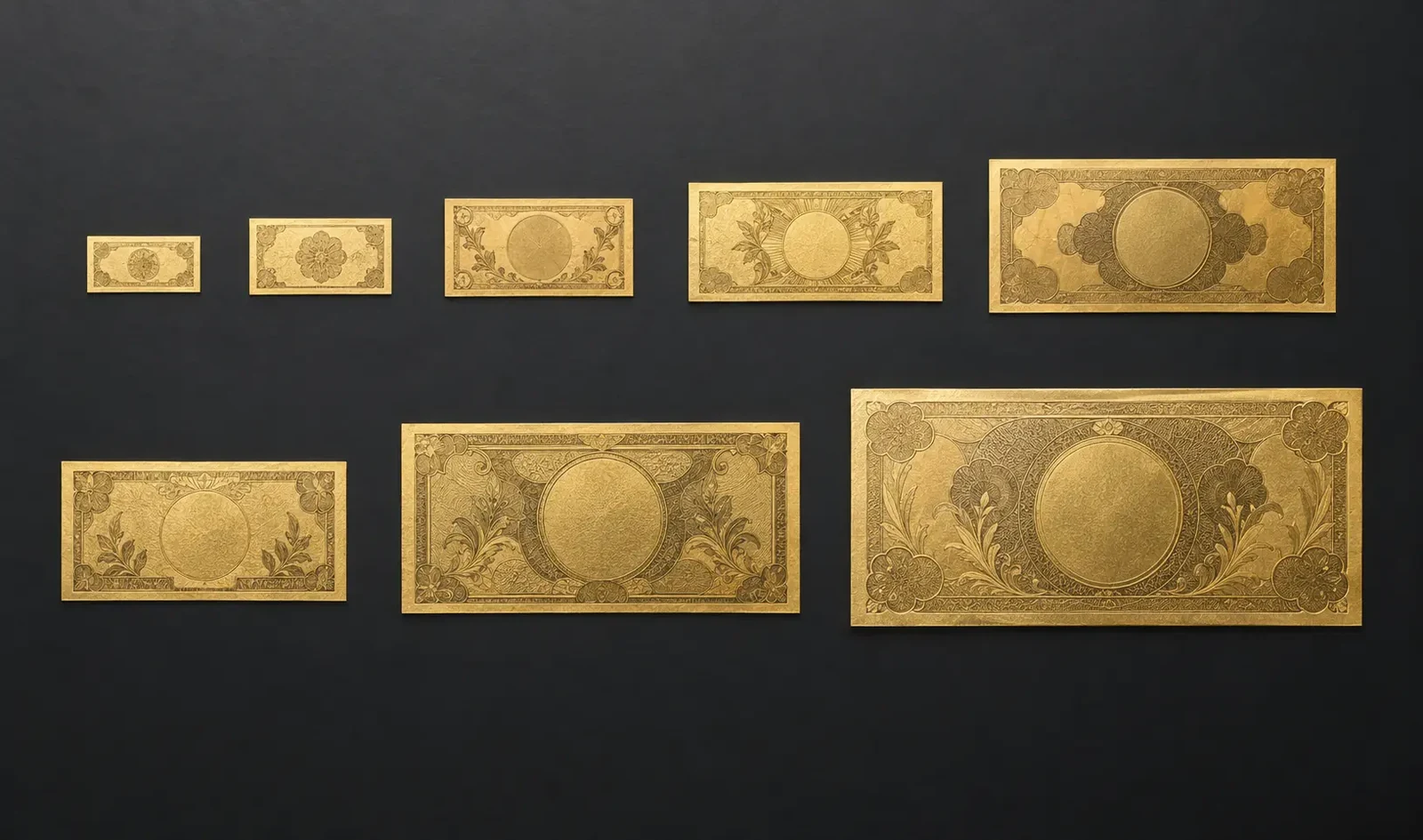
A 1 Goldback contains 1/1,000 of a troy ounce of 24-karat gold (.999 fine). Every other denomination is a fixed multiple of that unit, so the entire table below is derivable from a single published specification.
Of 10 state series, the issuer publishes a denomination set for 5 and none at all for 5. That absence is a verified finding, not a gap in our research.
Key takeaways
- Gold content never changes. It is a published specification, fixed per denomination, independent of the gold price, the series or the seller. Only price moves.
- Goldback Inc. does not publish per-state denomination sets. It publishes one system-wide scheme plus a rule about which series carry the fractional values.
- That rule would allow a set to be derived for the four series that lack one. We do not derive it, because a derivation published as fact is an invention.
- The 100 Goldback is discontinued (confirmed 2026-03-23, final series Idaho). It remains in the table because existing notes exist.
- Availability differs from existence. A denomination being part of a series does not mean a given seller stocks it today.
Gold Content by Denomination
The base unit is the 1/1,000 troy ounce contained in a 1 Goldback. Each denomination below is a stated multiple of it.
| Denomination | Gold content (troy oz) | As a fraction | Multiple of base unit | Production status |
|---|---|---|---|---|
| ¼ Goldback | 0.00025 | 1/4,000 | 0.25× | Current |
| ½ Goldback | 0.0005 | 1/2,000 | 0.5× | Current |
| 1 Goldback | 0.001 | 1/1,000 | 1× | Current |
| 2 Goldback | 0.002 | 1/500 | 2× | Current |
| 5 Goldback | 0.005 | 1/200 | 5× | Current |
| 10 Goldback | 0.01 | 1/100 | 10× | Current |
| 25 Goldback | 0.025 | 1/40 | 25× | Current |
| 50 Goldback | 0.05 | 1/20 | 50× | Current |
| 100 Goldback | 0.1 | 1/10 | 100× | Discontinued (2026-03-23) |
Specification read from Goldback Inc. material; base unit captured 2026-07-24. Manufacturing is by Valaurum using the Aurum vacuum-deposition process.
State Series and Published Denomination Sets
Goldback names 9 states with full series. Whether it publishes a denomination set for a given series is a separate question, and mostly the answer is no.
| Series | Introduced | Status | Published denomination set |
|---|---|---|---|
| Utah | 2019 | Full series | ¼, ½, 1, 2, 5, 10, 25, 50 |
| Nevada | 2020 | Full series | 1, 5, 10, 25, 50 |
| New Hampshire | 2021 | Full series | 1, 5, 10, 25, 50 |
| Wyoming | 2022 | Full series | Not published |
| South Dakota | 2023 | Full series | Not published |
| Arizona | 2025 | Full series | Not published |
| Florida | 2025 | Full series | ¼, ½, 1, 2, 5, 10, 25, 50, 100 |
| Oklahoma | 2025 | Full series | Not published |
| California | 2026 | Limited Early Release | Phase 1 only: ¼, 1, 5 |
| Idaho | 2026 | Full series | 1, 5, 10, 25, 50 |
Series data read from Goldback Inc.’s own pages, captured 2026-09-06. “Not published” means the issuer publishes no set for that series on any of its own surfaces — not that we could not find one.
What “Not Published” Means Here
This is the finding most likely to be misread, so it is worth stating plainly.
Goldback publishes a single system-wide denomination scheme and a rule about which series carry the smaller values: five standard denominations of 1, 5, 10, 25 and 50, plus the ¼, ½ and 2 “for series released in 2025 and on.” It does not publish a per-series lineup for most states.
That rule would let anyone construct a plausible set for Wyoming, South Dakota, Arizona, Oklahoma. We deliberately do not. Applying a general rule to produce a specific claim, then publishing it as though the issuer had stated it, is how errors enter a niche and stay there. Where the issuer is silent, this page says so.
Two series do have published sets worth noting individually. Florida carries the full listed set including the 100. Utah was refreshed and relaunched on 2026-08-25, and the issuer published its lineup verbatim as eight denominations; the earlier Utah notes listed 1, 5, 10, 25, 50 and remain in circulation, which is why older coverage cites a shorter set.
How Many Denominations Exist
The issuer’s own pages disagreed on this until recently. On 24 July 2026 the buying guide listed eight while the About page listed nine including the 100, under a heading that already read “eight denominations.” On 2026-09-06 the About page no longer lists the 100 and the two agree on 8.
The earlier disagreement is recorded rather than erased, because it explains why other coverage cites nine. If you are citing a count, cite the page and the date you read it.
Methodology
- Gold content is a published specification, not a measurement of ours and not an estimate. It does not change.
- Every figure on this page is rendered from a single source file that also guards the rest of the site. A page that contradicts it fails our build, so this table cannot quietly drift out of step with our other coverage.
- Absences are recorded as findings. Where the issuer publishes no denomination set, that was established by sweeping its own site index rather than by failing to find one.
- Nothing is derived. A set that could be inferred from a general rule is still not a published set.
- No prices appear here. Gold content is fixed; what a note costs is not, and the two are routinely confused.
How to Cite This Page
The Goldback Guide, “Goldback Denomination Reference: Gold Content by Denomination and Series.” Specifications and series data read from Goldback Inc. sources, 2026-09-06. Available at: https://thegoldbackguide.com/goldback-denomination-reference/
Gold content can be cited directly, since it is a fixed specification. Series data should be re-checked before republication, as new series launch and existing ones are refreshed.
Frequently Asked Questions
Why does a denomination’s gold content never change?
Because it is a manufacturing specification rather than a market figure. A 1 Goldback contains 1/1,000 of a troy ounce whatever gold is doing that day. The price you pay changes; the metal inside does not.
Why is no denomination set published for some series?
The issuer publishes one system-wide scheme rather than a lineup per state. For four full series it never states a set anywhere on its own pages. That is its editorial choice, and this page reports it rather than filling the gap.
Can I work out the missing sets from the rule?
You could construct a plausible answer. It would not be a published fact, and if you cite it as one you are attributing a claim to the issuer that it never made. That distinction is the whole reason this page exists.
Does this tell me what a Goldback is worth?
No. It tells you exactly how much gold each denomination contains, which is one input among several. See our exchange rate versus melt value explainer for why the three figures attached to a note differ.
Before buying against any of this, the buyer verification checklist covers how to confirm a listing states its series, edition and denomination correctly.
Prices, availability, denominations and promotions change without notice. Verify the live listing before ordering.
We may earn a commission at no additional cost to you. This coverage may not be neutral or independent.
Educational content only, not financial advice. Goldbacks are privately issued and are not legal tender under 31 U.S.C. § 5103; merchant acceptance is voluntary everywhere. Series, denominations and availability change; verify against the issuer’s current pages before relying on any figure. Past performance does not guarantee future results.
Continue Reading